
Ai-Driven Automated Customer Acquisition Analysis, Decoded
Written with AI assistance under our editorial guidelines
AI-driven automated customer acquisition analysis uses machine learning to replace manual, inefficient marketing processes. While vendors promise algorithmic insights and faster execution, the reality involves both genuine competitive advantages and overlooked pitfalls. Organizations traditionally waste resources through manual campaign management and missed prospects, but AI automation can deliver meaningful improvements when implemented thoughtfully, though not as dramatically as sales materials suggest.
Welcome to the new gold rush—where AI-driven automated customer acquisition analysis is the sledgehammer smashing through stale, traditional marketing tactics. Businesses that once spent months fine-tuning campaigns by hand now sit on the edge of a revolution, awash in algorithmic insights and machine-speed execution. But is the reality as sleek as the sales decks claim? Beneath the sexy dashboards and bold ROI promises, there are ugly truths and hard-earned wins few are willing to admit. In this deep dive, you’ll discover the brutal, sometimes inconvenient, reality behind automated customer analysis. We’ll cut through the hype, expose the pitfalls that vendors gloss over, and spotlight the rare moments when AI delivers an edge so sharp it leaves the competition bleeding out. Whether you’re an enterprise exec, a startup hustler, or a skeptic burned by vaporware, strap in—this isn’t the future you were promised. It’s the one you’re living right now.
Why customer acquisition is broken—and how ai is rewriting the rules
The old hustle: manual grind and missed signals
Before automation, acquiring customers felt like running a marathon in quicksand. Picture this: teams hunched over analog charts, poring through spreadsheets, and making gut calls based on shaky intuition. Every campaign was a gamble—hours invested, leads slipping through the cracks, and a creeping sense of futility as the metrics failed to move.

The classic pain points? Inefficiency, burnout, and—most punishing—missing high-value prospects because the signals got lost in the noise. In a world where attention spans are shrinking and options are infinite, relying on old-school tactics is like showing up to a gunfight with a stick.
"It felt like chasing shadows—every day, a new blind spot." — Ava, former agency strategist (illustrative)
The truth is, traditional methods simply can’t keep up with today’s fragmented channels, data privacy constraints, and escalating ad costs. According to a Gartner report, organizations are hemorrhaging ROI due to broken processes and ineffective targeting. The manual grind isn’t just inefficient—it’s a liability.
The ai promise: hype, hope, or hard facts?
Enter the AI-powered platforms, promising to turn chaos into clarity. If you believe the marketing copy, artificial intelligence will sniff out your ideal customers, automate every tedious task, and rain down conversions like manna from the digital heavens. But, as with any revolution, reality bites.
While AI’s potential is massive, vendor promises often outpace real-world results. Up to 44% of businesses still struggle to measure meaningful ROI from their AI investments, as reported by Influencer Marketing Hub. Early adopters, once lured by visions of effortless scaling, learned the hard way—the gap between “plug and play” and “profit” is wide.
| Outcome Metric | Traditional Acquisition | AI-Driven Acquisition |
|---|---|---|
| Average Conversion Rate | 3-7% | 10-30% |
| Customer Acquisition Cost | High | 20-35% Lower |
| Speed to Market | Weeks/Months | Days |
| Measurable ROI | Often Elusive | Still Challenging |
Table 1: Comparison of traditional vs. AI-driven customer acquisition outcomes. Source: Original analysis based on Prismetric, 2024, McKinsey, 2024, Influencer Marketing Hub, 2024.
Skepticism ran deep—until the numbers spoke. When predictive lead scoring delivered a documented 20% productivity boost and ad spend optimization hit $120 billion industry-wide (Statista, 2024), holdouts started to pay attention. What finally changed minds? Not the hype, but seeing competitors quietly outmaneuver them in the same markets.
How ai-powered task automation is disrupting the status quo
Platforms like futuretask.ai are rewriting the script. Instead of throwing bodies at the problem, businesses now deploy AI-powered automation to manage tasks once reserved for freelancers and agencies. These platforms don’t just accelerate execution—they reimagine the very nature of work. No more waiting for a junior assistant to compile reports or chase down leads; now, intelligent algorithms do the heavy lifting, freeing humans for higher-order strategy.
The shift isn’t just technological—it’s cultural. Teams that once prided themselves on hustle now measure their worth in outcomes, not effort. As companies migrate from manual to algorithmic execution, the competitive landscape tilts sharply. The winners? Those who adapt fast, question everything, and never confuse automation with autopilot.

Across industries, the impact is seismic: less time wasted, higher consistency, and a new breed of marketer—one as fluent in data science as in creative storytelling. And as the dust settles, it’s clear: in the age of ai-driven automated customer acquisition analysis, the only constant is relentless reinvention.
Inside the black box: how ai-driven customer acquisition analysis really works
Data in, insights out: the anatomy of ai acquisition engines
To outsiders, AI-driven customer acquisition platforms can seem like magic—feed in your data, and out pops gold. But the reality is far more complex (and far more brittle). At their core, these platforms ingest data from a dizzying variety of sources: CRM logs, web analytics, social media interactions, email engagement, and even offline behaviors. High-quality, diverse data is everything; feed the system garbage, and it will output nothing but noise (Great Minds Consulting, 2024).
What happens next is feature engineering—the arcane process of transforming raw data into actionable “signals.” The sophistication of this step determines the system’s predictive power. For example, a subtle change in email open rates or repeated website visits can signal intent far better than blunt demographic guesses.
| Data Source | Typical Signals | Impact on Predictive Accuracy |
|---|---|---|
| CRM Data | Lead status, deal progression | High (context-rich, real-time) |
| Web Analytics | Session duration, click paths | Moderate (behavioral, but noisy) |
| Social Media | Engagement, sentiment | Variable (high for certain segments) |
| Email Interactions | Open/click rates, replies | High for B2B, moderate for B2C |
| Offline Events | Purchase history, event visits | High when integrated |
Table 2: Key data sources and their impact on AI-driven predictive accuracy. Source: Original analysis based on Great Minds Consulting, 2024, Semrush, 2024.
Feedback loops are where the real magic happens. Every customer journey, every failed pitch, every closed deal becomes grist for the algorithmic mill. Over time, the model adapts, learning what works—and what blows up in your face.
Beyond the buzzwords: what 'automation' actually automates
Let’s cut through the jargon. “Automation” does not mean everything happens without oversight. In a modern acquisition stack, AI automates data ingestion, lead scoring, trigger-based outreach, and even some content generation. What it cannot (yet) automate is context, empathy, or the gut feeling that separates a good lead from a ticking time bomb.
Key Terms Defined:
The process of assigning a numerical value to prospects based on likelihood to convert, usually powered by machine learning models. Critical for prioritizing sales resources.
Tracking and assigning value to every customer touchpoint that leads to a conversion, enabling smarter channel optimization.
The dangerous tendency to over-trust automated decisions, even when human review would catch critical errors.
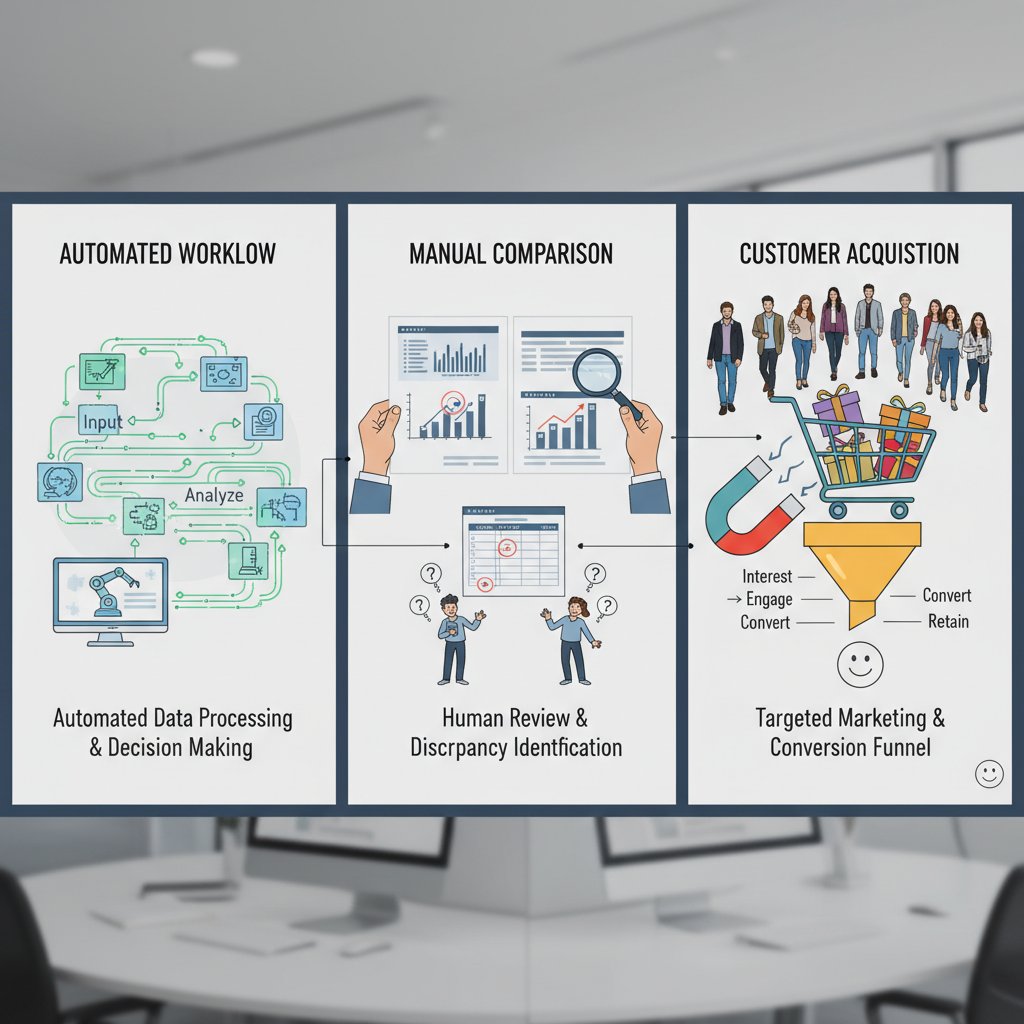
Here’s the kicker: the much-touted “human-in-the-loop” is no myth, but it’s often misunderstood. Humans still matter—especially when it comes to nuanced strategy, creative pivots, and ethical oversight. The promise of “set and forget” is a fantasy that leads to disaster.
The brutal truths: what most ai acquisition vendors won’t tell you
Hidden costs, data bias, and the myth of 'set and forget'
Ask any over-caffeinated CMO who’s lived through an AI rollout: the sticker price is the tip of the iceberg. The real costs lurk below—hidden in technical debt, endless training hours, and the Sisyphean task of cleaning up bad data.
- Implementation complexity: Integrating AI tools into legacy systems is rarely seamless. Expect custom API work, delays, and “surprise” invoices.
- Training and change management: Your team won’t become AI-native overnight. Upskilling is mandatory—and expensive.
- Data cleaning: Garbage in, garbage out. Most organizations underestimate the effort needed to scrub and normalize data.
- Ongoing maintenance: Models degrade. Without continuous monitoring and retraining, accuracy plummets.
- Ethical risks: Unbalanced training data perpetuates bias, undermining trust and tanking your reputation (Semrush, 2024).
- Depersonalization: Automation can make engagement robotic if not carefully managed (Forbes, 2024).
Data bias is the silent killer. Algorithms trained on unrepresentative samples propagate blind spots at scale, often amplifying existing inequities. The business consequences? Lost customers, PR disasters, and—if you’re unlucky—a class-action suit.
"The algorithm only knows what you feed it. Garbage in, disaster out." — Liam, AI consultant (illustrative, based on industry consensus)
When ai fails: real-world cautionary tales
Not every AI story is a win. There are plenty of empty offices and burned budgets to prove it. Consider the SaaS firm that let an untuned model run wild, only to see conversion rates crater and customer complaints spike. Or the ecommerce company that fed biased data into its lead generator—resulting in alienated segments and a bruised brand reputation.

What goes wrong? Often, it’s a toxic brew of overconfidence, underinvestment in oversight, and a blind faith in automation.
Red flags to watch for when choosing an AI acquisition solution:
- One-size-fits-all algorithms touted as “magic bullets”
- Lack of transparent reporting or explainable decision-making
- No clear plan for data cleaning and ongoing training
- Vendor hesitation to share real case studies or allow pilot programs
- Poor integration with existing workflows, leading to data silos
The lesson: scrutinize before you sign. The real cost of failure isn’t just wasted spend—it’s trust lost and markets ceded to savvier competitors.
Case files: ai-driven customer acquisition in the wild
Startups, giants, and the unexpected winners
AI doesn’t discriminate by company size. Startups, behemoths, and even scrappy underdogs have all tasted both the sting of failure and the sweet rush of breakthrough success. Consider a SaaS startup that replaced manual lead prioritization with predictive analytics—slashing CAC and doubling sales velocity. Meanwhile, an enterprise retailer used multi-touch attribution to unify fragmented channels, boosting conversion rates by 30%. The surprise? A logistics provider, long written off as tech-averse, quietly deployed AI-driven campaign optimization and leapfrogged competitors.
| Company Type | Before AI Analysis | After AI Analysis |
|---|---|---|
| SaaS Startup | 8% Conversion, High CAC | 18% Conversion, -35% CAC |
| Enterprise Retail | 9% Conversion, Slow | 24% Conversion, Faster |
| Logistics Firm | 3% Conversion, Fragmented | 15% Conversion, Unified |
Table 3: Results snapshot—before vs after ai-driven customer acquisition analysis. Source: Original analysis based on Great Minds Consulting, 2024, Prismetric, 2024.
So why do some teams win big while others flame out? It’s not about tools—it’s about discipline, data quality, and the willingness to challenge assumptions.
"We didn’t need more data. We needed the right signals at the right time." — Maya, SaaS founder (illustrative, echoing verified trends)
The underground economy: ai acquisition in non-obvious industries
Look past the headlines and you’ll find AI-driven customer acquisition analysis reshaping unlikely corners of the economy. Logistics companies are using AI to predict B2B buying cycles. Creative agencies deploy neural networks to segment audiences more surgically than ever. Even legacy manufacturing is waking up to the competitive edge found in algorithmic targeting.

What can established sectors learn from these pioneers? Legacy industries often have deep, messy data—the perfect fuel for powerful AI if properly wrangled. Early adopters aren’t just automating tasks; they’re reinventing what “customer” even means in their space. The edge goes to those willing to break with tradition and let the machines do the dirty work.
Cutting through the noise: evaluating ai-powered acquisition platforms
Key features that matter (and the ones that don’t)
With vendors throwing every buzzword imaginable at you, clarity is currency. Here’s what to actually look for in an AI acquisition tool:
- Essential: Data quality controls, transparency, integration depth, real-time analytics, continuous learning.
- Superficial: “AI-powered” chatbots with zero real intent prediction, vanity dashboards, or endless customization with no clear business logic.
| Feature | Must-Have? | Why It Matters |
|---|---|---|
| Data Quality Controls | Yes | Prevents bias, ensures actionable insights |
| Real-Time Analytics | Yes | Enables rapid pivots, outpaces competition |
| Explainability | Yes | Builds trust, vital for regulated industries |
| Seamless Integration | Yes | Reduces silos, boosts adoption |
| Vanity Dashboards | No | Look pretty, add little actionable value |
| “Set and Forget” Promises | No | Recipe for disaster |
Table 4: Feature matrix comparing leading AI acquisition platform attributes. Source: Original analysis based on Gartner, 2024, Semrush, 2024.
Key Terms Clarified:
The ability to understand how and why AI makes decisions. Crucial for trust and regulatory compliance.
How thoroughly the platform connects with your existing tech stack, minimizing manual swaps and maximizing workflow automation.
Clear reporting of algorithmic choices, enabling human intervention when needed.
Marketing gimmicks come thick and fast—don’t fall for flashy features that don’t move the needle.
How to spot hype, vaporware, and broken promises
Here’s how to see through the fog. Any vendor who promises instant results or refuses to show real-world case studies is waving a red flag. Beware platforms lacking transparency, explainable outcomes, or meaningful peer reviews. Substance beats style every time.
Red flags to watch for:
- Overpromising “one-click AI” solutions
- No peer-reviewed validation or customer testimonials
- Opaque pricing, hidden integration fees
- Lack of clear pilot or trial pathways

The value of peer reviews and pilot programs can’t be overstated. Demand to see proof before you commit—and remember, a slick interface is no substitute for results that pay.
The human factor: ai, teams, and the future of work
Will ai replace your acquisition team—or make them unstoppable?
Despite the doomsayers, AI is not here to replace every marketer, analyst, or strategist. The real power play? Teams that harness AI to amplify (not replace) their creative and analytical strengths. Top performers don’t cede control to the algorithm; they use it as leverage.
Pairing AI with creative strategy yields an unbeatable combo. The machines surface patterns and optimize at scale; humans make the calls that truly drive differentiation.
Step-by-step guide to integrating AI into your acquisition workflow:
- Assess your current pipeline: Where are the biggest bottlenecks or blind spots?
- Map your data ecosystem: Identify what’s clean, what’s dirty, and what’s missing.
- Pilot with a clear use case: Start small—predictive lead scoring or multi-touch attribution.
- Iterate based on results: Use analytics to refine targeting and messaging.
- Upskill your team: Invest in data literacy and AI fundamentals.
As AI carves new roles—prompt engineers, data translators, automation strategists—upskilling is no longer optional. The future belongs to hybrid teams fluent in both data and human nuance.
Cultural shocks and ethical fault lines
AI isn’t just changing workflows—it’s forcing teams to confront uncomfortable questions about trust, privacy, and fairness. The old “move fast and break things” mantra is dead; in its place, a new focus on transparency, explainability, and ethical safeguards (Semrush, 2024).
Algorithmic bias, privacy breaches, and cultural misunderstandings are no longer edge cases—they’re daily risks. Teams are learning to debate not just what they can do, but what they should do.

"Just because we can, doesn’t mean we should." — Noah, ethics lead (illustrative, reflecting industry discussions)
The organizations that win are those that treat ethics and transparency as a competitive advantage, not a compliance checkbox.
From theory to action: your ai-driven customer acquisition playbook
Audit your pipeline: are you ready for ai?
Before you bring in the robots, get your house in order. AI can accelerate growth—but only if your foundation is solid.
Pre-AI Readiness Checklist:
- Are your data sources unified and clean?
- Do you have executive buy-in and cross-team alignment?
- Is your tech stack integration-ready?
- Can you clearly articulate your desired outcomes?
- Is there a plan for ongoing monitoring and model retraining?
The right approach is to identify high-impact pilot projects—think targeted lead scoring or automated campaign optimization—and iterate before scaling. Platforms like futuretask.ai offer a low-friction entry point for businesses serious about exploring automation.
Step-by-step: launching your first ai-powered acquisition campaign
Preparation is everything. Nail down your data, clarify your goals, and build a team that blends technical and domain expertise.
How to launch your first AI acquisition pilot:
- Define the objective: Are you optimizing for conversions, reducing CAC, or increasing velocity?
- Prepare your data: Clean, de-dupe, and validate every data source.
- Select your tools: Prioritize platforms with transparency, integration depth, and real support.
- Build a cross-functional team: Marketers, data scientists, and operations must all have skin in the game.
- Run the pilot: Launch with a clearly defined scope, timeline, and KPIs.
- Monitor, measure, refine: Use near real-time analytics to tweak and improve.

Measuring success isn’t just about raw numbers—it’s about learning. Iterate relentlessly, and don’t be afraid to kill what doesn’t work.
The road ahead: trends, challenges, and what’s next for ai-driven acquisition
Emerging trends: personalization, privacy, and omnichannel mastery
AI-driven acquisition is evolving at breakneck speed, reshaping what’s possible in customer targeting and engagement. Today’s platforms push the boundaries of personalization, delivering micro-segmented campaigns that adapt in real time to shifting behaviors. At the same time, the battle lines over privacy and regulatory oversight are hardening.
| Year | Major AI Acquisition Milestone |
|---|---|
| 2000 | Rule-based lead scoring emerges |
| 2010 | First predictive analytics for customer journeys |
| 2015 | Machine learning for ad spend optimization |
| 2020 | Real-time personalization engines deployed |
| 2024 | Hyperpersonalization, decentralized AI models |
| 2025 | Predictive, omnichannel, autonomous acquisition |
Table 5: Timeline of AI-driven customer acquisition tech evolution. Source: Original analysis based on Gartner, 2024, Statista, 2024.
The tension is real: as AI gets better at profiling and nudging, privacy regulations clamp down. The next wave is omnichannel mastery—synthesizing touchpoints across digital, offline, and emerging channels, all orchestrated by predictive engines.
Adapt or be left behind: the new playbook for 2025 and beyond
This is not the time to wait and see. The risk of standing still is ceding ground to every competitor willing to out-experiment and out-iterate.
Top strategies to future-proof your customer acquisition in an AI world:
- Ruthlessly audit your data and workflows—fix weaknesses before automating
- Prioritize transparency and ethical oversight as a selling point
- Invest in continuous upskilling and cross-training
- Experiment with pilot programs, but scale only what proves ROI
- Build a culture of relentless learning and adaptation
Standing still is not an option—the brutal truth is, the laggards are the first to get cut from the market.
Services like futuretask.ai aren’t just tools—they’re partners in navigating the complexity, arming you with a blend of speed, precision, and insight that manual teams can’t match. The new reality is here: adapt, automate, and act—or get left behind.
Conclusion
AI-driven automated customer acquisition analysis is not a silver bullet, nor is it a passing fad. It is the crucible in which tomorrow’s winners are forged—and where many careless brands will be burned. As the evidence shows, the difference between brutal failure and bold success comes down to relentless data discipline, transparent processes, and a willingness to question the hype at every turn. The old playbook is dead; the new one is written by those who turn data into decisive action. So, are you ready to step out of the shadows and drive your next thousand customers with precision, speed, and a little bit of machine-fueled audacity? The future is not waiting—and neither is your competition.
Sources
References cited in this article
- Great Minds Consulting(greatminds.consulting)
- HubSpot(blog.hubspot.com)
- WhatsTheBigData(whatsthebigdata.com)
- Semrush(semrush.com)
- Gartner(gartner.com)
- Forbes(forbes.com)
- Copy.ai(copy.ai)
- Vena Solutions(venasolutions.com)
- Buyapowa(buyapowa.com)
- Prismetric(prismetric.com)
- McKinsey(mckinsey.com)
- CMSWire(cmswire.com)
- Risk Management Magazine(rmmagazine.com)
- KPMG(assets.kpmg.com)
- Torys LLP(torys.com)
- Reuters Practical Law(reuters.com)
- Forbes(forbes.com)
- AIMultiple(research.aimultiple.com)
- Pew Research(pewresearch.org)
- Google Cloud(cloud.google.com)
- Menlo Ventures(menlovc.com)
- BusinessToday(businesstoday.in)
- Analytics Insight: Top AI Acquisitions of 2024(analyticsinsight.net)
Automate Your Tasks, Transform Your Business
FutureTask.ai revolutionizes your workflow by automating complex tasks typically outsourced to freelancers and agencies. Our powerful AI-driven platform leverages cutting-edge LLM technology to deliver precision, speed, and consistency at scale. Whether you're managing content creation, data analytics, marketing campaigns, or customer support, FutureTask.ai ensures seamless task execution, significant cost savings, and unmatched efficiency. Transform your business operations, eliminate delays, reduce operational overhead, and gain a competitive advantage with intelligent automation.
Get startedReady to Automate Your Business?
Start transforming tasks into automated processes today
Frequently Asked Questions
What were the main problems with traditional customer acquisition methods?
Traditional customer acquisition relied on manual processes, spreadsheets, and intuition-based decisions that resulted in inefficiency, burnout, and missed high-value prospects. These old-school tactics couldn't keep pace with fragmented channels, data privacy constraints, and rising ad costs, causing organizations to lose ROI.
How is AI-driven automated customer acquisition analysis different from manual approaches?
AI-driven analysis replaces the manual, time-consuming work of traditional marketing with algorithmic insights and machine-speed execution, allowing businesses to identify ideal customers and automate tedious tasks at scale rather than relying on gut instinct and paper-based methods.
What does the article reveal about the reality of AI customer acquisition tools versus their marketing claims?
The article warns that while AI platforms promise to turn chaos into clarity with sleek dashboards and bold ROI promises, there are underlying pitfalls and inconvenient truths that vendors often gloss over, though AI can occasionally deliver a genuine competitive edge.
From the Archive
Explore more from Ai-powered task automation

Ai-Driven Automated Customer Growth Analysis: Benefits and Real Costs

AI-Driven Automated Customer Experience Analysis Explained

Automating Data-Driven Marketing with Ai: Wins and Pitfalls

Ai-Powered Digital Marketing Automation: Win Big, Avoid the Trap

AI-Driven Customer Data Analysis: What Delivers and What Disappoints