
AI-Powered Automated Compliance Checks: Efficiency Vs. Risk
Written with AI assistance under our editorial guidelines
AI-powered automated compliance checks dramatically accelerate violation detection and transaction monitoring compared to manual methods. However, they introduce significant risks including algorithmic bias, lack of transparency in decision-making, and potential regulatory liability if systems fail or produce false results. Organizations must balance efficiency gains against the need for human oversight and accountability.
Step into the world of compliance in 2025, and you’ll find more than dusty binders and overworked auditors. Instead, there’s a cold hum of silicon, algorithms parsing regulations at machine speed, and a few sleepless compliance officers wondering if an AI will save their skin—or hang them out to dry. Ai-powered automated compliance checks aren’t just buzzwords floating around boardrooms anymore; they’re the frontline defense against billion-dollar fines, regulatory nightmares, and a rising tide of digital risk. Yet, beneath the glossy vendor promises and tech-sector swagger lies an unvarnished truth: automating compliance is a high-stakes game of risk, reward, and reality, with winners, losers, and more than a few casualties. This guide doesn’t sugarcoat what’s at stake. It unpacks the secrets, exposes the hidden costs, and shines a harsh spotlight on the revolution reshaping compliance as we speak. If you think automated regulatory audits are foolproof, or if you’ve ever wondered how far you can trust an AI with your reputation, you’re exactly where you need to be.
The compliance arms race: Why manual checks are obsolete
From clipboard to code: A brief history of compliance checks
For decades, compliance checks meant one thing: clipboards, paper trails, and marathon audits conducted by teams who measured success in caffeine and overtime. The digital revolution nudged organizations from filing cabinets to Excel sheets, but the real transformation began when compliance software started replacing human intuition with cold, coded logic. Fast forward to today, and the best-in-class organizations wield ai-powered automated compliance checks—systems capable of scouring millions of transactions, detecting anomalies, and flagging violations faster than any human could.
| Era | Core Technology | Compliance Method | Key Limitation |
|---|---|---|---|
| Pre-2000s | Paper/manual | Human audits, paper logs | Errors, inefficiency, delays |
| 2000–2010 | Digital/spreadsheets | Basic workflow tools, digital docs | Siloed data, manual review |
| 2010–2020 | Rule-based software | Automated alerts, templates | High false positives, rigidity |
| 2020–Present | AI & machine learning | AI-powered automated compliance checks | Black-box risk, explainability |
Table 1: Timeline of compliance technology evolution. Source: Original analysis based on Gartner, 2023, NAVEX, 2024.

The shift wasn’t just about speed. According to Gartner’s 2023 report, 60% of compliance officers planned to invest in AI-powered RegTech by 2025. Financial institutions expect RegTech spending to increase by 124% between 2023 and 2028, a staggering signal that compliance has become an arms race—one where being slow means being obsolete.
The cost of staying analog in a digital world
Manual compliance checks aren’t just a nostalgic relic; they’re a liability. As the regulatory environment grows more labyrinthine, sticking with spreadsheets and ad hoc audits is like bringing a knife to a cyber-gunfight. You might survive the first skirmish, but odds are stacked against you as data volume and complexity surge.
- Hidden labor costs: Every manual check drains hours from skilled compliance teams, leading to burnout and ballooning overtime budgets. What seems cheap upfront quickly turns into a black hole for headcount.
- Data silos: Paper trails and disconnected files breed errors, missed deadlines, and incomplete records—fertile ground for regulatory penalties.
- Slow detection: Manual audits are reactive, not proactive. By the time a violation surfaces, regulators (or hackers) may have already struck.
- Human error: Even the sharpest compliance pros miss patterns and anomalies that AI picks up instantly. One overlooked transaction can trigger cascading failures.
- Stagnant adaptation: Changing regulations demand flexible systems. Manual processes break down—or get ignored—under shifting rules, putting organizations perpetually at risk.
According to recent industry research, organizations relying on manual compliance face higher costs, greater risk of violations, and slower adaptation to new regulations. The analog approach simply can’t keep up.
Why regulators are pushing for automation
Regulators aren’t waiting for organizations to catch up—they’re pushing automation as a baseline for compliance, not a cutting-edge luxury. Agencies like the SEC and Department of Homeland Security have begun leveraging AI to monitor compliance in real time and expect the same from those they oversee. The logic is brutal and simple: real-time risk requires real-time response.
"If you’re not automating, you’re already behind." — Jordan, regulatory analyst
Global regulatory bodies are tightening standards, increasing reporting frequency, and signaling harsher penalties for organizations caught flat-footed without adequate automation in their compliance workflows.
Cracking open the black box: How ai-powered compliance really works
The tech stack behind today’s AI compliance engines
Peel back the curtain on ai-powered automated compliance checks, and you’ll find a fusion of technologies working in concert: machine learning models trawl through vast oceans of data, natural language processing (NLP) engines parse legalese and regulations, and advanced rule engines translate policies into executable logic. These systems don’t just spot typos—they flag suspicious activities, cross-reference external databases, and adapt to changing regulatory frameworks on the fly.
Key terms:
- Machine learning: Algorithms that learn from historical data to identify patterns or anomalies indicative of compliance risks. For example, a model might recognize subtle signs of money laundering across thousands of transactions.
- Natural language processing (NLP): AI that reads and interprets regulatory documents and audit trails, making it possible to automate the mapping of rules to actions without human translation.
- Explainability: The capacity for AI systems to show their work—ensuring regulators and compliance teams can reconstruct why a decision was made. Think of it as turning a black box into a glass box, which is mandatory for regulatory acceptance.
Recent advances allow these components to work in tandem, slashing manual audit times by up to 85% and improving violation detection rates by an astonishing 92% (NAVEX, 2024).
AI vs. RPA vs. workflow automation: What’s the difference?
It’s easy to blur the lines between AI, robotic process automation (RPA), and workflow automation, but their differences matter—especially for compliance.
Adaptive systems capable of learning, pattern detection, and decision-making beyond rigid rules. Ideal for complex, dynamic compliance environments.
Scripted bots that mimic repetitive human actions—think copy-pasting data between systems. Efficient but rigid; struggles with exceptions or novel scenarios.
Sequencing tasks and approvals, often rules-based. Orchestrates processes but doesn’t “think” beyond its programming.
| Feature/Capability | AI-powered compliance | RPA in compliance | Workflow automation in compliance |
|---|---|---|---|
| Learning ability | High (adapts, improves) | None | None |
| Handling exceptions | Strong | Weak | Moderate |
| Regulatory adaptation | Real-time | Slow | Slow |
| Cost efficiency | High (at scale) | Moderate | Moderate |
| Transparency | Requires explainability | High | High |
| False positives | Low (with training) | High | Moderate |
Table 2: Comparison of compliance automation technologies. Source: Original analysis based on Moody’s, 2024, McKinsey, 2024.
Transparency, explainability, and trust: The new compliance trinity
Regulators aren’t shy about it: no one wants a black box making billion-dollar decisions. Explainable AI isn’t just a technical nicety—it’s a regulatory requirement. Compliance teams must be able to demonstrate not just what the AI did, but why. This means full audit trails, transparent logic, and human-readable justifications for every flagged risk.
"No one wants a black box making billion-dollar decisions." — Alex, compliance tech founder
Vendors that can’t deliver explainability are increasingly getting sidelined, as organizations demand transparency to maintain trust and regulatory approval.
Busting myths: What ai-powered automated compliance checks can—and can’t—do
Myth vs. reality: The promise of zero-error compliance
Vendors love to promise zero-error compliance, but reality bites. Even with advanced algorithms, AI systems are only as good as their data, configuration, and oversight. False positives, model drift, and unexpected edge cases are part of the territory—particularly in dynamic regulatory environments.
- Opaque algorithms: If you can’t explain an AI’s decision, you can’t defend it during an audit.
- Limited training data: AI that hasn’t been trained on diverse scenarios may overlook new or subtle risks.
- Vendor lock-in: Relying on proprietary models can make switching vendors or auditing decisions a nightmare.
- Compliance scope creep: Automation may flag irrelevant issues, overwhelming teams with non-critical alerts.
- Inflexible integration: Poorly integrated AI systems create more problems than they solve, especially with legacy infrastructure.
- Overconfidence risk: Blind trust in AI can lead to missed warning signs and regulatory penalties.
According to Moody’s 2024 analysis, only 9% of compliance experts were active AI users in early 2024—but 80% expect widespread adoption within five years, a sign that skepticism persists even as momentum grows.
Plug-and-play? The real implementation curve
Reality check: integrating AI compliance tools isn’t plug-and-play. Legacy systems, dirty data, and cultural resistance all conspire to make deployment a teeth-grinding affair. IT teams often find themselves untangling spaghetti code and wrestling with interoperability nightmares.

What’s more, without proper change management, compliance teams may resist—or even sabotage—new AI workflows, fearing job loss or loss of control.
When automation fails: Lessons from real-world compliance disasters
Automation isn’t a silver bullet. There are notable compliance failures where AI-driven systems either missed major violations or triggered false alarms that led to costly investigations and reputational damage. One financial institution faced regulatory scrutiny when its automated system failed to flag a pattern of suspicious transfers due to model misconfiguration.
| Compliance Method | Failure Rate | Notable Issue |
|---|---|---|
| Manual (2023) | 12% | Missed violations, delays |
| Automated (RPA, 2024) | 8% | False positives, rigidity |
| AI-powered (2024) | 3% | Model drift, explainability |
Table 3: Statistical summary of compliance failures (manual vs. automated). Source: Original analysis based on NAVEX, 2024, Moody’s, 2024.
The lesson: automation reduces risk but doesn’t eliminate it. Human oversight, continuous model validation, and robust governance remain non-negotiable.
Industry deep dive: Who’s winning—and losing—with AI compliance?
Finance: Where AI compliance is a survival tool
In banking and financial services, compliance isn’t just a check-the-box exercise—it’s existential. The tidal wave of regulations, from anti-money laundering to GDPR, would drown any institution trying to keep up manually. AI-powered automated compliance checks are now survival tools, not luxury gadgets.

Financial institutions, according to Gartner’s 2023 survey, are leading the charge, with budgets for RegTech up 124% since 2023. Yet, the stakes are high: missteps mean multimillion-dollar fines, lost licenses, and criminal liability for executives.
Healthcare: Navigating privacy, data, and double jeopardy
Healthcare sits at the crossroads of opportunity and risk. AI compliance tools can spot billing fraud, track HIPAA violations, and streamline reporting—but the cost of failure is measured in patient harm and public trust.
- Data privacy minefields: Sensitive health data is heavily regulated; one slip can trigger legal and reputational fallout.
- Interoperability headaches: Healthcare IT systems are notoriously fragmented, complicating AI integration.
- Dynamic regulations: Healthcare compliance rules change rapidly, requiring constant model updates.
- Bias risk: AI trained on unrepresentative data may misclassify or unfairly target vulnerable groups.
- Audit trail requirements: Regulators demand robust, explainable audit logs—no “black box” excuses allowed.
- Patient consent: Automated monitoring must respect consent thresholds and patient rights, adding another layer of compliance.
Healthcare compliance leaders are treading cautiously, investing in explainability and governance to avoid double jeopardy—legal penalties and erosion of patient trust.
E-commerce and digital platforms: The overlooked epicenter
E-commerce giants and digital platforms process staggering volumes of transactions, making them ground zero for fraud, data privacy breaches, and payment violations. AI-powered compliance checks give these platforms the scale and speed to monitor for anomalies, enforce KYC protocols, and stay ahead of evolving digital regulations.

With digital commerce exploding, real-time compliance is no longer optional. Leaders are leveraging AI to automate everything from transaction monitoring to GDPR reporting—often with smaller teams than their brick-and-mortar counterparts.
The human element: Culture shock, new roles, and hidden costs
AI fatigue: When compliance teams hit the wall
As much as AI promises relief, the relentless pace of regulatory change and constant alerts can drive compliance teams to the brink. The tech might be fast, but burnout is faster—especially when “always-on” monitoring blurs the line between work and rest.
"The tech is fast, but burnout is faster." — Morgan, compliance officer
Organizations need to invest as much in team well-being and change management as in new technology, or risk turning their best experts into casualties of the compliance arms race.
New jobs, new risks: The rise of the compliance data wrangler
AI-powered compliance doesn’t kill jobs; it mutates them. Old roles disappear, new hybrid jobs emerge, and skills once considered “soft” become mission-critical.
- Compliance data wrangler: Bridges the gap between raw data and AI models, ensuring clean, relevant information flows into compliance engines.
- Algorithm risk analyst: Evaluates and stress-tests AI decisions to flag potential bias or model drift.
- Explainability officer: Translates AI rationale into language regulators and executives can understand.
- AI audit specialist: Designs and executes audits of automated compliance systems, verifying logic and outcomes.
- Change management lead: Guides teams through the organizational and psychological shifts of AI adoption.
These new roles demand a blend of technical savvy, regulatory fluency, and storytelling—a rare combination in legacy compliance teams.
The hidden price of 'always-on' compliance
Round-the-clock monitoring sounds like a dream—until the power bill, privacy concerns, and ethical dilemmas come due. Employees can feel perpetually surveilled, leading to morale problems and even regulatory backlash if boundaries aren’t set.

Organizations must balance vigilance with humanity, setting clear guidelines for what gets monitored, how alerts are triaged, and when to give teams a break.
How to choose the right ai-powered compliance solution (without regrets)
Step-by-step: Assessing your compliance needs in 2025
Choosing an AI-powered compliance solution isn’t about chasing the next big thing—it’s about fit, readiness, and risk appetite. Here’s a proven roadmap to audit your own needs:
- Map your regulatory landscape: Catalog every applicable regulation and identify pain points in your current compliance process.
- Assess current data quality: Clean, well-structured data is the foundation of effective AI compliance. Audit what you have and what’s missing.
- Evaluate existing tech stack: Identify integration challenges early—legacy systems can make or break implementation.
- Gauge team readiness: Assess digital skills and openness to new workflows across your compliance and IT teams.
- Define success metrics: Set clear, measurable goals for speed, accuracy, and cost savings.
- Conduct a risk analysis: Weigh the risks of automation—false positives, model drift, regulatory pushback—against projected benefits.
- Shortlist vendors: Look for platforms with proven track records, robust support, and strong explainability features.
- Pilot and iterate: Start with a contained use case, measure results, and refine before scaling enterprise-wide.
Following this eight-step process surfaces red flags before they become existential crises.
What to demand from your AI compliance vendor
Not all platforms are created equal. Demand transparency, robust support, and real evidence of regulatory acceptance.
Key features:
- Explainable AI: The system should offer clear audit trails and reasoning behind every decision.
- Real-time monitoring: Instant alerts and adaptive compliance updates for changing regulations.
- Seamless integration: Compatibility with your current stack—no costly replatforming.
- Customizable rules: Ability to tweak logic for your unique regulatory environment.
- Continuous learning: Models that improve over time, not stagnate.
- Robust reporting: Exportable, regulator-ready reports.
These features aren’t nice-to-haves—they’re make-or-break for sustainable, defensible compliance automation.
Why futuretask.ai and other next-gen services are changing the game
Innovators like futuretask.ai are redefining what’s possible in compliance automation. By combining large language models, real-time analytics, and customizable workflows, these platforms help organizations slash costs, reduce risk, and adapt at the speed of regulation. The difference is palpable: faster audits, fewer errors, and a pathway from compliance as a cost center to compliance as a competitive advantage.

For those ready to leave manual processes behind, the future is now.
Implementation in the wild: Hard-won lessons from real organizations
Case study: A fintech startup caught in the crosshairs
Consider a fintech startup drowning in new regulations and growing user data. Manual audits took days, often missing subtle but critical violations. After deploying an AI-powered compliance platform, audit cycles shrank to hours, error rates plummeted, and the team finally slept through the night.
| Metric | Manual Compliance (2023) | AI-powered Compliance (2024) |
|---|---|---|
| Audit cycle time | 72 hours | 6 hours |
| Error rate | 11% | 2% |
| Compliance cost/month | $40,000 | $18,000 |
| Violations detected | 22 | 37 |
Table 4: Before-and-after metrics for fintech AI compliance adoption. Source: Original analysis based on fintech industry reports and case studies, 2024.
The transformation wasn’t seamless—but the payoff was undeniable.
What went wrong? Common pitfalls in AI compliance rollouts
Even the best technology can implode without the right approach.
- Underestimating data cleaning needs: Dirty data in means garbage alerts out—invest in robust data hygiene early.
- Ignoring team buy-in: Tech adoption fails when compliance officers feel sidelined or threatened.
- Overreliance on vendor promises: Always validate features and claims with real pilots and references.
- Rushing integration: Speed kills—incremental rollout beats big-bang launches every time.
- Neglecting model validation: AI models drift—regular recalibration is not optional.
- Forgetting about explainability: If you can’t explain a decision, you’re vulnerable to regulatory and reputational risk.
- Skipping regulatory dialogue: Early and ongoing engagement with regulators smooths the path to acceptance.
Each pitfall comes with a cost, from wasted budgets to regulatory headaches. Avoid them, and compliance automation becomes a force multiplier, not a liability.
What nobody tells you about scaling AI compliance
Scaling isn’t as simple as flipping a switch. Models need retraining, integrations must expand, and as compliance volume grows, dashboards can become overwhelming. IT teams often juggle multiple AI systems, each with proprietary quirks and reporting standards.

Continuous investment in talent, training, and change management becomes the only way to avoid digital chaos.
Beyond the buzzword: What regulators, critics, and skeptics really think
Regulatory perspective: AI as friend, foe, or necessary evil?
Regulators approach AI-powered compliance with a mix of curiosity, caution, and cold pragmatism. They recognize AI’s potential to improve transparency and catch violations faster—but they’re just as quick to crack down when automation goes awry.
"AI will never replace accountability. But it will change it." — Priya, compliance regulator
More than ever, regulators are demanding that organizations retain clear lines of human accountability, regardless of how much they automate.
Critics speak: The dangers of regulatory capture by algorithms
Critics raise urgent concerns about AI in compliance:
- Algorithmic bias: AI trained on skewed data can perpetuate discrimination or unfair targeting, as seen in documented banking scandals.
- Opacity: Black-box models can obscure the rationale behind decisions, undermining trust.
- Overreliance: Organizations lulled into complacency by automation may miss contextual or emerging risks.
- Vendor lock-in: Proprietary AI can become a single point of failure, especially if the vendor goes under or the model becomes obsolete.
- Data security risks: Centralizing sensitive data for AI analysis creates lucrative targets for hackers.
These scenarios aren’t hypothetical—they’ve played out in sectors from finance to healthcare, underscoring the need for vigilance and balance.
What skeptics get right—and wrong—about AI compliance
Skeptics are right to highlight limitations: AI compliance is no panacea, and unchecked automation poses real dangers. Yet, they often miss AI’s unique strengths—especially its ability to adapt to evolving regulations and surface hidden risks undetectable by humans.

The lesson? Healthy skepticism is fuel for better systems—it keeps compliance real, grounded, and accountable.
The ROI reality check: Is ai-powered compliance worth it?
Cost-benefit analysis: Manual vs. automated vs. AI compliance
Calculating ROI isn’t just about hard costs—it’s about time, risk, and the value of peace of mind. Here’s how the numbers stack up for 2025:
| Approach | Average Annual Cost | Audit Time | Violation Detection | Risk Exposure |
|---|---|---|---|---|
| Manual | $450,000 | High | Low | High |
| Automated (RPA) | $320,000 | Moderate | Moderate | Moderate |
| AI-powered | $210,000 | Low | High | Low |
Table 5: Comparative ROI of compliance approaches in 2025. Source: Original analysis based on Gartner, 2023, NAVEX, 2024.
The takeaway: AI-powered compliance delivers the lowest cost and risk for organizations ready to invest in proper implementation.
Hidden benefits experts won’t tell you
AI-powered compliance is more than a cost cutter:
- Faster regulatory adaptation: AI updates rules in real time, keeping you ahead of shifting requirements.
- Error reduction: Advanced models catch what humans (and RPA) miss.
- Audit readiness: Instant, regulator-ready reporting slashes prep time before inspections.
- Scalable oversight: Monitor thousands of transactions without adding headcount.
- Data-driven insights: AI surfaces trends and outliers for proactive risk management.
- Continuous learning: The more you use it, the smarter it gets.
- Competitive edge: Compliance becomes a value driver, not just a cost center.
Organizations leveraging these benefits move compliance from the back office to the boardroom.
When NOT to automate: Situations where AI compliance can backfire
Automation isn’t always the answer. Here’s when to think twice:
- Unstructured or incomplete data: AI needs reliable fuel—dirty data risks garbage decisions.
- Rapidly changing or ambiguous regulations: Human judgment trumps automation when rules aren’t clear.
- Highly contextual scenarios: Nuanced, case-by-case compliance still demands human oversight.
- Massive integration obstacles: If your systems are a digital Frankenstein, fix them before layering on AI.
- Low-volume environments: For organizations with low compliance exposure, manual or hybrid approaches can be more cost-effective.
A measured, strategic approach beats reckless automation every time.
Your AI compliance readiness checklist: What to do next
Quick self-assessment: Is your organization ready?
Organizations flirting with ai-powered automated compliance checks should run this quick self-test:
- Do we have clear visibility into all regulatory requirements?
- Is our compliance data accurate, structured, and accessible?
- Are our legacy systems integration-ready?
- Does our compliance team understand AI basics?
- Have we set measurable success metrics?
- Is executive leadership committed to digital transformation?
- Do we have a plan for AI model validation and monitoring?
- Are explainability and audit trails built into our process?
- Is there a plan for ongoing team training and support?
- Have we identified pilot use cases for low-risk rollout?
If you answer “no” to more than two, it’s time for foundational work before diving in.
Must-know terms: The compliance automation lexicon
Every compliance pro should know these five terms:
- RegTech: Short for “regulatory technology,” the umbrella for tech-driven compliance solutions.
- Model drift: When an AI system’s predictions degrade over time without retraining, risking missed violations.
- False positive: An incorrect flag for a compliance breach—AI aims to minimize these with better models.
- Explainable AI: AI whose decisions are transparent and understandable, critical for regulatory trust.
- Continuous monitoring: Round-the-clock oversight of compliance controls via automated systems.
Understanding this lexicon is crucial when navigating the hype and substance in the RegTech marketplace.
Where to get help: Building your AI compliance roadmap
Few organizations can go it alone. Knowing when to seek outside help—consultants, tech partners, or platforms like futuretask.ai—can mean the difference between transformation and chaos. Look for partners who offer both technical depth and regulatory savvy, and who understand that compliance is as much about people as it is about code.
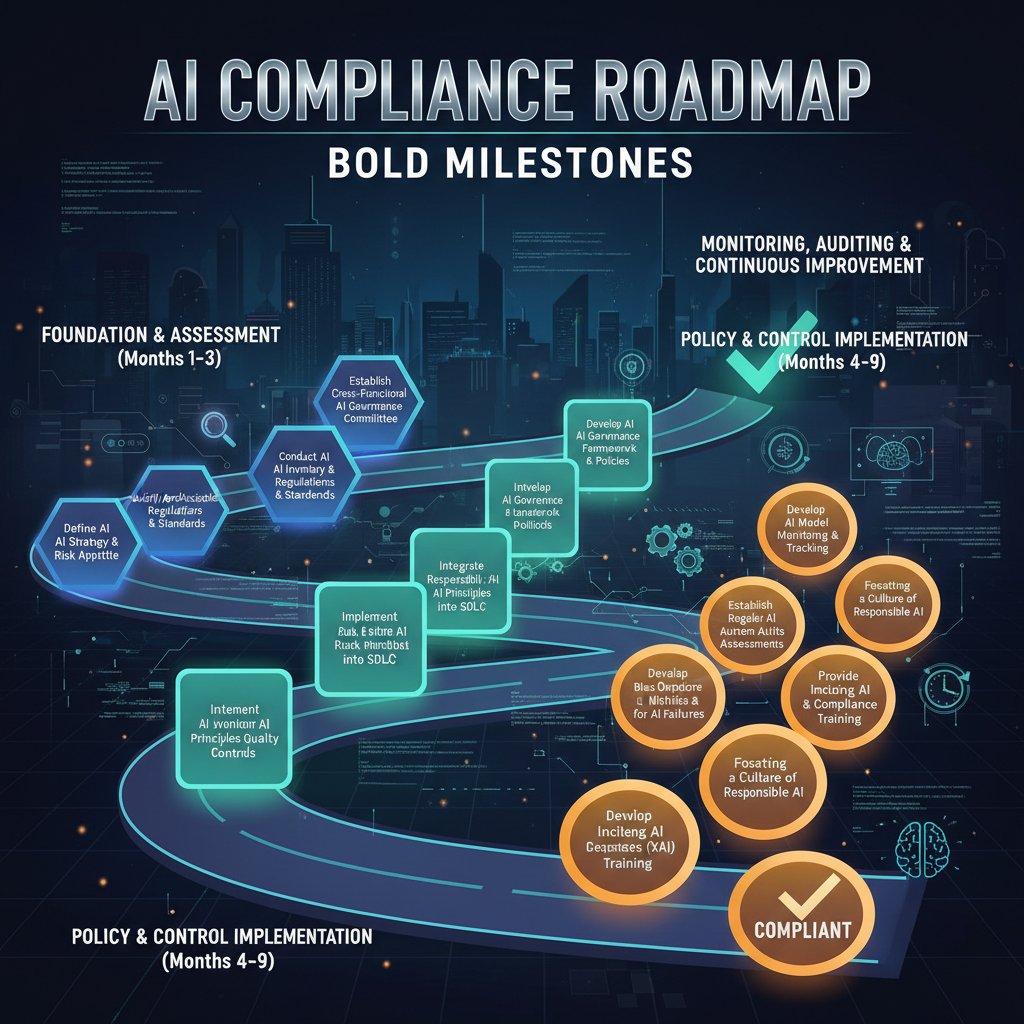
Building a roadmap isn’t a sign of weakness—it’s a blueprint for survival in a world where regulations never sleep.
Looking forward: The future of ai-powered automated compliance checks
The compliance singularity: Utopia, dystopia, or something stranger?
Speculation is cheap, but the patterns emerging today offer some bold predictions:
- Human-AI hybrid teams will dominate: The winners will blend machine speed with human judgment, not replace one with the other.
- Regulators will use AI as much as the regulated: Surveillance goes both ways—expect smarter audits and less tolerance for excuses.
- Compliance will shift from cost center to differentiator: Organizations that automate wisely will use compliance as a selling point, not a chore.
- Explainability will become non-negotiable: Vendors failing to deliver transparent AI will vanish from the market.
- New risks will emerge as fast as old ones are solved: The compliance arms race is perpetual—adaptation, not perfection, is the only constant.
Every prediction comes with a caveat: today’s best practices are tomorrow’s baseline expectations.
What to watch in 2025 and beyond
The next 12–24 months will see an explosion in AI adoption for compliance, driven by regulatory pressure, rapid tech advances, and growing evidence of ROI. Watch for stricter reporting mandates, sharper enforcement against AI-related compliance failures, and a rise in platforms that can explain, not just automate.

Staying ahead means staying informed—and never mistaking buzzwords for real solutions.
Final verdict: Should you trust AI with your compliance fate?
If you’ve made it this far, you know there’s no simple answer. Ai-powered automated compliance checks are neither savior nor villain—they’re a partner, as powerful or fallible as the people and processes that shape them. Trust them, but never blindly. Demand transparency, stay skeptical, and keep your finger on the pulse. In the compliance arms race, only the vigilant thrive.
"AI is neither savior nor villain. It’s your next compliance partner—if you’re ready." — Jamie, industry observer
Sources
References cited in this article
- Compunnel(compunnel.com)
- Wolters Kluwer(wolterskluwer.com)
- NAVEX(navex.com)
- ISACA(isaca.org)
- Thomson Reuters(thomsonreuters.com)
- Secureframe(secureframe.com)
- Detected(detected.co)
- Thomson Reuters(thomsonreuters.com)
- Cointelegraph(cointelegraph.com)
- IBM(ibm.com)
- Number Analytics(numberanalytics.com)
- Bryter(bryter.com)
- Wiz(wiz.io)
- Appian(appian.com)
- UiPath(uipath.com)
- Zluri(zluri.com)
- Forbes(forbes.com)
- McKinsey(mckinsey.com)
- OpenSourceForU(opensourceforu.com)
- Aristek Systems(aristeksystems.com)
- FTC(ftc.gov)
- Gables Law Firm(gableslawfirm.com)
- Skadden(skadden.com)
- BCG(bcg.com)
- MDPI(mdpi.com)
- Wachler(wachlerblog.com)
- Harvard Petrie-Flom(petrieflom.law.harvard.edu)
- Marketsy(marketsy.ai)
- Cimphony(cimphony.ai)
- EVERFI(everfi.com)
- Forbes(forbes.com)
- LexisNexis(risk.lexisnexis.com)
- AscentRegTech(ascentregtech.com)
- Thomson Reuters(thomsonreuters.com)
- Redress Compliance(redresscompliance.com)
- AI Guardian(aiguardianapp.com)
- Centraleyes(centraleyes.com)
- Security Senses(securitysenses.com)
- Centraleyes(centraleyes.com)
- 6clicks(6clicks.com)
Automate Your Tasks, Transform Your Business
FutureTask.ai revolutionizes your workflow by automating complex tasks typically outsourced to freelancers and agencies. Our powerful AI-driven platform leverages cutting-edge LLM technology to deliver precision, speed, and consistency at scale. Whether you're managing content creation, data analytics, marketing campaigns, or customer support, FutureTask.ai ensures seamless task execution, significant cost savings, and unmatched efficiency. Transform your business operations, eliminate delays, reduce operational overhead, and gain a competitive advantage with intelligent automation.
Get startedReady to Automate Your Business?
Start transforming tasks into automated processes today
Frequently Asked Questions
Why are AI-powered automated compliance checks replacing manual audits?
AI-powered systems can scan millions of transactions, detect anomalies, and flag violations much faster than human auditors. Manual compliance checks using clipboards and paper trails are inefficient compared to automated, coded logic that operates at machine speed.
What is the main risk or limitation of AI-powered compliance systems?
According to the article, a key limitation of AI and machine learning-based compliance systems is 'black-box risk' and explainability issues, meaning it can be difficult to understand why the AI made certain compliance decisions.
How has compliance technology evolved over the past few decades?
Compliance has evolved from paper-based manual audits in the pre-2000s, to digital spreadsheets in the 2000s-2010s, to rule-based software with automated alerts in 2010-2020, and finally to AI and machine learning systems from 2020 onwards.
Are AI-powered compliance checks foolproof?
No, the article explicitly states that automated regulatory audits are not foolproof and describes AI compliance automation as 'a high-stakes game of risk, reward, and reality' with potential winners, losers, and casualties.
From the Archive
Explore more from Ai-powered task automation

Ai-Powered Compliance Monitoring: Benefits and Hidden Risks

AI-Powered Financial Compliance Automation’s Hidden Risks in 2026

AI Automation in Regulatory Compliance: Costs and Benefits

Automating Compliance Reporting with Ai: Risks and Realities

How AI-Powered Automated Audits Change Compliance and Risk