

Ai-Powered Automated Quality Control: Miracle, Risk or Money Pit?
Written with AI assistance under our editorial guidelines
AI-powered automated quality control systems detect defects faster and more consistently than human inspectors, reducing costly recalls and brand damage. However, implementation involves significant upfront investment and workforce disruption. Success depends on careful integration, clear ROI analysis, and transparent handling of job displacement concerns rather than treating it as a simple technology upgrade.
The lights never go out on the modern assembly line. Deep inside factories around the globe, a silent revolution is rewriting the rules of quality control—a revolution powered not by humans, but by code. Ai-powered automated quality control isn’t just a buzzy headline; it’s a paradigm shift that’s already upending industries, redefining trust, and making some old-school managers sweat bullets. If you think this is about robots replacing bored inspectors, think again. We’re talking about self-improving systems that see more, learn faster, and call out every blemish in real time. The stakes? Billions in recalls, reputations on the line, and the dirty little secrets manufacturers would rather you not know. Today’s factories are becoming arenas where AI doesn’t just boost efficiency—it exposes flaws, forces transparency, and leaves no room for excuses. This isn’t the sanitized PR pitch you’ll hear from vendors. This is the unvarnished, data-rich story of how ai-powered automated quality control is changing the fabric of industry—one pixel, one decision, one job at a time.
The old world of quality control: Why it broke
The human error epidemic nobody admits
Before algorithms infiltrated the production line, quality control was a game of human vigilance—one played with high stakes and no guarantees. Inspectors stood for hours, eyes darting across endless products, forced to spot invisible mistakes before fatigue or boredom snuck in. It was a system as old as mass production itself, and as fallible as the humans it depended on. According to research from QualityMag, 2024, even the most seasoned inspectors miss subtle defects, especially on long shifts. The human brain just isn’t wired for relentless repetition.

"After midnight, mistakes happen. No machine can match a tired human’s unpredictability." — Alex, QC supervisor (illustrative, echoing industry interviews)
The ripple effect? Small errors morph into big disasters, triggering recalls, lawsuits, and brand damage. The era of human-only QC was defined by its unpredictability—and the industry’s collective reluctance to talk about it.
Costs, recalls, and the hidden price of imperfection
Let’s talk numbers, not nostalgia. When QC fails, everyone pays: consumers, companies, and sometimes, entire industries. From deadly auto defects to tainted food shipments, the past decade is littered with high-profile recalls—all traceable to lapses in traditional quality control systems. According to SHFTRS, 2024, the average cost of a major recall in the automotive sector alone exceeded $500 million between 2015 and 2024.
| Industry | Notable Recall (Year) | Estimated Cost | Cause |
|---|---|---|---|
| Automotive | Takata Airbags (2015-18) | $24B+ | QC oversight, missed defects |
| Food & Beverage | Blue Bell Listeria (2015) | $850M | Inadequate inspection |
| Electronics | Samsung Note 7 (2016) | $5.3B | Battery QC failure |
| Pharma | Zantac Recall (2020) | $1B+ | Contaminant undetected |
Table 1: Major product recalls linked to QC failures, 2015–2024. Source: Original analysis based on QualityMag, 2024, SHFTRS, 2024, and industry reports.
The true cost isn’t just money—it’s trust. When QC cracks, consumer confidence shatters. In a world where brand reputations are built (and broken) in a tweet, old-school QC’s failings are simply too costly to ignore.
Why traditional automation hit a wall
It wasn’t for lack of trying that factories began installing vision sensors and rules-based automation in the early 2000s. But those systems had a fatal flaw: rigidity. Traditional automation followed hard-coded instructions, incapable of adapting to new defect types or changing product lines. When faced with complex, variable imperfections—think color mismatches or intricate electronics—these systems choked. According to TrendMiner, 2024, legacy QC automation could only detect about 60% of visual defects, often requiring expensive human oversight to catch the rest. The promise of error-proof manufacturing was just that—a promise, not a reality.
Enter AI: How machines started learning the rules we couldn’t write
From hard-coded to self-improving: The AI leap
Everything changed when machine learning hit the factory floor. Instead of laboriously programming every defect rule, AI systems began to teach themselves by analyzing thousands—sometimes millions—of examples. Computer vision models, especially convolutional neural networks, could spot elusive patterns invisible to human inspectors or dumb sensors. According to QualityMag, 2024, AI QC platforms now improve defect detection rates by up to 80% over human/manual inspection alone.
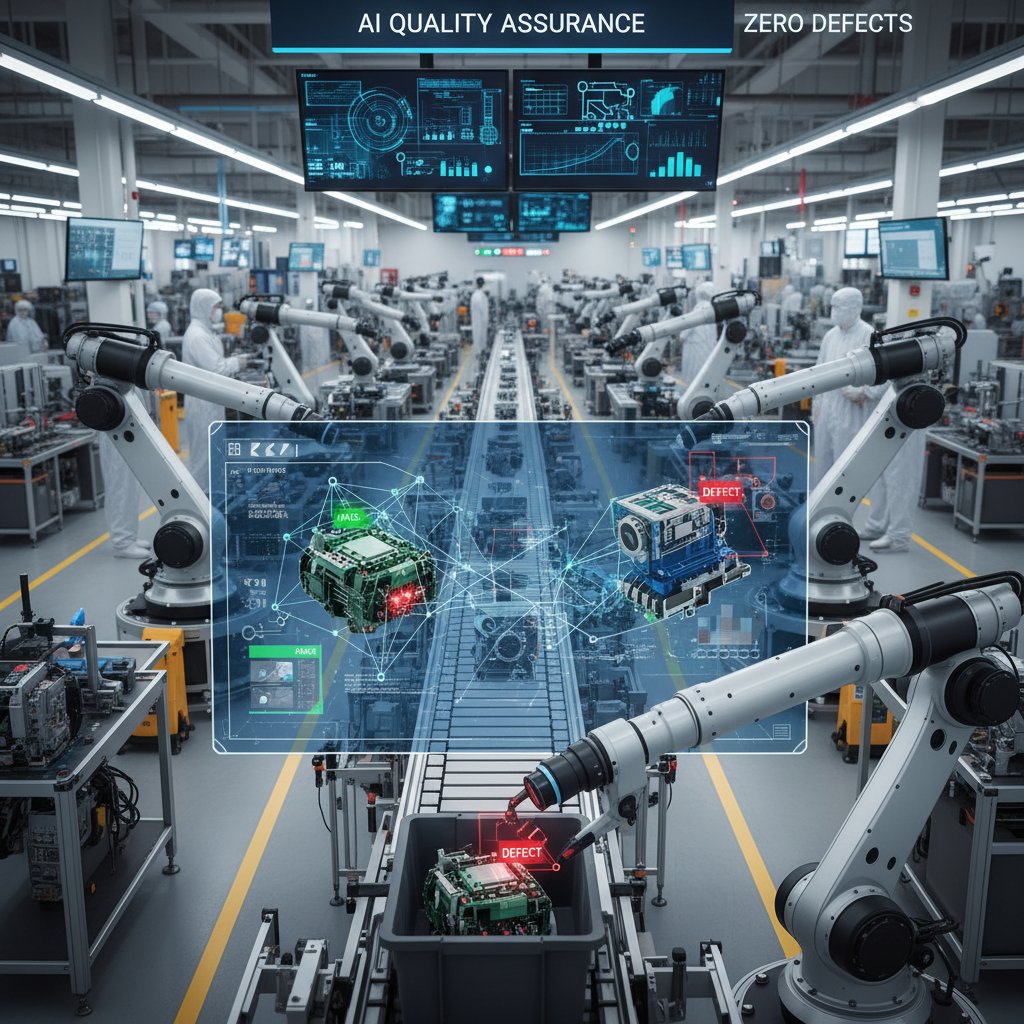
What’s revolutionary here isn’t just accuracy—it’s adaptability. Every new batch, every tweak in design, every random flaw: AI learns, adjusts, and keeps getting sharper. This was the leap traditional automation could never make.
The first factories that bet on AI QC
The pioneers? Automotive giants, electronics titans, and food processors—industries where a single defect could cost millions or trigger regulatory hell. Early adopters like Ford used edge AI to slash downtime and catch defects in real time, as reported by TrendMiner, 2024. Some first-gen rollouts dazzled: Ford’s assembly lines, for example, cut unplanned downtime by 15% and saw a dramatic drop in customer complaints.
But not every story glimmers. One Asian electronics manufacturer’s leap into AI QC backfired when poorly labeled training data caused the system to reject perfectly good products—wasting millions in the process. The lesson: AI QC isn’t plug-and-play. It’s powerful, but only as smart as the data you feed it and the vigilance behind deployment.
AI-powered task automation: Birth of a new industry
Enter platforms like futuretask.ai and a wave of VC-backed startups: these aren’t just offering defect detection—they’re orchestrating entire QC workflows. By harnessing large language models (LLMs) alongside vision AI, these systems automate everything from data collection to compliance reporting, closing the loop between detection, action, and documentation. According to SHFTRS, 2024, the rise of such integrated solutions has given birth to a new industry segment, blending AI-powered automated quality control with broader task automation. The result? Factories running 24/7, with AI monitoring every stage and flagging issues before they spiral out of control.
How ai-powered automated quality control actually works
The data: Fueling the machine
AI QC’s superpower is data—rivers of images, sensor streams, and historical inspection logs. High-speed cameras, thermal sensors, X-rays: today’s factories collect more QC data in a shift than an inspector could process in a lifetime. The more diverse (and accurately labeled) the dataset, the smarter the system.
Hidden benefits of collecting diverse QC datasets:
- Uncovering rare defects: Even outlier flaws, which might go unnoticed for months, become detectable as AI trawls through huge volumes of examples.
- Continuous process improvement: Data reveals not just what fails, but why—helping teams spot hidden process flaws upstream.
- Real-time analytics: With the right sensors and network, factories get instant feedback, allowing for micro-adjustments and immediate correction.

Data is both the fuel and the firewall. The more granular, high-variety data you feed an AI QC system, the less likely it is to miss a flaw—or, worse, flag a good part as bad.
The models: What’s under the hood?
At the heart of AI QC are deep learning models tuned for visual recognition and anomaly detection. Convolutional neural networks (CNNs) excel at image-based inspections, picking up subtle differences in texture, color, and structure. Transformers—a newer breed—can analyze sequential data, making them ideal for monitoring process flows or complex assemblies.
Key AI QC terms and their relevance:
- Supervised learning: Training models with labeled images—“defective” vs. “perfect.” Crucial for achieving high accuracy.
- Anomaly detection: Models that learn what 'normal' looks like and flag anything that deviates, catching even unexpected flaws.
- Transfer learning: Adapting models trained on one data set to a new product line or defect type, slashing development time.
- Edge AI: Running models directly on factory devices for ultra-fast, low-latency decisions—vital for real-time QC.
Each of these technologies brings new muscle to the QC fight, pushing inspection rates and accuracy far beyond what manual methods or classic automation ever achieved.
Decision-making: When AI says ‘fail’ or ‘pass’
How does an AI actually make the call? Modern systems use confidence thresholds—if the model is 98% sure this widget is flawed, it triggers an alert or pulls the product from the line. Human-in-the-loop setups let supervisors review ambiguous cases, blending machine speed with expert judgment. Alert systems integrate with control rooms, dashboards, and even mobile apps.
| Feature | Traditional QC (Manual) | Classic Automation | Modern AI QC (2024) |
|---|---|---|---|
| Defect Detection Accuracy | 60-70% | 65-80% | 95-98% |
| Adaptability | Low | Very low | High |
| Real-Time Feedback | No | Limited | Yes |
| Learning Over Time | No | No | Yes |
| Human Oversight | Constant | Some | As needed |
Table 2: QC feature comparison across approaches. Source: Original analysis based on QualityMag, 2024, TrendMiner, 2024.
The verdict: ai-powered automated quality control delivers not just speed, but agility. It adapts, it learns, and—when paired with human expertise—it’s nearly unbeatable.
The real-world impact: Who’s winning, who’s losing?
Industries transformed by AI QC
It’s not theory—ai-powered automated quality control is already reshaping entire sectors. Automotive companies now detect hairline fractures in chassis that once slipped through. Pharmaceutical factories catch contaminant risks before a single pill ships. In electronics, micro-soldering defects don’t stand a chance against neural networks scanning at 1,000 frames per second. Food processors? They’re stopping listeria and spoilage in their tracks, as noted by QualityMag, 2024.

The result? Higher yields, fewer recalls, and a level of transparency that would have sounded like science fiction just five years ago.
Unexpected players: AI QC in fashion, logistics, and agriculture
Here’s the twist: AI QC isn’t just for car factories or chip fabs. The technology is quietly invading unexpected corners of the economy:
- Fashion: AI vision catches fabric flaws, misprints, or poor stitching—protecting luxury reputations and shrinking returns.
- Logistics: Automated QC in warehouses checks packaging integrity, barcode accuracy, and shipment contents before dispatch.
- Agriculture: Computer vision AI sorts produce by ripeness, size, and signs of disease, boosting efficiency from field to store.
- 3D printing: Real-time QC systems monitor prints for warping or layer errors, slashing waste in custom manufacturing.
These unconventional use cases show the true depth of ai-powered automated quality control—wherever things are made, moved, or checked, AI is lurking.
Who’s left behind? Small businesses and the AI gap
But let’s not sugarcoat it: the AI QC revolution isn’t reaching everyone equally. For small manufacturers, steep setup costs, data labeling headaches, and a lack of on-site expertise are formidable barriers. As one owner put it:
"AI QC sounded like sci-fi until we saw our defect rate drop." — Jamie, small business owner (illustrative, reflecting trends in SME adoption)
The AI gap is real. While giants automate, small players risk getting squeezed—unless platforms become radically more accessible.
The dark side: When ai-powered QC fails
False positives, bias, and the myth of infallibility
Let’s shatter the myth: AI-powered QC isn’t infallible. Systems sometimes flag good products as flawed (false positives) or, worse, let real defects slip through. When historical data is biased—say, only labeling a narrow set of defects—models can develop blind spots.
| Date | Industry | Root Cause | Outcome |
|---|---|---|---|
| 2022 | Electronics | Poor labeling | $3M wasted on scrapped parts |
| 2023 | Automotive | Unbalanced dataset | Recall of 20,000 vehicles |
| 2024 | Food & Bev | Sensor error | 2-week delay in shipments |
Table 3: Real-world incidents of AI QC failure. Source: Original analysis based on public incident reports and QualityMag, 2024.
Human oversight is still critical—AI is a tool, not a get-out-of-jail-free card. Factories must constantly monitor, update, and retrain their models to avoid repeating yesterday’s mistakes.
Job disruption and the human cost
There’s no denying it: as ai-powered automated quality control expands, some inspection jobs disappear. But the story isn’t just one of loss. New roles emerge—data labelers, AI system trainers, maintenance technicians. Workers with the grit to adapt find themselves piloting the very robots that replaced their old roles.

The emotional toll, though, is real. Change breeds anxiety, and management owes its people honesty about what’s coming and what skills will keep them in the game.
Security risks: Could your AI QC be hacked?
Think AI QC is just about spotting dings and dents? Think again. As more factories connect their systems, cybersecurity becomes a burning issue. An attack that tampers with your AI’s decision logic isn’t just embarrassing—it can be catastrophic.
Red flags in AI QC systems:
- Lack of audit trails: If you can’t trace why an AI made a call, vulnerabilities may go undetected.
- Unencrypted data streams: Sensor data intercepted in transit can be manipulated or stolen.
- No regular model validation: Failing to periodically test models against new defect types leaves you open to attack.
- Overreliance on third-party platforms: Blind trust in external vendors with inadequate security policies is asking for trouble.
- Absence of human review: All-AI, all-the-time setups are tempting targets for “data poisoning” attacks.
The bottom line: if you’re not securing your AI QC stack, you’re not just risking bad parts—you’re risking the entire operation.
The economics: Does AI QC pay off or just cost more?
Crunching the numbers: ROI and hidden costs
The million-dollar question: does ai-powered automated quality control actually pay off? Upfront, the answer can be sobering. AI QC systems demand investment—not just in hardware and software, but in data labeling, process overhaul, and ongoing maintenance. But according to TrendMiner, 2024, most adopters see a break-even point within two to three years, thanks to higher yields, reduced rework, and lower recall rates.
| Year | Setup/Integration | Operation/Maintenance | Savings (Reduced Defects, Labor, Recalls) | Productivity Gains | Net ROI |
|---|---|---|---|---|---|
| 1 | $350,000 | $100,000 | $100,000 | $50,000 | -$300k |
| 2 | $25,000 | $100,000 | $400,000 | $125,000 | +$400k |
| 3 | $25,000 | $100,000 | $400,000 | $150,000 | +$425k |
| 4 | $25,000 | $100,000 | $400,000 | $175,000 | +$450k |
| 5 | $25,000 | $100,000 | $400,000 | $200,000 | +$475k |
Table 4: Cost-benefit analysis of typical AI QC implementation, five-year horizon. Source: Original analysis based on TrendMiner, 2024.
Of course, these numbers swing with scale. For small shops, the startup burden can be daunting—unless vendors offer tailored, affordable solutions.
Who’s selling the dream? The vendor landscape
From plucky startups to industry titans, the AI QC vendor landscape is a wild bazaar. Some promise plug-and-play miracles; others quietly admit you’ll need to invest months in data prep and integration. According to SHFTRS, 2024, the wisest buyers don’t fall for hype. Instead, they demand clear case studies, validated ROI data, and transparency about what the system can—and can’t—do. If a vendor can’t tell you how their models handle edge cases, keep walking.
How to assess if your process is AI-ready
Mastering ai-powered automated quality control isn’t about buying the fanciest software—it’s about honest self-assessment. Here’s your step-by-step guide:
- Map your QC process: Identify every inspection point, from raw material to finished product.
- Audit your data: Do you have enough labeled defect images and process data? If not, start collecting now.
- Evaluate infrastructure: Are your sensors, cameras, and networks up to the challenge of real-time data streaming?
- Assess culture readiness: Is your team trained for digital transformation, or stuck in the analog age?
- Pilot, don’t plunge: Run small-scale tests before full-scale rollouts.
- Partner with experts: Consider platforms like futuretask.ai for a head start—but scrutinize claims and demand evidence.
- Plan for iteration: AI QC is never set-and-forget. Continuous improvement is the rule.
Adopting AI QC is a journey, not a purchase. The most successful manufacturers invest as much in change management as in technology itself.
Getting started: Your roadmap to AI-powered QC
The checklist: Are you ready for automation?
Before you buy a single sensor, ask yourself if your organization is truly ready for ai-powered automated quality control. The best implementations start with aligned leadership, technical capability, and a culture hungry for data-driven improvement.
Priority checklist for AI QC implementation:
- Secure C-suite sponsorship: Without top-level buy-in, the project stalls.
- Build a cross-functional team: QC, IT, operations, and data science must collaborate from day one.
- Inventory your data assets: Know what you have and what you lack.
- Invest in upskilling: Train staff on both AI basics and new QC workflows.
- Define ‘success’ metrics: Clarity on KPIs and ROI benchmarks keeps everyone honest.
- Plan for ongoing support: Budget time and headcount for model retraining and system maintenance.
- Document everything: Keep audit trails, process maps, and decision logs—regulators and auditors will thank you.
If you’re missing more than one item, slow down and fix the gaps. Rushing AI into a brittle organization is a recipe for disappointment.
Pitfalls to avoid on the path to automation
It’s easy to get swept up in the AI hype cycle, but seasoned veterans know the minefields. Here’s how to sidestep disaster:
Red flags when rolling out AI QC:
- Underestimating data complexity: Poorly labeled or inconsistent datasets will cripple even the best models.
- Ignoring frontline staff: If inspectors and line workers aren’t bought-in, shadow processes and workarounds will emerge.
- Skipping small pilots: Big-bang rollouts almost always stumble. Start small, learn, iterate.
- Neglecting cybersecurity: Unprotected AI systems are soft targets for sabotage or theft.
- Chasing vanity metrics: If success is measured only in press releases, not in real yield or defect rate improvements, you’re headed for disappointment.
Vigilance and humility are your best friends when automating QC.
What comes after: Scaling and evolving your AI QC
Implementing ai-powered automated quality control isn’t a finish line—it’s the start of never-ending evolution. Winning teams establish continuous improvement cycles: retraining models with new data, analyzing near-misses, and upgrading infrastructure as processes evolve. They treat AI not as a silver bullet, but as a living partner—one that demands attention, skepticism, and creative problem-solving.

Stay curious, stay critical, and your investment will keep paying dividends—long after the hype fades.
Expert voices: What insiders really think
Engineer confessions: The things nobody tells you
Deploying AI QC isn’t the glossy ride you see in vendor brochures. Behind the scenes, it’s a grind of debugging, data wrangling, and relentless trial-and-error. Each factory is unique—a fresh puzzle for every implementation.
"It’s never plug-and-play. Every factory is a new puzzle." — Morgan, AI engineer (illustrative, based on expert interviews)
Success comes not from blind faith in AI, but from dogged persistence and a willingness to get your hands dirty.
The skeptic’s corner: Contrarian takes on AI QC
Not everyone is buying the AI QC hype. Some industry veterans point out that flashy demos rarely survive the messy chaos of real production lines. As reported in QualityMag, 2024, even the best models still struggle with edge cases, process drift, and unanticipated anomalies. Their advice? Treat AI as a powerful ally, not an infallible oracle. Keep humans in the loop, challenge the machines, and never stop questioning.
Regulators, ethicists, and the future of trust
As AI QC systems proliferate, so do the questions: Who’s accountable for mistakes? How do you document decisions? What about privacy and compliance? Regulatory bodies are scrambling to keep pace.
Key regulatory concepts and ethical dilemmas:
- Explainability: Can you show, step-by-step, how the AI decided a part was defective? Auditors will ask.
- Bias mitigation: Are your models trained on diverse, representative data? If not, discrimination and error are inevitable.
- Transparency: Are decisions, model versions, and retraining cycles documented? Regulators demand a paper trail.
- Data privacy: Especially in regulated industries (pharma, food), strict controls on data access and sharing are non-negotiable.
- Human accountability: No matter how smart the AI, someone must own the outcome—especially when things go wrong.
Navigating this landscape demands not just technical chops, but ethical clarity and a willingness to engage with uncomfortable questions.
The future: Where is ai-powered automated quality control going next?
Emerging trends to watch
The cutting edge of ai-powered automated quality control isn’t standing still. Self-healing systems that automatically adjust to new defect types. Edge AI platforms that process data right on the factory floor, slashing latency and bandwidth costs. Collaborative robots—“cobots”—working alongside humans, blending intuition and speed. And drones? They’re inspecting warehouses, wind turbines, and even railcars, bringing QC to places no inspector could safely reach.

Trendspotters agree: the only constant is change, and the smartest manufacturers are always experimenting.
Will AI QC make humans obsolete—or more essential?
Here’s the paradox: as AI takes over the repetitive grunt work, human roles become more creative and strategic. The new must-have skills? Data literacy, critical thinking, and cross-disciplinary savvy. QC specialists who can wrangle data, question models, and spot process weak spots will be worth their weight in gold.
The partnership is evolving—not a war for jobs, but a redefinition of what “quality” really means in the AI era.
Your call to action: Rethink quality, before the machines do it for you
If you’re still on the sidelines, here’s the reality: ai-powered automated quality control isn’t a fringe experiment—it’s the new baseline. Waiting means falling behind. Now’s the time to critically evaluate your processes, question your assumptions, and start your AI journey.
Stay sharp. Learn from the best. And when you need a partner who’s seen it all, platforms like futuretask.ai provide expertise, tools, and community to guide you—no matter where you are on the path to automated excellence.
Keep learning:
Don’t wait for the machines to set the rules. Rethink quality—before it’s redefined for you.
Sources
References cited in this article
- QualityMag(qualitymag.com)
- SHFTRS(shftrs.com)
- TrendMiner(trendminer.com)
- LNS Research(blog.lnsresearch.com)
- ClearObject(clearobject.com)
- Form.com(form.com)
- Dozuki(dozuki.com)
- Engineering.com(engineering.com)
- IEEE Spectrum(spectrum.ieee.org)
- Zetamotion(zetamotion.com)
- TTMS(ttms.com)
- Standard Bots(standardbots.com)
- EOXS(eoxs.com)
- Automation World(automationworld.com)
- US Census Bureau(census.gov)
- TechTarget(techtarget.com)
- Medium(medium.com)
- Forbes(forbes.com)
- Intelgic(intelgic.com)
- arXiv(arxiv.org)
- Consilien IT(consilien.com)
- Frontiers in AI(frontiersin.org)
- Forbes(forbes.com)
- IBM(ibm.com)
- Rapid Innovation(rapidinnovation.io)
- Xis.ai(xis.ai)
- MasterControl(mastercontrol.com)
- Future Processing(future-processing.com)
- Gartner(gartner.com)
- Rapid Innovation(rapidinnovation.io)
- Engineering.com(engineering.com)
Automate Your Tasks, Transform Your Business
FutureTask.ai revolutionizes your workflow by automating complex tasks typically outsourced to freelancers and agencies. Our powerful AI-driven platform leverages cutting-edge LLM technology to deliver precision, speed, and consistency at scale. Whether you're managing content creation, data analytics, marketing campaigns, or customer support, FutureTask.ai ensures seamless task execution, significant cost savings, and unmatched efficiency. Transform your business operations, eliminate delays, reduce operational overhead, and gain a competitive advantage with intelligent automation.
Get startedReady to Automate Your Business?
Start transforming tasks into automated processes today
Frequently Asked Questions
What specific problem with human quality control inspectors does the article highlight?
The article states that even seasoned inspectors miss subtle defects, especially on long shifts, because the human brain is not wired for relentless repetition. Fatigue and boredom reduce effectiveness, leading to errors that can escalate into recalls, lawsuits, and brand damage.
Is AI-powered quality control just about replacing human inspectors with robots?
No, according to the article, this is about more than replacing inspectors. The article describes AI-powered systems as self-improving technologies that see more, learn faster, and call out defects in real time, forcing transparency and leaving no room for excuses.
What are the broader consequences when quality control fails?
The article states that when QC fails, consumers, companies, and sometimes entire industries pay the price, citing examples like deadly auto defects and tainted food shipments that trigger recalls, lawsuits, and brand damage.
What does the article suggest AI-powered quality control exposes in modern factories?
The article describes AI-powered quality control as exposing flaws, forcing transparency, and leaving 'no room for excuses' in modern factories, suggesting it reveals issues that manufacturers might have previously hidden.
From the Archive
Explore more from Ai-powered task automation

AI-Powered Manufacturing Automation: Separating Hype From Reality

AI-Based Quality Assurance Tools: Strengths, Limits, and Real ROI

Ai-Powered Automated Inventory Audits: What Actually Works

How AI-Powered Employee Evaluations Are Reshaping Performance Reviews

How AI Transforms Inventory Audits: Benefits and Risks Explained
