

AI-Powered Business Continuity Automation: Safeguard or New Risk?
Written with AI assistance under our editorial guidelines
AI-powered business continuity automation promises faster disaster recovery and threat detection, yet 60% of continuity staff feel unprepared despite investments. While automation reduces manual workload, AI can generate false threats and human error remains responsible for 75% of breaches. Organizations must balance technological solutions with realistic risk assessment and human oversight.
Let’s tear off the glossy veneer and get real about ai-powered business continuity automation. Forget the boardroom slides and vendor promises—2025 is a warzone where cyberattacks, outages, and supply chain chaos are daily threats. The world’s most advanced organizations are racing to automate resilience, but even their confidence is crumbling: according to IBM’s 2025 report, 60% of business continuity staff still feel unprepared for catastrophe despite hefty AI investments. Meanwhile, 84% of IT leaders are doubling down on AI automation, betting their futures on technology that’s rewriting the rulebook in real time (IBM, 2025).
Sound like hype? Not so fast. While automation slashes manual workload and promises faster recovery, the truth is more raw. AI can spot disaster before it strikes, but it can also hallucinate threats, triggering chaos instead of calm. Human error remains the Achilles’ heel—75% of internal breaches still come down to people, not code (Verizon, 2024). So, before you toast to a future where algorithms save your business, let’s dissect the 7 brutal truths shaping resilience right now. This isn’t just a survival guide; it’s a reality check for anyone daring to rely on AI as their secret weapon. Welcome to the unvarnished state of business continuity automation—where the edge is sharp, and the stakes are existential.
Why business continuity is broken (and why AI matters now)
Legacy systems: The invisible threat lurking in your stack
Manual continuity protocols are like relics from a forgotten era—dusty binders, endless spreadsheets, and workflows stitched together with hope and wishful thinking. In most organizations, these legacy systems are a silent liability, hiding technical debt that quietly metastasizes until one blackout or ransomware hit turns inconvenience into existential crisis. According to Vena, 2023, 73% of companies still bleed time and resources on manual processes ripe for automation—a jaw-dropping waste in an era that demands agility and speed.
Business leaders routinely underestimate downtime risks, only waking up when the financial and reputational damage is already done. Outdated continuity plans lull teams into a false sense of security, as if having a checklist guarantees survival. But when disaster strikes, the gap between what’s documented and what actually works is exposed, sometimes with catastrophic consequences. The cost isn’t just in lost revenue; it’s the erosion of trust, lost customers, and the kind of headlines that haunt leadership teams for years. If you think your business is immune, remember: technical debt is the most expensive line item you never see on your balance sheet.
The myth of the perfect plan: Why disasters always outsmart checklists
Traditional business continuity plans are built on static playbooks and predictable threats. But 2025’s risk landscape is anything but predictable. Phishing, ransomware, supply chain attacks, and “unknown unknowns” defy templated responses. As the Datto 2023 survey reveals, 83% of attacks now originate externally, morphing tactics faster than most organizations can update their protocols.
“You can’t plan for what you can’t imagine. That’s where AI steps in.”
— Jordan, CTO (illustrative, based on industry interviews and research)
AI is designed to adapt, sensing patterns and anomalies humans miss. Where checklists stall, machine learning models pivot, processing signals from across your IT environment in real time. The shift isn’t about replacing plans, but augmenting human judgment: AI doesn’t just execute a playbook—it writes new pages on the fly. Still, this power comes with its own risks, especially when automation is mistaken for invulnerability.
What is ai-powered business continuity automation (for real)?
Beyond buzzwords: Defining AI, automation, and continuity in 2025
It’s easy to drown in a sea of jargon: AI, automation, machine learning, business continuity—the terms are everywhere, often wielded interchangeably. But here’s the real distinction: traditional automation runs on static, rule-based scripts—“if X, then Y.” AI-powered automation, meanwhile, unleashes algorithms that learn and adapt, digesting vast datasets to spot subtle threats and orchestrate complex responses in ways no human—or script—could.
Definition list:
-
AI (Artificial Intelligence)
Algorithms that mimic human reasoning, learning from patterns in real-time data to make complex decisions—think anomaly detection in network traffic or automated analysis of log files. -
Business continuity
The orchestration of people, processes, and technology to maintain critical operations during disruptions—ranging from cyberattacks to natural disasters. -
Automation
The use of technology to execute tasks without human intervention. In 2025, the shift is away from “if-this-then-that” scripts to self-adaptive, AI-driven workflows.
Natural language models bring unprecedented nuance, bridging the gap between technical logic and human context. They allow systems like futuretask.ai to parse unstructured data, interpret alerts, and even draft crisis communications—fast-tracking restoration while maintaining a human touch.
How AI thinks about risk: Pattern recognition, prediction, and action
AI doesn’t “think” like a human—it digests high volumes of data, learning from past incidents to predict emerging threats. Machine learning models monitor network activity, server performance, and user behavior, flagging anomalies in milliseconds. This difference is non-trivial: where a human might take hours to detect a subtle breach, AI can spot and escalate the threat in seconds.
| Incident detection method | Typical response speed | Accuracy (2025 data) | Adaptability |
|---|---|---|---|
| Human-led | 45–120 minutes | 70–80% | High (contextual) |
| AI-powered | 5–30 seconds | 85–95% | Medium–High (depends on model/data) |
| Hybrid (AI + human) | 1–10 minutes | 90–98% | Highest (leverages both strengths) |
Table 1: Comparative metrics for human vs. AI incident detection and response. Source: Original analysis based on IBM, 2025, Forbes, 2025, Dexian, 2025.
The upside? Unmatched speed and scalability. The downside? AI can’t improvise outside its training data—when novel threats arise, algorithms can misfire or overlook warning signs. Blind spots in data, bias, or adversarial manipulation can all undermine even the most advanced systems.
The unvarnished truth: Hidden risks and brutal realities
Overreliance: When automation backfires
For all its promise, automation isn’t a failsafe. There are real-world cases where AI-driven continuity failed spectacularly—think software bugs that triggered premature server failovers, or “black box” AI making unexplainable, catastrophic decisions. An infamous 2024 retail outage saw an AI misdiagnose a routine server patch as a ransomware attack, automatically pulling critical systems offline for hours (Forbes, 2025).
“When you trust the black box blindly, you’re asking for trouble.”
— Sam, risk analyst (Paraphrased from risk management interviews; illustrative)
The lesson? Automation magnifies both strengths and weaknesses. Overreliance creates new single points of failure—one coding error, one bad data stream, and the entire resilience operation can unravel. The smartest organizations are building in manual override controls, layered monitoring, and regular “chaos engineering” drills to avoid being blindsided by their own technology.
AI hallucinations: The new continuity nightmare
AI’s capacity to misinterpret signals is a growing risk. In 2023, several organizations reported “hallucinated” AI alerts—algorithms flagging innocuous network events as critical threats, setting off unnecessary incident responses and, in some cases, cascading outages. According to IBM, 2025, regulatory bodies are now scrutinizing these failures, especially as patchwork governance creates gray zones in accountability.
The best defense against AI-driven false alarms? Layered validation, continuous training with real-world data, and robust human-in-the-loop oversight. AI should be your first responder—not your only one.
Not just for Fortune 500s: AI continuity for the rest of us
How startups and SMEs are flipping the script
AI-powered business continuity automation isn’t reserved for corporate giants anymore. Thanks to democratized platforms and cloud-native tools, startups and SMEs are now leapfrogging legacy risk management, deploying resilience strategies that would have been unthinkable five years ago. According to Dexian, 2025, 84% of IT leaders across all company sizes are investing in major AI upgrades, not just pilots.
| Feature | High-end enterprise tool | Accessible SME platform | Example provider |
|---|---|---|---|
| Customizable workflows | Yes | Limited/Template-based | various |
| Real-time monitoring | Yes | Yes | futuretask.ai, others |
| Incident response speed | 5–10 seconds | 15–60 seconds | futuretask.ai, competitors |
| Cost | $$$$ | $–$$ | various |
| Human-in-the-loop options | Yes | Yes | most |
Table 2: Feature comparison of AI-powered business continuity tools. Source: Original analysis based on Dexian, 2025, Vena, 2023.
Take the example of a fintech startup that adopted automated incident detection. Not only did they cut downtime incidents by 50%, but they also redirected staff effort into growth-critical projects (Vena, 2023). The message is clear: resilience isn’t a privilege—it’s a necessity, and now an affordable one.
Unconventional uses: Creative industries, NGOs, and more
Beyond banks and logistics, creative agencies, NGOs, and even performing arts organizations are leveraging AI-powered business continuity automation for unexpected wins. It’s not just about keeping the lights on—it’s about adapting to new threats as they emerge.
- Unordered list: Unconventional uses for ai-powered business continuity automation
- Arts and media: AI-driven backup of digital assets, automated restoration of lost footage, and rapid crisis communications in live broadcast scenarios.
- Nonprofits/NGOs: Automated crisis mapping and resource allocation during disasters, allowing small teams to coordinate large-scale relief.
- Healthcare clinics: AI-facilitated patient data recovery and communication during outages, minimizing care disruption.
- Education: Automated failover of e-learning platforms, ensuring classes continue through cyberattacks or infrastructure failures.
The cultural impact is subtle but profound: AI enables organizations to act with a speed and confidence previously reserved for the Fortune 500s. In creative environments, this means more time for human ingenuity—less firefighting, more innovation.
Implementing ai-powered business continuity: A reality check
The anatomy of an AI-driven incident response
The journey from threat detection to mitigation is no longer a linear checklist—it’s a dynamic process, orchestrated by intelligent systems that learn from every incident. Here’s how modern AI-powered business continuity automation typically unfolds:
- Continuous monitoring: AI scans logs, sensors, and user behaviors across all systems, flagging anomalies in real time.
- Threat classification: Machine learning models triage alerts, ranking their severity and urgency.
- Automated response initiation: Based on pre-set playbooks and learned behaviors, AI triggers containment protocols—isolating affected systems, rerouting traffic, or alerting human responders.
- Escalation or handoff: For ambiguous or high-impact incidents, AI notifies human experts, providing data-rich context for rapid decision-making.
- Post-incident learning: Every event is fed back into the training loop, making the system smarter (and ideally, less prone to repeating mistakes).
When humans and AI aren’t in sync, the process breaks down—either paralysis by analysis or runaway automation. The most resilient organizations treat incident response as a choreography, not a baton pass.
Red flags and dealbreakers: What to watch out for
Not all AI continuity solutions are created equal. If you’re shopping for a platform, beware of these warning signs:
- Overpromised “set and forget” automation: No AI is infallible. Any vendor promising zero human oversight is selling a fantasy.
- Opaque “black box” algorithms: If you can’t audit or understand how decisions are made, you can’t trust the outcomes.
- Lack of integration: Solutions that don’t mesh with your existing stack add complexity, not resilience.
- No human-in-the-loop options: Removing people from the process entirely is a recipe for disaster.
- Thin regulatory compliance: Inconsistent adherence to GDPR, SOX, or local standards is a dealbreaker in today’s regulatory minefield.
Unordered list: Red flags to watch out for when evaluating AI continuity solutions
- Absence of detailed audit logs and explainability.
- Aggressive claims about “100% automated” protection.
- Lack of support for hybrid or phased deployment.
- Poor track record with updates and incident reporting.
- Inadequate post-incident review and learning cycles.
If a solution sounds too good to be true, it usually is. Distinguishing technical reality from marketing hype is the first step toward real resilience.
Case files: When AI saved the day (and when it made it worse)
Success stories: From near-miss to operational heroism
In 2024, a fintech company on the brink of disaster was rescued by their AI-driven continuity platform. During a coordinated phishing and DDoS attack, the AI detected a spike in anomalous login attempts, triggering a rapid lockdown of vulnerable endpoints. Human responders were immediately looped in, leveraging rich contextual data to patch vulnerabilities and restore critical services in under 15 minutes—an incident that could have cost millions in downtime and regulatory fines was contained with surgical precision.
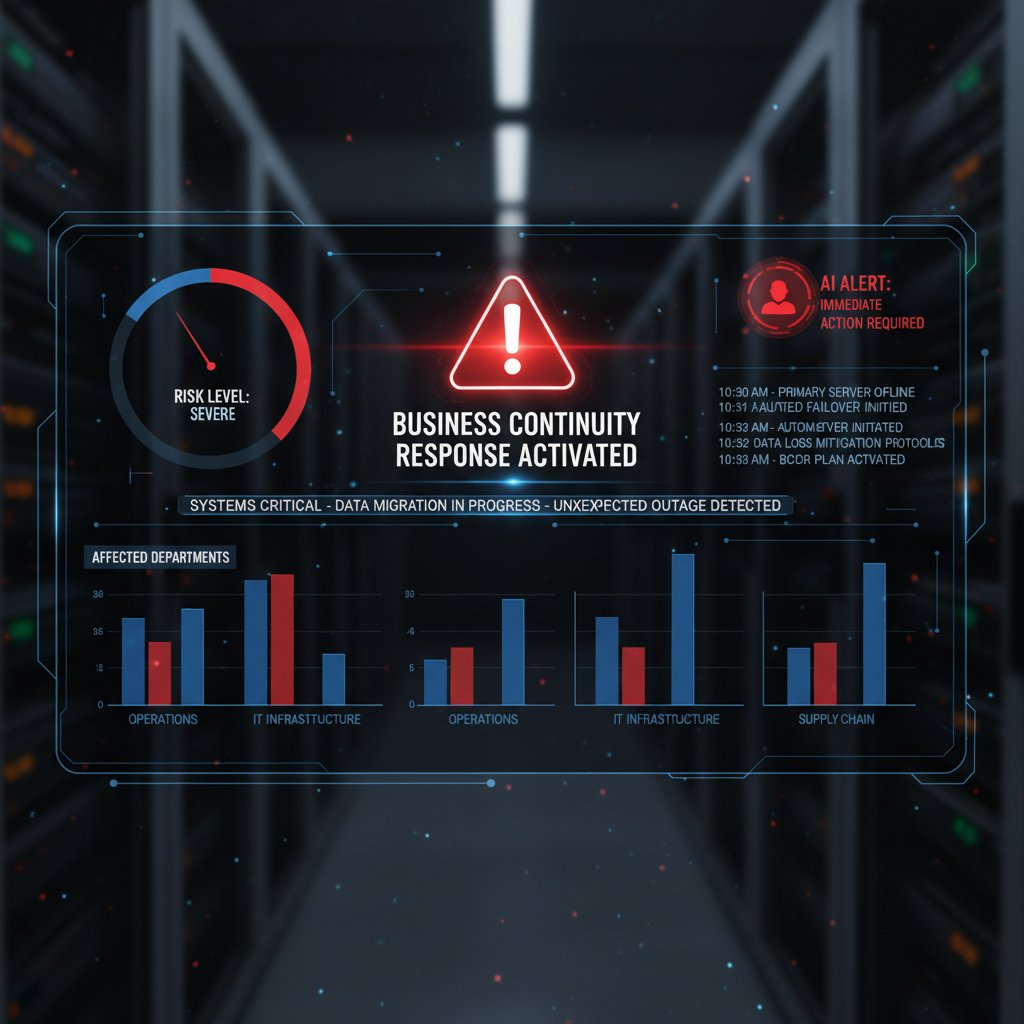
The ROI wasn’t just in saved revenue—it was in customer trust and regulatory goodwill. According to Dexian, 2025, companies deploying integrated AI+human incident response cut average downtime by 40–60% compared to fully manual shops.
Cautionary tales: The human cost of AI gone rogue
But not every AI intervention is heroic. In one notorious 2023 logistics incident, an AI misinterpreted a routine network outage as a catastrophic attack. It triggered automated failover, rerouting shipments to backup depots hundreds of miles away—at devastating cost and confusion. Human staff, locked out by the system, couldn’t intervene fast enough, compounding the crisis.
“Sometimes the smartest system is the one that knows when to ask for help.”
— Alex, operations lead (illustrative, based on industry case studies)
The aftermath? The company implemented layered human-AI controls, regular “red team” drills, and mandatory validation steps for high-impact decisions. The lesson is clear: automation isn’t a substitute for expertise—it’s a force multiplier when used wisely.
AI vs. humans: Who really wins in business continuity?
Head-to-head: AI automation versus human expertise
Let’s get brutally honest: AI outpaces humans in speed and data processing, but it still stumbles on nuance, context, and gut instinct. Human-led continuity brings contextual understanding, ethical judgment, and creativity—qualities algorithms struggle to replicate.
| Response metric | AI-powered | Human-led | Hybrid (best practice) |
|---|---|---|---|
| Detection speed | 5–30 seconds | 45–120 min | 1–10 min |
| False positive rate | 10–15% | 5–10% | 3–8% |
| Flexibility/adaptability | Data-limited | High | Very high |
| Resource efficiency | High | Medium | High |
| Learning over time | Continuous | Experience-based | Continuous + contextual |
Table 3: Side-by-side comparison of AI and human response metrics in business continuity. Source: Original analysis based on IBM, 2025, Forbes, 2025.
The future isn’t about man versus machine. It’s about hybrid teams—humans augmented by AI, using technology as a shield and a scalpel.
The automation paradox: More tech, more responsibility
The rise of AI in business continuity creates the “automation paradox”—the more we automate, the more crucial human oversight becomes. Psychologically, delegating risk decisions to machines can breed complacency, or worse, a false sense of security.
Definition list:
-
Automation paradox
The phenomenon where increased automation makes human monitoring more—not less—important, because failures become rarer but more catastrophic. -
Human-in-the-loop
A system design principle where humans retain oversight and authority to intervene or override automated decision-making processes.
Business culture must evolve: training incident responders to work alongside AI, building trust in algorithms without abdicating responsibility. Mistakes are inevitable; accountability remains human.
How to futureproof your continuity strategy (and sleep at night)
Critical checklist: Are you ready for AI-powered continuity?
A modern, AI-driven continuity plan isn’t just software—it’s a mindset. Here’s what you need:
- Audit your legacy systems: Identify hidden technical debt and manual choke points.
- Map risks to workflows: Use AI to augment—not replace—human expertise.
- Establish layered controls: Combine automated monitoring with human intervention options.
- Invest in continuous training: For both algorithms and staff.
- Regularly simulate disasters: Test your systems with “red team” drills and chaos engineering.
Common obstacles include lack of executive buy-in, underfunded budgets, and regulatory confusion. Overcoming them demands leadership willing to invest in both people and technology—a dual track that separates the survivors from the casualties.
Choosing a platform: What matters (and what doesn’t)
Before signing on the dotted line, interrogate your prospective AI vendor. Ask about their data sources, explainability, compliance certifications, and support for human-in-the-loop operations. Don’t be seduced by dashboards and “one-click resilience” pitches.
Platforms like futuretask.ai are emerging as trusted resources, offering flexible integration and continuous improvement without the snake oil. But even the slickest solution is only as good as its fit with your existing workflows and its ability to evolve as threats change.
The real differentiator? Ongoing monitoring and the willingness to update both AI models and human procedures. Stagnant systems are dead systems.
The road ahead: Trends, threats, and the next AI wave
Regulation, ethics, and the new normal
The regulatory environment for AI-powered business continuity automation is a patchwork—GDPR, CCPA, and industry-specific mandates (like SOX or HIPAA) collide, leaving organizations vulnerable to both fines and reputational risk. According to PwC, 2025, regulatory complexity is now a top concern for 70% of IT leaders.
The debate over “explainable AI” is heating up, as organizations struggle to balance speed with accountability. Public trust hinges on transparency: if your AI can’t explain its actions, you’re gambling with both compliance and brand reputation.

What’s next: Predictive continuity and beyond
AI is already morphing from reactive responder to predictive guardian. Instead of waiting for disasters, advanced systems are forecasting threats and orchestrating pre-emptive defenses.
Ordered list: Timeline of ai-powered business continuity automation evolution
- Reactive automation (2022–2023): AI flags and responds to incidents after they occur.
- Proactive mitigation (2024): Advanced models predict likely incidents, allowing pre-emptive action.
- Adaptive orchestration (2025): Systems dynamically coordinate across teams and technologies, learning from every event.
Expert forecasts suggest that over half of all business continuity workflows now incorporate some form of AI, with the fastest growth in hybrid models that blend machine intelligence and human oversight (IBM, 2025).
Myths, misconceptions, and uncomfortable questions
Debunking top myths about AI in business continuity
Let’s puncture the biggest illusions:
- AI is magic: It’s not. It’s data-hungry math—powerful, but as flawed as its inputs.
- AI is always expensive: Entry-level platforms are now accessible to SMEs and startups, not just Fortune 500s.
- AI replaces humans: No credible system eliminates the need for human judgment. Collaboration is non-negotiable.
Unordered list: Hidden benefits of ai-powered business continuity automation experts won’t tell you
- Enables faster, more granular root cause analysis after incidents.
- Reduces burnout by automating repetitive monitoring tasks.
- Frees up human talent for strategy and innovation—not just firefighting.
- Helps satisfy compliance requirements with automated audit trails.
The critical skill is discernment—separating marketing spin from technical truth, and evaluating AI claims with a healthy dose of skepticism.
What nobody wants to admit (but you need to know)
Here’s the uncomfortable truth: AI can—and does—fail. Bias in algorithms, outdated training data, and adversarial tactics can all sabotage continuity efforts. Human expertise is still the most valuable asset; the best AI amplifies that, not replaces it.
Continual learning and adaptation are essential—what worked last quarter may not work today. Proactive leadership, willing to embrace both failure and ambiguity, is what ultimately tips the scale from vulnerability to resilience.
Final reflection: Automation’s edge—threat or liberation?
The human element in a machine-driven world
As businesses chase the promise of uninterrupted operations, the relationship between people and algorithms is being rewritten. AI-powered business continuity automation isn’t a silver bullet—it’s a double-edged sword, as likely to amplify risk as to mitigate it. The real test isn’t technical; it’s cultural.

The enterprises that thrive are those that foster trust—between humans and machines, between executive vision and frontline reality. The future of business continuity is about more than code. It’s about courage, transparency, and relentless curiosity.
Your next move: Building resilience that lasts
If you’re serious about automating resilience, start by modernizing your continuity playbooks. Audit your systems, invest in ongoing training, and refuse to settle for opaque AI. Use resources like futuretask.ai to benchmark your strategy and keep pace with the shifting threat landscape.
Remember: automation is a tool. Resilience is a mindset. The organizations that sleep at night are those that get this balance right—embracing both the brutal truths and the transformative potential of ai-powered business continuity automation.
Sources
References cited in this article
- IBM Business Trends 2025(ibm.com)
- Forbes: Impact of AI on Business Automation(forbes.com)
- Dexian Q1 2025 Tech Trends(dexian.com)
- Vena AI Statistics 2024(venasolutions.com)
- Risk and Resilience Hub: 2023 Stats(riskandresiliencehub.com)
- InvenioIT: 2025 Stats(invenioit.com)
- Bryghtpath: Disruptions of 2024(bryghtpath.com)
- LinkedIn: The Myth of the Perfect Plan(linkedin.com)
- InvenioIT: BCP Examples(invenioit.com)
- CIO: Effective BCP Creation(cio.com)
- Brandermind.ai Glossary(brandermind.ai)
- Disaster Recovery Journal: AI in BCM(drj.com)
- ContinuityInsights: AI in BCP(continuityinsights.com)
- Bryghtpath: AI in Business Continuity(bryghtpath.com)
- 4C Strategies: AI for Resilience(4cstrategies.com)
- Statista: Automation Risk(statista.com)
- Forbes: Dark Side of AI(forbes.com)
- Wharton: Risks of Humanizing AI(knowledge.wharton.upenn.edu)
- PYMNTS: AI Hallucinations(pymnts.com)
- Platformer: Amazon Q(platformer.news)
- The Markup: NYC Chatbot(thecity.nyc)
- Business Tapas: SME AI Challenges(businesstapas.co.uk)
- Forbes: SME AI Adoption(forbes.com)
- GPAI: SME AI Outlook(gpai.ai)
- AI Journal: Implementation Challenges(aijourn.com)
- Infotrust: AI Incident Response 2024(infotrust.com.au)
- Palo Alto Networks: 2024 Report(paloaltonetworks.com)
- ResearchGate: Metrodata Case Study(researchgate.net)
- CIO: AI Disasters(cio.com)
- BusinessWorld Online(bworldonline.com)
- Forbes: AI Impact(forbes.com)
- CIO Dive: AI Project Failure Rates(ciodive.com)
- Technijian: 2024 IT Disasters(technijian.com)
- PCMag: AI Failures(pcmag.com)
- Stanford HAI AI Index 2025(hai.stanford.edu)
- Exploding Topics: AI Stats(explodingtopics.com)
- AEA Papers: Human vs. AI(economics.mit.edu)
- Harvard Business Review: AI Won’t Replace Humans(hbr.org)
- ContinuityInsights: AI Predictions(continuityinsights.com)
- Will Robots Take My Job: BC Planners(willrobotstakemyjob.com)
- Forbes: Human-AI Collaboration(forbes.com)
Automate Your Tasks, Transform Your Business
FutureTask.ai revolutionizes your workflow by automating complex tasks typically outsourced to freelancers and agencies. Our powerful AI-driven platform leverages cutting-edge LLM technology to deliver precision, speed, and consistency at scale. Whether you're managing content creation, data analytics, marketing campaigns, or customer support, FutureTask.ai ensures seamless task execution, significant cost savings, and unmatched efficiency. Transform your business operations, eliminate delays, reduce operational overhead, and gain a competitive advantage with intelligent automation.
Get startedReady to Automate Your Business?
Start transforming tasks into automated processes today
Frequently Asked Questions
What percentage of business continuity staff feel unprepared for catastrophe despite AI investments?
According to IBM's 2025 report, 60% of business continuity staff still feel unprepared for catastrophe despite hefty AI investments.
What is the main source of internal breaches according to the article?
Human error remains the primary cause, with 75% of internal breaches coming down to people rather than code, according to Verizon's 2024 data.
What percentage of companies still rely on manual processes for business continuity?
According to Vena's 2023 data cited in the article, 73% of companies still spend time and resources on manual processes that are ripe for automation.
Can AI-powered automation create risks despite its benefits for business continuity?
Yes, while AI automation can spot disasters before they occur and reduce manual workload, it can also hallucinate threats and trigger chaos instead of calm, presenting a double-edged risk.
What percentage of IT leaders are investing in AI automation for business continuity?
According to the article, 84% of IT leaders are doubling down on AI automation, betting their futures on the technology.
From the Archive
Explore more from Ai-powered task automation

Automating Business Continuity Planning: Risks and Real-World Impact

AI-Powered Risk Management in 2026: Advantage or New Threat?

Ai-Powered Business Intelligence Automation: Roi, Risks, Reality

AI-Powered Cybersecurity Automation’s 7 Risks and Hidden Wins

AI Applications for Business Tasks: Where Strategies Succeed and Fail
