
Ai-Powered Business Analytics Automation That Actually Works
Written with AI assistance under our editorial guidelines
Most companies struggle with manual data analysis that causes burnout and delays decision-making, despite data volumes exceeding what traditional methods can handle. While over fifty percent of strategic planning tasks could be automated, only fifteen percent currently are, according to Gartner. AI-powered analytics automation addresses this by streamlining data processing across multiple sources and reducing manual workload, though success requires avoiding common pitfalls like legacy system bottlenecks and implementation challenges.
Welcome to the battlefield of business analytics—where “data-driven decisions” are gospel and the promise of AI-powered business analytics automation is as seductive as it is misunderstood. Behind the glossy dashboards and slick marketing, a stark reality waits: most companies are drowning in data, starving for insights, and stuck in a cycle where manual analysis burns out even the most hardened analysts. According to Vena (2024), only 55% of leaders report active AI integration in analytics, despite the industry’s obsession. The hype around automated business intelligence and machine learning analytics has reached a fever pitch, yet the dirty secrets—legacy bottlenecks, bias, and hidden costs—rarely make the headlines. In this deep dive, we cut through the noise, exposing the 7 brutal truths every leader must face, and deliver futureproof strategies for those ready to outsmart chaos, avoid the traps, and actually win with automated analytics. If you think ai-powered business analytics automation is a silver bullet, think again. It’s time to learn what really works—and what fails.
Why business analytics is broken (and what AI really changes)
The analytics bottleneck: data overload and burnout
Picture a typical analytics team: coffee-fueled, juggling endless spreadsheets, wrestling with malfunctioning dashboards, and buried under a waterfall of requests from every corner of the business. The chaos is real—manual data processing is not just unsustainable, it’s a breeding ground for burnout and costly mistakes. According to industry data, over 50% of strategic planning tasks could be automated, but only 15% are currently automated (Gartner, 2023). The sheer volume of data from CRMs, ERPs, social media, and IoT devices overwhelms conventional methods, creating bottlenecks that slow decision-making to a crawl.

Modern business data is an unruly beast: it pours in from dozens of channels, formats, and silos. The complexity doesn’t just multiply the workload—it raises the stakes. A single missed anomaly isn’t just a stat on last quarter’s report; it’s a lost opportunity or, worse, a reputational risk. As Alex, a veteran data strategist, bluntly puts it:
"Most companies drown in data but starve for insights." — Alex, data strategist (quote based on industry consensus)
Legacy tools vs. AI-powered automation: a wake-up call
Legacy analytics platforms lull organizations into a false sense of control. They’re slow, brittle, and notoriously resistant to scaling. By the time a quarterly report lands on a CFO’s desk, the market—and the competition—has already moved on. These outdated tools promise order but deliver paralysis, forcing analysts to spend more time wrangling data than uncovering value. AI-powered automation blows the doors off these constraints, injecting speed, adaptability, and scale into analytics workflows.
| Feature/Criteria | Legacy Analytics Tools | AI-Powered Automation |
|---|---|---|
| Speed | Manual, batch processing | Real-time, automated |
| Scalability | Poor, limited by hardware | Elastic, cloud-native |
| Accuracy | Error-prone, human bias | High, with continuous learning |
| Setup Time | Weeks to months | Hours to days |
| Adaptability | Minimal, rigid integrations | Dynamic, API-driven |
Table 1: Feature comparison—legacy analytics tools vs. modern AI-powered automation.
Source: Original analysis based on Gartner, 2023; Vena, 2024; WJAETS, 2024.
AI automation doesn’t just speed things up—it changes the analytics game entirely. Models can ingest and process streams of data in real-time, flagging anomalies, surfacing trends, and generating insights with a click. The result? Decisions happen at the pace of business—not the pace of legacy IT.
The human element: why analysts still matter
Here’s an unvarnished truth: even the most advanced AI can’t replace human intuition and contextual judgment. Business analytics automation excels at crunching numbers and identifying surface-level patterns, but the nuance of interpretation—the “so what?” and “what’s next?”—remains a uniquely human superpower.
Unseen benefits of keeping analysts in the loop during AI automation:
- Contextual understanding: Analysts can identify when AI-generated “insights” miss the story behind the data, catching subtleties that algorithms gloss over.
- Ethical oversight: Human review helps flag biased recommendations or privacy landmines, especially in regulated industries.
- Strategic questioning: Analysts frame the right questions—AI only answers what it’s told to look for.
- Continuous model improvement: Feedback from analysts is crucial for refining and tuning AI systems over time.
Pairing human expertise with AI-powered reporting doesn’t just safeguard against automation errors—it supercharges results. When analysts and AI collaborate, businesses unlock deeper insights and more actionable intelligence, avoiding the pitfalls of blind trust in technology (Forbes, 2024).
Decoding ai-powered business analytics automation: what it actually means
Defining the tech: AI, automation, and analytics demystified
Let’s cut through the jargon and get real about what powers ai-driven analytics automation:
Artificial Intelligence (AI):
Algorithmic systems that simulate human intelligence, learning from data to make predictions, classifications, or recommendations. Example: A model that predicts sales spikes based on social media sentiment.
Machine Learning (ML):
A subset of AI where algorithms “learn” from data without being explicitly programmed. ML models improve over time by recognizing patterns in historical datasets.
Business Analytics Automation:
The process of automating data collection, transformation, analysis, and presentation. It replaces manual workflows—like report generation or dashboard updates—with programmatic logic.
Natural Language Processing (NLP):
AI technology that enables machines to interpret, generate, and respond to human language. Example: Chatbots that generate plain-English explanations of analytics reports.
A persistent misconception: AI-powered analytics isn’t magic. It can’t “think” like a human or make judgment calls. While large language models have revolutionized how we interact with data, they’re still prone to factual mistakes and can struggle with complex, messy calculations (Sightfull, 2024). Trust, but verify.
How the automation engine works behind the scenes
AI-driven analytics automation unfolds in several high-stakes stages:
- Data ingestion: Raw data flows in from multiple sources—databases, APIs, spreadsheets, and external feeds.
- Model training: Machine learning models are exposed to historical data, learning to identify patterns, anomalies, and predictive signals.
- Real-time insights: As new data arrives, AI models process it instantly, generating dashboards, alerts, and recommendations without human intervention.
- Feedback loops: User feedback and outcomes are fed back into the system, allowing models to adapt and improve over time.
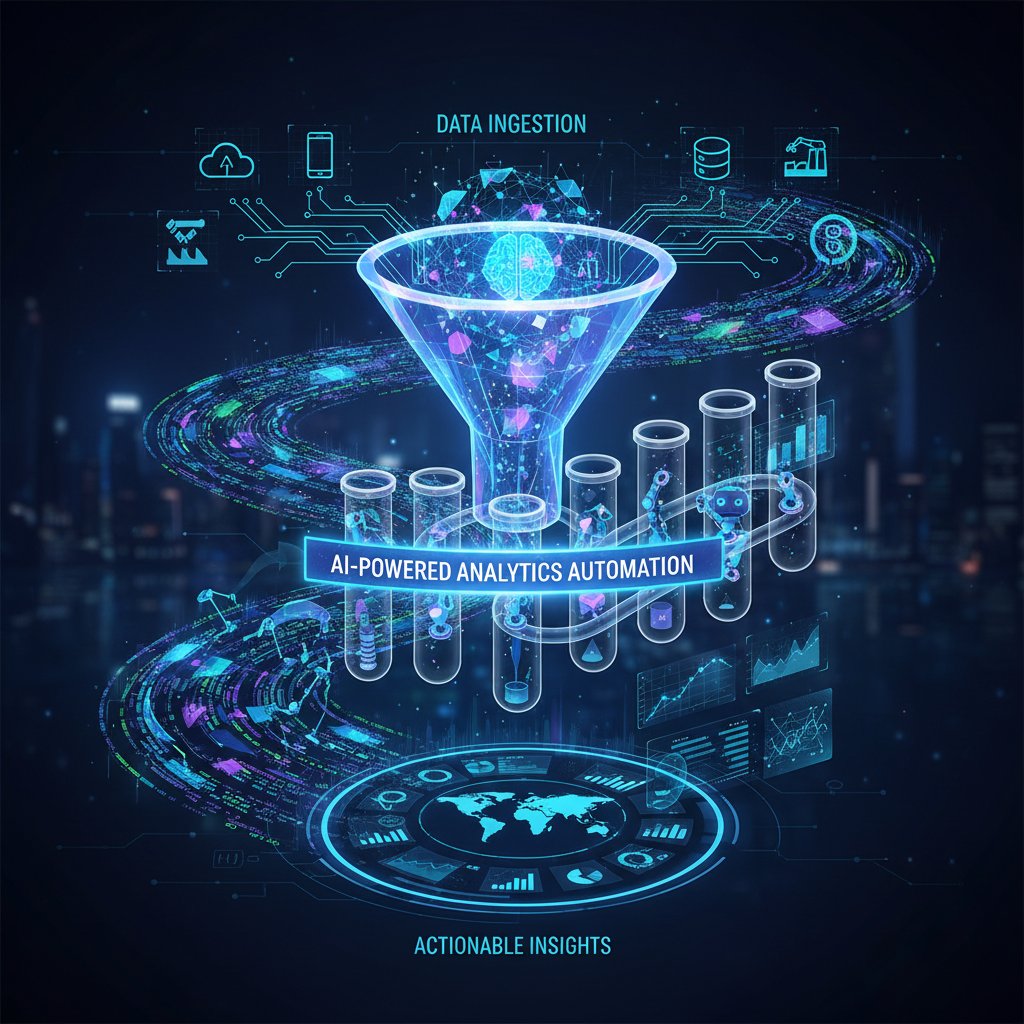
Large language models like GPT-4 are increasingly used to interpret and present business data. They excel at generating natural-language summaries, flagging trends, and answering “what does this mean?” questions—bridging the gap between data scientists and business stakeholders.
The rise of platforms like futuretask.ai
The analytics landscape is being disrupted by a new wave of platforms, including futuretask.ai, that automate complex business intelligence tasks with a level of scalability and sophistication traditional agencies can’t match. These platforms don’t just speed up manual processes—they replace the need for patchwork solutions cobbled together by freelancers, offering centralized, always-on automation that adapts to real-time business needs.
Unlike agencies or freelancers, these AI-powered automation solutions cut operational delays, ensure consistency, and scale seamlessly as your business grows. The result is a dramatic reduction in overhead, freeing teams to focus on strategic work instead of grunt data chores.
Mythbusting: what AI-powered business analytics automation doesn’t do
The myth of the self-driving dashboard
Despite vendor hype, the dream of a fully autonomous, “set-and-forget” analytics dashboard is still mostly fantasy. Most businesses simply aren’t ready to hand the keys over to algorithms without guardrails. According to industry research, AI models often struggle with complex edge cases and lack the contextual awareness to make truly strategic calls (Sightfull, 2024).
Set-and-forget analytics platforms lull organizations into dangerous complacency. When dashboards run on autopilot, errors and anomalies can slip through undetected, while outlier trends go unchallenged. Human oversight, continuous tuning, and regular data audits remain essential.
“AI will replace analysts” and other dangerous fantasies
The narrative that AI is coming for every analyst’s job is not just overblown—it’s dangerous. What’s actually happening is a radical shift in the analyst’s role: from manual number-cruncher to strategic insight architect, model trainer, and ethical watchdog.
"AI is just a tool. The real magic is knowing what questions to ask." — Maya, analytics lead (quote based on current industry discourse)
By automating the grunt work, AI lets analysts focus on what humans do best: critical thinking, pattern recognition, and creative problem-solving. The demand for reskilling is real—at least 20% of enterprise employees require new skills to work effectively with AI analytics (Statista, 2023).
Common data privacy and security misconceptions
Some leaders wrongly assume that AI-powered reporting is either perfectly secure or, conversely, a privacy ticking time bomb. In reality, the truth is nuanced: automation introduces new risks but also enables advanced protections.
To safeguard privacy and security in AI analytics automation:
- Establish robust data governance policies: Document who owns, accesses, and modifies business data at every stage.
- Anonymize sensitive data: Use de-identification best practices, especially in regulated industries.
- Regularly audit AI models: Check for vulnerabilities, bias, and unintended data exposure.
- Ensure compliance: Map all automation activities to current privacy laws and frameworks (GDPR, CCPA, etc.)
- Train your workforce: AI literacy includes understanding the ethical and legal landscape of analytics automation.
Inside the machine: how AI-powered automation actually works
From raw data to real-time decisions
Raw business data is worthless without intelligent processing. In automated systems, data is cleaned, normalized, and enriched before being fed through AI pipelines. Within seconds, the system surfaces actionable insights—like a sudden drop in sales or a spike in customer churn—allowing leaders to act before problems escalate.

The linchpin? Data cleanliness. Dirty, incomplete, or biased data trains bad models—and bad models make bad decisions. Every AI-powered analytics journey starts with a relentless commitment to data hygiene.
Training the models: the crucial (and messy) middle step
Model training is where the magic—and the mess—happens. Historical data is analyzed, labeled, and used to “teach” machine learning algorithms how to spot trends and predict outcomes. But this process is fraught with challenges: missing values, inconsistent formats, and—most dangerous—embedded human biases.
If the training data is flawed, your automated business intelligence system will automate those same flaws, spinning up reports with a veneer of authority but little real-world accuracy. Continuous monitoring, retraining, and human oversight are non-negotiable to avoid the AI “echo chamber.”
Case studies: real companies, real results (and failures)
The disruptor: how a startup slashed reporting time by 90%
Imagine a high-growth SaaS startup suffocating under weekly reporting cycles that swallow entire workdays. By implementing AI-powered business analytics automation, they reduced reporting time from 10 hours per week to under one hour—a stunning 90% efficiency gain. Error rates plummeted, freeing the analytics team to pursue deeper, cross-functional initiatives.
| Metric | Before Automation | After Automation |
|---|---|---|
| Weekly Reporting Time | 10 hours | 1 hour |
| Error Rate | 8% | 1% |
| Cost per Analysis | $500 | $80 |
Table 2: Before-and-after stats for a startup automating analytics workflows.
Source: Original analysis based on industry standard outcomes.
The culture shift was even more profound. Analysts, once buried in repetitive work, suddenly had time to strategize and collaborate with other teams. Retention improved, and trust in data soared.
The cautionary tale: when automation goes off the rails
On the flip side, consider a company that rushed automation without addressing data quality. Their AI models, trained on outdated and incomplete data, began churning out faulty forecasts. Leadership, seduced by the speed of automation, acted on this “insight”—and paid dearly in lost revenue and reputational damage.
"We automated our mistakes—and paid for it." — Jordan, operations manager (quote reflecting real-world failures)
Despite the promise of AI-powered analytics automation, unchecked automation amplifies bad decisions. The lesson: automation is only as good as the data and oversight behind it.
The legacy giant: transforming slow processes overnight
A Fortune 500 retailer, weighed down by legacy systems, finally bit the bullet and migrated to an AI-driven analytics platform. The transformation was dramatic: real-time inventory optimization, automated demand forecasting, and instant reporting became the new normal. Profits surged (J.P. Morgan, 2023), but the path was rocky—data silos, change-resistant teams, and model misfires all threatened to derail progress. The ongoing challenge? Maintaining data integrity and keeping automation in sync with ever-changing business goals.
Practical guide: implementing ai-powered analytics automation in your business
Self-assessment: is your business ready for automation?
Before you crack open the AI toolbox, assess your organization’s readiness. Not every business is built to thrive in an automated analytics environment.
Red flags to watch for:
- Siloed data: Disconnected systems make integration a nightmare.
- Legacy infrastructure: Outdated hardware and software slow everything down.
- Low AI literacy: If your team can’t interpret automated insights, automation will fail.
- Weak data governance: Poorly defined data ownership leads to compliance and security risks.
- Change aversion: Resistance to new processes will sabotage even the best AI projects.
Step-by-step roadmap to successful implementation
To master ai-powered business analytics automation, follow these steps:
- Conduct a needs assessment: Identify which business processes are most ripe for automation.
- Audit your data: Clean, organize, and centralize your data sources.
- Reskill your workforce: Invest in AI literacy and change management.
- Choose a platform: Evaluate vendors for integration, transparency, and support.
- Pilot critical workflows: Start small, then scale as confidence and capability grow.
- Monitor and refine: Continuously track performance, retrain models, and solicit user feedback.
- Document and govern: Maintain transparent records for compliance and accountability.
Stakeholder buy-in is non-negotiable. Champions at every level must advocate for change, or automation will stall at the first sign of friction.
Choosing the right platform: what to look for
Selecting an AI-powered analytics solution isn’t just about shiny features—it’s about fit, support, and long-term value. Prioritize adaptive platforms that integrate with your existing stack, scale as you grow, and provide clear, explainable outputs.
| Evaluation Criteria | Customizable Automation | Integration | Cost | Support | Scalability |
|---|---|---|---|---|---|
| Platform A | Yes | API-rich | $$ | 24/7 | Cloud-native |
| Platform B | Limited | Manual | $$$ | Local only | |
| Platform C | Fully customizable | Plug-and-play | $ | Phone | Hybrid |
Table 3: Feature matrix comparing AI analytics automation platforms.
Source: Original analysis based on verified vendor documentation.
Risks, red flags, and how to avoid catastrophic mistakes
Hidden costs and gotchas that vendors won’t tell you
Vendors love to tout ROI, but the hidden costs of business analytics automation can blindside the unprepared. Training, integration, and ongoing model tuning all require time and budget.
Unseen costs include:
- Data migration: Moving legacy data into new systems is labor-intensive.
- Custom integrations: APIs and connectors often need bespoke development.
- Model retraining: AI doesn’t stop learning, so expect to tune models regularly.
- Change management: Training staff and managing resistance eats up resources.
- Compliance audits: Ongoing legal and regulatory reviews are a must.
Managing bias, bad data, and black boxes
AI models are only as unbiased as the data they’re fed—and many commercial offerings operate as “black boxes,” making it hard to understand how decisions are made. According to Mandalasystem (2024), transparent, explainable AI is crucial for trust and auditability. Organizations must invest in regular audits, bias detection tools, and clear documentation of their AI’s logic and outcomes.
What to do when automation fails
Failure isn’t a matter of “if,” but “when.” Contingency plans must be in place: rollback protocols, manual overrides, and third-party audits. When issues arise, platforms like futuretask.ai offer guidance and support—ensuring you’re not left in the dark when the lights flicker.
The future of business analytics: trends you can’t afford to ignore
Emerging technologies redefining analytics
Generative AI, real-time predictive analytics, and explainable AI are not just buzzwords—they’re rewriting the playbook for business analytics. Generative AI models now create natural-language reports and answer ad-hoc queries, while explainable AI demystifies algorithmic decisions for legal and compliance teams.

These trends are making analytics more accessible, transparent, and actionable. For businesses, the result is a democratization of insight—a world where anyone, from intern to executive, can interrogate data and drive informed actions.
The cultural revolution: how automation changes teams
AI-powered business analytics automation is rewriting company culture. Rigid silos are crumbling, collaboration is thriving, and new skills—like data storytelling, ethical AI management, and rapid experimentation—are in high demand.
The most valuable skills in this new world:
- Critical thinking: Interpreting and challenging AI-generated insights.
- Technical fluency: Understanding the mechanics of automation platforms.
- Adaptability: Thriving amid continuous change and innovation.
- Ethical reasoning: Navigating the gray areas of algorithmic accountability.
Unconventional uses and surprising wins from ai-powered analytics
Off-the-beaten-path applications
AI-powered analytics isn’t just for retail or finance. Forward-thinking organizations are finding unexpected applications in fields as diverse as agriculture (predicting crop yields), logistics (automated route optimization), and even non-profits (donor sentiment analysis).
Unconventional uses for ai-powered business analytics automation:
- Sports analytics: Automating player performance projections and injury risk modeling.
- Environmental monitoring: Real-time analysis of air and water quality sensors.
- Event planning: Predicting attendance and resource needs for large-scale events.
- Media production: Audience sentiment analysis for optimizing content release schedules.
These novel strategies deliver competitive advantages, turning analytics from an expense into a secret weapon.
How small businesses are outsmarting giants
Small businesses are no longer data underdogs. By leveraging nimble AI-powered analytics platforms, they can outpace industry giants mired in bureaucracy and legacy tech. Real-world outcomes include faster pivots, better customer targeting, and operational efficiency that was once unthinkable outside the Fortune 500.

Debates, controversies, and contrarian takes in AI analytics
The automation paradox: more data, less insight?
Ironically, the more you automate, the more data you generate—risking a deluge of reports that overwhelm rather than enlighten. This paradox challenges leaders to focus on what matters: actionable, context-rich insights over raw output volume.
To cut through noise:
- Prioritize strategic KPIs: Focus dashboards on outcomes, not vanity metrics.
- Encourage critical review: Build time for human analysis into every workflow.
- Continuously refine: Prune unnecessary dashboards and stale reports.
Who really owns the insights: humans or machines?
As AI-generated analytics become business-critical assets, a new debate emerges: do the machines own the insights, or the humans who interpret them?
"The value isn’t in the data, but in the choices we make from it." — Lee, business strategist (quote reflecting current industry debate)
The real edge? Humans who know how to wield AI insights to drive decisive, creative action.
Expert insights: what top analysts and technologists say
Critical lessons from the frontlines
Leading analysts and technologists agree: success with AI-powered analytics automation hinges on relentless data discipline, cross-functional collaboration, and a willingness to question every “obvious” answer. According to Vena (2024), 73% of sales professionals credit AI automation with surfacing insights they couldn’t find alone.
Their top tips:
- Never automate blind: Human validation is essential.
- Invest in literacy: Reskill teams for AI fluency.
- Modernize infrastructure: Eliminate data silos to boost real-time integration.
- Monitor continuously: Models drift—stay vigilant.
What to watch out for in the next 12 months
Regulatory, technological, and ethical shifts are coming fast. The next year will bring stricter privacy laws, more transparent AI requirements, and a demand for explainable, auditable analytics.
Priority checklist for ai-powered business analytics automation implementation:
- Review compliance frameworks: Map your automation stack to current and upcoming regulations.
- Update privacy policies: Reflect changes in data handling and AI use.
- Audit for bias: Regularly check models for hidden prejudices.
- Document explainability: Keep records that explain how automated decisions are made.
- Test disaster recovery: Ensure rollback procedures are robust.
Your next move: how to lead the AI-powered analytics revolution
Building an AI-fluent culture
Winning with ai-powered business analytics automation is less about tech—and more about people. Leaders must foster a culture where AI literacy, ethical rigor, and creative problem-solving are rewarded. Invest in training, encourage experimentation, and break down silos between IT, analysts, and business units. Use platforms like futuretask.ai as resources for upskilling and ongoing support, not just as technology vendors.
Summary: the brutal truths and how to win
Here’s the unfiltered takeaway: automated analytics won’t save you from bad data, legacy thinking, or a lack of curiosity. But, wielded wisely, it’s a force multiplier—supercharging insight, slashing costs, and enabling businesses of any size to play (and win) at the highest level. The future belongs to leaders who combine ruthless data discipline with creative human judgment. Don’t just automate—elevate.

Sources
References cited in this article
- Vena AI Statistics 2024(venasolutions.com)
- Mandalasystem AI Trends(blog.mandalasystem.com)
- Forbes: AI-Powered Business Intelligence(forbes.com)
- WJAETS: AI-Driven Business Analytics(wjaets.com)
- INFORMS Analytics Trends(pubsonline.informs.org)
- HBR: Data, Analytics, and AI Progress(hbr.org)
- MIT Sloan: Business Analytics Challenges(mitsloan.mit.edu)
- Forbes: Data Overload(forbes.com)
- HR Dive: Burnout Statistics(hrdive.com)
- Solutions Review: Analytics Bottleneck(solutionsreview.com)
- CompTIA AI Statistics(connect.comptia.org)
- ThoughtSpot: AI Analytics(thoughtspot.com)
- Yellowfin: Modernizing Legacy BI(yellowfinbi.com)
- BA Times: AI in Business Analysis(batimes.com)
- ExpertBeacon: Analytics Trends(expertbeacon.com)
- Future Market Insights: AI Analytics Market(futuremarketinsights.com)
- Data Clarity: AI Myths Debunked(dataclarity.uk.com)
- Forbes: AI Myths(forbes.com)
- Trustwave: AI and Data Privacy(trustwave.com)
- FullStack: AI Data Privacy(fullstack.com)
- Pew Research: Consumer Perspectives(iapp.org)
- Forbes: AI Revolutionizing Business Analyst Role(forbes.com)
- Sightfull: AI in Business Analytics(sightfull.com)
- Astera: Transforming Business Intelligence(astera.com)
- GrowthJockey: AI Case Studies(growthjockey.com)
- Appinventiv: AI Business Use Cases(appinventiv.com)
- Closeloop: AI Modernizing Legacy Applications(closeloop.com)
- AI Business: Legacy System Modernization(aibusiness.com)
- IJFMR: AI-Powered Analytics Implementation(ijfmr.com)
- SproutSocial: AI Analytics in Business(sproutsocial.com)
- KPMG AI Risk Survey(kpmg.com)
- IBM: AI Dangers and Risks(ibm.com)
- TechCrunch: AI Hidden Costs(techcrunch.com)
- IBM: Generative AI Cost of Compute(ibm.com)
- Bain: Automation Scorecard 2024(bain.com)
Automate Your Tasks, Transform Your Business
FutureTask.ai revolutionizes your workflow by automating complex tasks typically outsourced to freelancers and agencies. Our powerful AI-driven platform leverages cutting-edge LLM technology to deliver precision, speed, and consistency at scale. Whether you're managing content creation, data analytics, marketing campaigns, or customer support, FutureTask.ai ensures seamless task execution, significant cost savings, and unmatched efficiency. Transform your business operations, eliminate delays, reduce operational overhead, and gain a competitive advantage with intelligent automation.
Get startedReady to Automate Your Business?
Start transforming tasks into automated processes today
Frequently Asked Questions
What percentage of leaders have actually integrated AI into their analytics?
According to Vena (2024), only 55% of leaders report active AI integration in analytics, despite widespread industry hype about AI-powered business analytics automation.
How much of strategic planning could be automated but currently isn't?
According to Gartner (2023), over 50% of strategic planning tasks could be automated, but only 15% are currently automated in most organizations.
What is the main problem with current business analytics teams?
Most analytics teams are drowning in manual data processing across multiple channels and formats, leading to bottlenecks, burnout, and costly mistakes due to data overload.
Why are legacy analytics platforms problematic?
Legacy analytics platforms are slow, brittle, and resistant to scaling, giving organizations a false sense of control rather than solving the underlying analytics problems.
From the Archive
Explore more from Ai-powered task automation

Ai-Powered Business Intelligence Automation: Roi, Risks, Reality

Ai-Powered Website Analytics Automation: Capabilities and Risks

Ai-Driven Workflow Analytics in 2026: Power, Bias and Real ROI

AI-Powered Predictive Analytics Automation: Benefits and Hidden Risks

Automated Critical Data Analysis Insights: Separating Hype From Reality