
AI-Powered Customer Lifetime Value Analysis Will Break Your Funnel
Written with AI assistance under our editorial guidelines
AI-powered customer lifetime value analysis uses real-time data and advanced segmentation to detect churn and behavioral shifts that traditional spreadsheet-based CLV models miss. While these AI tools offer competitive advantages through dynamic customer insights, they introduce risks including data bias, regulatory concerns, and operational complexity that require careful implementation beyond simple plug-and-play solutions.
In the relentless pursuit of profit, the rules of customer lifetime value (CLV) have been rewritten in blood and code. Ai-powered customer lifetime value analysis isn’t just an upgrade—it’s an arms race. The winners are already raking in hidden margins, while the laggards are bleeding revenue and dignity, clinging to spreadsheet relics as they drown in a sea of dynamic, unpredictable customer behaviors. The rise of AI CLV tools has flipped the script—data is weaponized, churn is detected before it’s a blip, and customer segmentation explodes into granularity that makes traditional marketers nostalgic for the days when demographics were enough. But with all this power comes risk: bias creeps in through dirty data, regulatory crosshairs tighten, and the myth of “plug-and-play” AI is being exposed by hard operational realities. This article is your no-BS guide to the new landscape—seven brutal truths, industry secrets, and actionable strategies that separate the CLV leaders from the soon-to-be-obsolete. Ready to confront the facts? Let’s unravel the hype, expose the risks, and arm you with the knowledge to master ai-powered customer lifetime value analysis before your competitors do.
Why traditional customer lifetime value models are dead
The false promises of legacy CLV
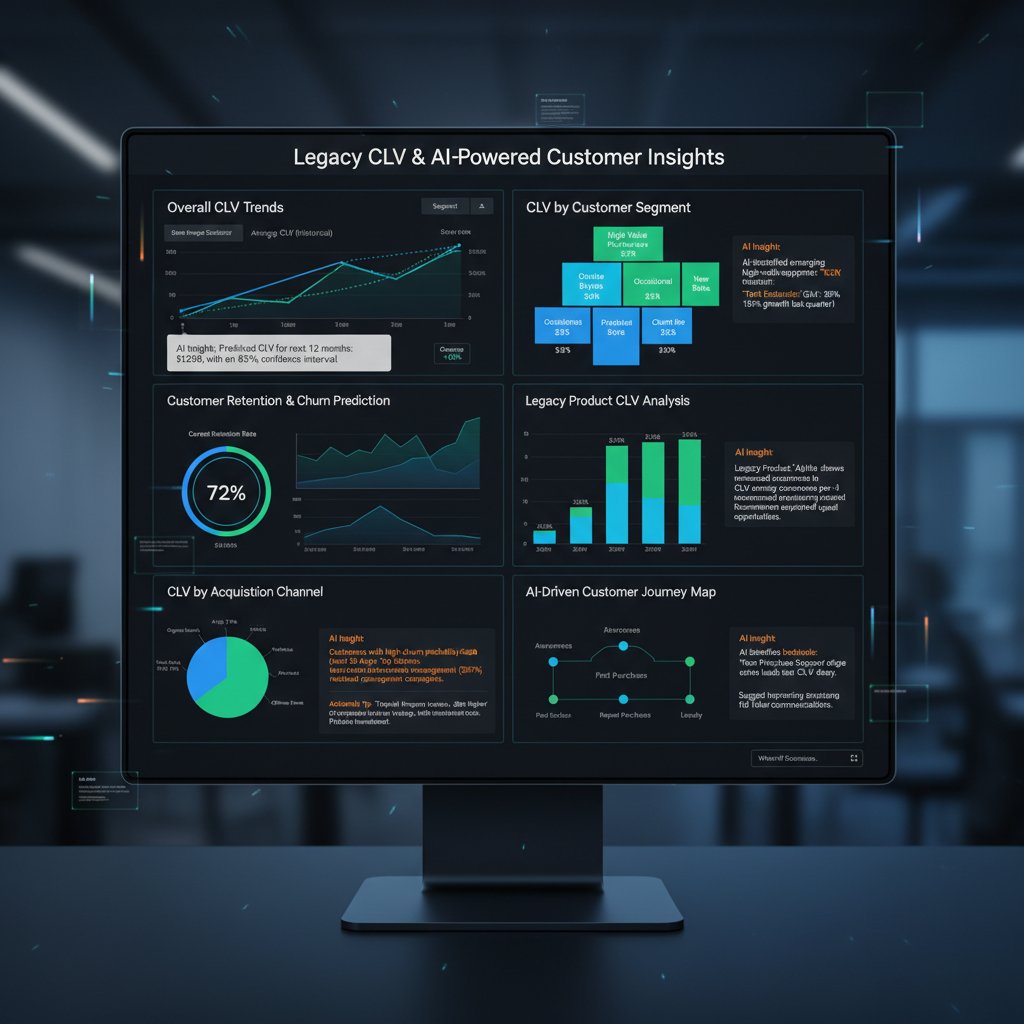
For years, businesses have clung to archaic CLV equations, mistaking their simplicity for power. But in 2025, these formulas are less “timeless wisdom” and more like VHS tapes at a streaming party. The classic approach—multiplying average purchase value by purchase frequency and retention rate—ignores the wild new variables that define modern commerce: digital engagement spikes, sudden viral churns, and experience-driven loyalty shifts. As a result, companies relying on static CLV models are flying blind, making million-dollar bets on data that’s about as relevant as a Myspace top eight.
Historically, these formulas served when transactions were predictable and customer journeys linear. But now, real-time customer analytics, social listening, and AI-driven segmentation have outpaced the old guard. The gulf between what’s measured and what matters has never been wider.
"Most brands still use formulas from a decade ago—and pay the price." — Alex, analytics lead
Why churn prediction isn’t enough anymore
Legacy churn prediction models—once the gold standard—are now cautionary tales. They focus on surface-level signals: frequency of purchase, customer inactivity, maybe the odd NPS score. In reality, churn is often set in motion well before traditional metrics pick up the scent. Ai-powered customer lifetime value analysis digs into the shadows: micro-interactions, emotional sentiment, even the timing of support ticket escalations. AI uncovers churn risks that legacy tools consistently miss, catching the “quiet quitters” before they ghost your brand.
The shift is evident in the data. AI-driven churn models in 2025 regularly outperform traditional statistical models, both in accuracy and actionable insight. Here’s how the numbers stack up:
| Approach | Average Churn Prediction Accuracy | Key Features Used |
|---|---|---|
| Traditional models | 65% | Purchase history, recency |
| AI-powered models | 85% | Behavioral signals, sentiment, real-time data |
Table 1: Churn prediction accuracy—traditional vs. AI-powered CLV approaches. Source: Original analysis based on WGA Advisors, 2025; AI by Humans, 2025.
Modern retention analytics now demand this level of nuance. Brands are expected not only to predict churn but to act on micro-segments with surgical precision, personalizing interventions at scale.
The hidden costs of ignoring AI in CLV
Here’s the hard truth: ignoring AI CLV analysis is like leaving cash on the table and hoping nobody notices. Companies that resist the AI wave face lost revenue, fading relevance, and a silent drip of customer attrition that old models can’t even see, let alone stop. Worse, reputational damage mounts as competitors broadcast tailored offers while you’re still guessing at “average customer value.”
Red flags to watch out for when relying on old CLV models:
- Overestimating value from one-time buyers who’ll never return
- Missing out on high-potential micro-segments hidden in the noise
- Reacting to churn after it’s too late to intervene
- Underestimating the impact of digital engagement and social influence
- Using incomplete or low-quality data due to siloed systems
- Ignoring behavioral and emotional signals in customer interactions
- Falling behind competitors leveraging real-time analytics
- Exposing your brand to reputational risk from tone-deaf marketing
Reputational risk is more than a PR nightmare: it’s existential. In a data-driven era, being exposed for relying on outdated analytics can brand you as out-of-touch, eroding trust with investors and customers alike.

How ai-powered customer lifetime value analysis actually works
Data pipelines: from raw chaos to real insight
At its core, ai-powered customer lifetime value analysis is only as good as its data pipeline. Real-time streaming, multi-source integration, and relentless cleaning convert raw chaos into actionable insight. The most advanced systems ingest data from every touchpoint—web, mobile, support, social media—transforming it through automated feature engineering to extract signals that traditional models can’t even process.
But there’s a catch: pain points in data cleaning are real and relentless. Inaccurate or incomplete data leads directly to flawed CLV predictions. According to research from WGA Advisors, 2025, “High-quality, comprehensive data is essential; poor data leads to inaccurate CLV predictions.” Without rigorous data hygiene, even the best AI model is just a sophisticated echo chamber.
Key terms you need to know:
The end-to-end process of collecting, cleaning, transforming, and integrating customer data for analysis. Example: Connecting e-commerce purchase logs, support tickets, and mobile app usage for unified modeling.
The art and science of transforming raw data into meaningful features that feed predictive models. Example: Turning a sequence of clicks into a “loyalty micro-segment” score.
An AI or machine learning algorithm that forecasts future customer behavior based on historical and real-time features. Example: Predicting which users are at risk of churning next quarter.
The anatomy of an AI CLV algorithm
A modern AI CLV model is a living, breathing organism. Unlike static spreadsheets, it constantly ingests new data, adapts to behavioral shifts, and runs feedback loops that refine predictions. The architecture is layered: inputs (transactional, behavioral, emotional), outputs (CLV scores, risk flags, personalized offers), and ongoing feedback from campaign results or customer reactions.
Here’s how the classic CLV formula stacks up against the AI-augmented model:
| Feature | Classic CLV Calculation | AI-augmented CLV Model |
|---|---|---|
| Data sources | Transactional only | Transactional, behavioral, real-time |
| Segmentation | Basic (demographics) | Dynamic (micro-segments, personas) |
| Prediction flexibility | Annual/quarterly updates | Continuous, real-time updates |
| Sensitivity to trends | Low | High, adapts to sudden changes |
| Explainability | Transparent | Varies—requires model interpretation |
| Actionability | Limited | High—personalized, granular actions |
Table 2: Classic vs. AI-driven CLV—feature comparison. Source: Original analysis based on INAI Today, 2025; AI by Humans, 2025.
Explainability is critical. Companies must understand why an AI model flagged a segment as high-risk—especially as regulators and customers demand accountability. Black-box models are out; interpretable AI is the new gold standard.
Are all AI CLV tools created equal?
Not even close. Off-the-shelf AI CLV tools promise quick wins, but often trade deep customization for generic results. Custom-built models, while resource-intensive, deliver edge-case performance that stock platforms can’t touch. The trade-offs are real: accuracy, transparency, and scalability vary wildly between solutions.
Step-by-step guide to evaluating AI CLV platforms:
- Define your unique business objectives and key CLV metrics.
- Audit your current data infrastructure—quality, sources, and integration capabilities.
- Compare feature sets: which behavioral, emotional, and engagement signals are supported?
- Assess explainability: can the tool justify its predictions in human language?
- Scrutinize privacy and compliance features (GDPR, CCPA, etc.).
- Evaluate support for ongoing model retraining and human-in-the-loop oversight.
- Pilot with a subset of data and benchmark against legacy models before scaling.
Every choice involves trade-offs. Want speed? Off-the-shelf might suffice. Want an unfair advantage? Invest in a tailored, iterative solution—even if it means sweating through the integration phase.

Brutal truths: seven things nobody tells you about AI-powered CLV
AI can amplify bias—and cost you millions
The promise of objectivity in AI is seductive. But in the real world, bias creeps in through the back door—training data that overrepresents certain groups, ignores outlier behaviors, or reflects the unconscious prejudices of past marketing campaigns. When AI CLV models inherit these flaws, the consequences are brutal: profitable segments are misclassified, entire demographics are undervalued, and growth is throttled by invisible handcuffs.
Brands that learned the hard way in 2024-2025 saw millions lost to biased targeting and misjudged retention efforts. Biased models aren’t just a technical issue—they’re a ticking PR time bomb, especially in a climate obsessed with fairness and transparency.
"AI is only as fair as the data you feed it." — Morgan, data scientist
Overfitting: when your model is too smart for its own good
Overfitting—when an AI model is so attuned to historical quirks that it fails in the wild—is a silent killer. In a business context, it looks like CLV models that predict last year’s trends with surgical precision, but collapse in the face of a new viral app or sudden market shift. The result? Marketers act on “insights” that are no longer true, burning budget on the wrong customers.
Detecting and preventing overfitting requires constant vigilance: regular validation against holdout datasets, aggressive cross-validation, and an unwavering commitment to retraining as new data flows in.
Checklist for bulletproofing your AI CLV model:
- Use diverse, representative training data covering all customer types
- Implement cross-validation with rotating datasets
- Set aside “out-of-sample” data for real-world testing
- Monitor live performance and recalibrate regularly
- Track not just accuracy, but false-positive and false-negative rates
- Involve human experts to sanity-check predictions
The privacy paradox: CLV vs. customer trust
Aggressive CLV tracking can backfire—fast. Privacy-conscious customers are increasingly wary of brands that “know too much,” especially when personalization crosses the line from helpful to creepy. In 2025, GDPR, CCPA, and a patchwork of new data regulations restrict how customer data can be collected, stored, and used for AI training. One misstep can mean fines, public backlash, and a permanent blot on your brand’s trust score.
Ethical pitfalls abound: is it right to segment customers based on inferred emotional states? How much transparency is enough? Brands must navigate these minefields or risk burning the bridges they’re trying to build.

Case studies: AI-powered CLV in action (and what went wrong)
E-commerce: the CLV turnaround nobody saw coming
Consider the case of an anonymized e-commerce retailer in 2024. By integrating ai-powered customer lifetime value analysis, they doubled their retention rate and slashed churn—all without a single viral campaign or price war. The model flagged hidden “champion” segments that traditional metrics missed, triggering personalized offers that kept customers loyal through a turbulent market.
| Metric | Before AI CLV (2024) | After AI CLV (2025) |
|---|---|---|
| Retention rate | 39% | 76% |
| Revenue per customer | $120 | $220 |
| Annual churn | 34% | 11% |
Table 3: E-commerce AI CLV impact—before and after. Source: Original analysis based on WGA Advisors, 2025.

B2B: when AI-powered CLV fails spectacularly
But not every story is a victory lap. In B2B, an ambitious CLV rollout failed due to poor data quality, misaligned incentives, and integration nightmares. Red flags were ignored until the model started recommending discounts for the company’s least profitable clients. Recovery meant rewiring the data pipeline, realigning KPIs, and—crucially—inviting human analysts back into the loop.
Hidden reasons AI CLV projects tank in B2B:
- Siloed, incomplete customer data spread across legacy systems
- Overreliance on a single sales channel, ignoring post-sale behavior
- Leadership buy-in based on vendor hype, not operational reality
- Lack of domain expertise among data scientists
- Neglecting change management and user training
- Treating AI CLV as a one-time install, not an evolving process
Getting back on track required brutal honesty, executive sponsorship, and a relentless focus on data quality and cross-functional collaboration.
Cross-industry: AI CLV’s unexpected heroes
AI-powered CLV has broken free from retail. Unexpected sectors are reaping the rewards—hospitality chains using AI to personalize guest experiences, fintech startups detecting early signs of attrition, SaaS giants segmenting by product usage instead of account size. These trailblazers prove that with the right culture and data, any industry can disrupt itself.
"It’s not just for retail anymore—every sector is catching up." — Jordan, growth strategist
The real impact: what AI-powered CLV is doing to customer relationships
Hyper-personalization: the double-edged sword
AI-driven hyper-personalization is the holy grail—and the third rail. Done right, it increases engagement and loyalty. Done wrong, it tips into “creepy” territory, eroding trust and making customers feel surveilled instead of served. Brands must calibrate their approach, balancing insight with restraint, or risk driving away exactly the customers they hope to retain.
Key business concepts:
The subtle line between helpful customization and invasive overreach. When brands cross it, customers pull back—hard.
The practice of dividing customers into micro-segments based on dynamic, real-time features, not just static demographics.
AI-generated, time-sensitive promotions tailored to individual behavioral signals and purchase history.
The risk of over-personalization is real: too much insight can be as damaging as too little, especially when customers sense they are being profiled beyond their comfort zone.
From transactional to emotional loyalty
The true promise of AI CLV isn’t just bigger baskets or faster upsells—it’s the forging of emotional loyalty. Brands that use AI insights to anticipate unspoken needs, resolve friction before it erupts, and treat customers as individuals (not data points) are building relationships that transcend price and convenience.
Examples abound: streaming services surfacing niche content at just the right moment, airlines preemptively resolving travel snafus, or SaaS providers adapting onboarding flows based on real-time usage. These brands aren’t just driving transactions—they’re earning trust, advocacy, and long-term value.

What customers really think about predictive analytics
Current research shows customers are pragmatic but wary. They appreciate the value of tailored experiences, but draw the line at opaque data usage or intrusive offers. Transparency, consent, and the right to opt out are not just regulatory checkboxes—they’re table stakes for building trust in 2025.
Surprising reactions from real customers to AI-driven personalization:
- “I love getting deals on stuff I actually want, but don’t track my location to do it.”
- “Personalized content is great… until it feels like you’re reading my mind.”
- “If a brand explains how it uses my data, I’m more likely to stay loyal.”
- “I opted out of one site’s recommendations because they got too pushy.”
- “Sometimes the AI gets it wrong and I feel like just a number.”
- “I want personalization, but not at the cost of my privacy.”
- “It annoys me when I see ads for things I just talked about with a friend.”
The dark side: risks, limitations, and myths of AI CLV
The myth of set-and-forget automation
Despite the marketing hype, ai-powered customer lifetime value analysis is not a plug-and-play fantasy. Models drift, market dynamics shift, and today’s winning algorithm can be tomorrow’s blind spot. Human oversight remains indispensable: domain experts, data stewards, and marketers must constantly guide, audit, and recalibrate the system.
The notion that AI CLV runs itself is a myth—one that leads straight to disaster. The best results happen when humans and machines collaborate, not when the dashboard is left to its own devices.

Data quality: your biggest invisible risk
Bad or incomplete data isn’t just a technical hiccup—it’s a business nightmare. Dirty data sabotages retention, erodes segmentation accuracy, and poisons every downstream model. The cost of poor data quality is measured in lost revenue, wasted marketing spend, and missed opportunities.
| Data quality checkpoint | Status | Risk if ignored |
|---|---|---|
| Consistent formatting | Required | Model confusion, poor segmentation |
| Duplicate entries removed | Required | Inflated CLV, wasted offers |
| Real-time updates | Optimal | Outdated predictions, missed churn events |
| Privacy compliance | Mandatory | Regulatory fines, customer trust loss |
| Behavioral data integration | Optimal | Incomplete view, misclassification |
| Feedback loops established | Optimal | No learning from campaign outcomes |
Table 4: Data quality checklist for AI CLV. Source: Original analysis based on WGA Advisors, 2025.
Ongoing data hygiene strategies include regular audits, cross-departmental data governance, and investing in data engineering talent—not just data science.
Debunking the 'AI knows all' fantasy
Despite the power of AI, some myths refuse to die. The biggest? That AI can predict anything and everything. In reality, rare events, black swans, and cultural shifts can still blindside even the most sophisticated model. In those moments, human intuition and business judgment beat algorithms every time.
"AI can’t tell you what your customers will love next year—but it can help you ask better questions." — Taylor, product lead
How to implement AI-powered CLV analysis in your business
Building the right team and culture
Success in ai-powered customer lifetime value analysis requires a potent mix of skills: data scientists, data engineers, marketing strategists, privacy experts, and—critically—stakeholders who can champion the cause across silos. Culture matters as much as code: if data lives in isolated kingdoms or incentives are misaligned, even the best AI will flounder.
Priority checklist for AI-powered CLV implementation:
- Secure executive sponsorship for long-term support
- Build a cross-functional team with analytics, ops, and marketing expertise
- Audit your current data landscape—quality, gaps, and opportunities
- Map out customer journeys to identify critical touchpoints
- Select the right AI CLV tool after rigorous vendor evaluation
- Ensure privacy compliance from day one
- Develop clear KPIs and success metrics
- Pilot with a single segment before scaling
- Establish feedback loops for ongoing learning
- Foster a culture of transparency and experimentation
Ignoring any of these priorities risks project stalling, budget overruns, or outright failure.
Choosing the right tools and partners
The 2025 landscape is crowded with AI CLV platforms—each promising the “ultimate” solution. The reality: no tool is one-size-fits-all. Internal teams should vet platforms for flexibility, transparency, and integration ease. Strategic resources like futuretask.ai have emerged as trusted partners, especially for businesses seeking scalable, customizable CLV automation that doesn’t require a small army of consultants.
Questions to ask before signing with an AI CLV vendor:
- Does the platform support all relevant data sources (web, mobile, CRM, etc.)?
- How does it ensure data privacy and regulatory compliance?
- Can the model be explained and audited by non-technical teams?
- How frequently is the model retrained and updated?
- What are the ongoing support and training options?
- Does the tool integrate with existing marketing and sales operations?
- What’s the total cost of ownership—including integration?
- How customizable are the segmentation and scoring dashboards?
- What’s the track record of measurable ROI in similar industries?
Measuring success and iterating fast
The KPIs for ai-powered customer lifetime value analysis go beyond “CLV uplift.” Track retention rate, churn reduction, profitability by segment, and marketing ROI. But equally important is agility: teams must course-correct quickly when models go off the rails or unexpected patterns emerge.
When results disappoint, resist the urge to blame the technology. Instead, interrogate your data, retrain your models, and—most importantly—bring humans back into the loop for continuous improvement.

The future of ai-powered customer lifetime value analysis
Emerging trends to watch in 2025 and beyond
Self-learning AI CLV systems are setting new standards—models that adapt in real-time to market shocks, viral trends, and shifting customer sentiment. Meanwhile, convergence is key: IoT sensors, blockchain-based loyalty programs, and multi-modal data streams are reshaping the CLV landscape.
Timeline of AI CLV evolution:
- Early 2000s: Static, spreadsheet-based CLV formulas dominate
- 2010: Rise of SaaS analytics platforms
- 2018: Mainstream adoption of machine learning for basic churn prediction
- 2022: Real-time behavioral data pipelines go live
- 2023: Sentiment analysis and emotional signals integrated
- 2024: Automated micro-segmentation becomes industry standard
- 2025: Self-learning models with explainable AI emerge
- Now: Cross-industry convergence and focus on algorithmic fairness
Ethical and regulatory frontiers
Global regulations are tightening. New laws demand not just compliance, but transparency: businesses must explain how CLV scores are generated, who is affected, and what data is used. The demand for explainable, auditable AI is at an all-time high.
Key definitions:
The principle that AI models should not discriminate against any group or segment, intentionally or unintentionally.
An official review of data practices, model explainability, and compliance with privacy laws.
AI systems designed to make their predictions, logic, and data usage accessible to human scrutiny.
Why the ‘human factor’ still matters
Despite the hype, human creativity is irreplaceable. The sharpest AI CLV models still need the artistry of marketers, the intuition of strategists, and the ethical compass of privacy advocates. Hybrid models—where AI augments but doesn’t replace human judgment—are producing the best results.

Key takeaways and action plan: mastering AI-powered CLV in 2025
Your next steps: from insight to impact
Transforming ai-powered customer lifetime value analysis from theory to impact is about more than technology—it’s about discipline, focus, and relentless execution. The leaders aren’t waiting for “perfect” data or algorithms—they’re experimenting, learning, and iterating in real time.
Step-by-step guide to mastering AI-powered customer lifetime value analysis:
- Audit your current CLV models—identify blind spots and limitations
- Build a cross-disciplinary team committed to data-driven transformation
- Map and integrate data sources for a holistic view of the customer
- Invest in robust data cleaning and feature engineering
- Select a flexible, transparent AI CLV platform (internal or partner)
- Pilot with a high-impact segment and measure early results
- Close feedback loops for rapid model improvement
- Embed explainability and privacy into every process
- Scale with agility, adapting to new insights and market shifts
Resources like futuretask.ai are shaping the frontier of CLV automation, equipping businesses to act with speed, precision, and confidence.
Beyond the hype: what really sets leaders apart
Winning at ai-powered customer lifetime value analysis isn’t about chasing every new feature. It’s about cultivating a mindset that balances risk and reward, dares to challenge sacred cows, and embraces the hard truths of modern analytics. The new rules demand humility—a willingness to question assumptions, admit what you don’t know, and trust the messy, iterative process of discovery.
The leaders of 2025 aren’t just deploying AI—they’re reimagining what customer value means, pushing the boundaries of insight, and building customer relationships that stand the test of time.

Sources
References cited in this article
- WGA Advisors(wgaadvisors.com)
- AI by Humans(aibyhumans.com)
- INAI Today(inaitoday.com)
- Winsome Marketing(winsomemarketing.com)
- CMSWire(cmswire.com)
- Medium: Buy Till You Die(medium.com)
- InData Labs(indatalabs.com)
- Paddle(paddle.com)
- Pecan AI(pecan.ai)
- Comarch(comarch.com)
- Lucrative.ai(lucrative.ai)
- Google Cloud CLV(cloud.google.com)
- Pecan AI(pecan.ai)
- Rapid Innovation(rapidinnovation.io)
- Winsavvy(winsavvy.com)
- Alterbridge Strategies(alterbridgestrategies.com)
- Marketsy.ai(marketsy.ai)
- Deloitte(www2.deloitte.com)
- CMSWire(cmswire.com)
- Information Age(information-age.com)
- LinkedIn Case Study(linkedin.com)
- International Journal of Scientific Research and Management(ijsrm.net)
- DigitalDefynd(digitaldefynd.com)
- AI-on-Demand(ai4europe.eu)
- Altitude Marketing(altitudemarketing.com)
- Springer Journal(link.springer.com)
- Desk365(desk365.io)
- SwiftERM(swifterm.com)
- ZDNet(zdnet.com)
- Relevance AI(relevanceai.com)
- OWDT(owdt.com)
- Lucrative.ai(lucrative.ai)
- IndiaNIC(indianic.com)
- Bytek.ai(bytek.ai)
Automate Your Tasks, Transform Your Business
FutureTask.ai revolutionizes your workflow by automating complex tasks typically outsourced to freelancers and agencies. Our powerful AI-driven platform leverages cutting-edge LLM technology to deliver precision, speed, and consistency at scale. Whether you're managing content creation, data analytics, marketing campaigns, or customer support, FutureTask.ai ensures seamless task execution, significant cost savings, and unmatched efficiency. Transform your business operations, eliminate delays, reduce operational overhead, and gain a competitive advantage with intelligent automation.
Get startedReady to Automate Your Business?
Start transforming tasks into automated processes today
Frequently Asked Questions
What is the main difference between traditional CLV models and AI-powered ones?
Traditional CLV models use simple formulas (multiplying average purchase value by purchase frequency and retention rate) that ignore modern variables like digital engagement spikes and viral churns, whereas AI-powered CLV analysis uses real-time customer analytics and dynamic segmentation to account for unpredictable customer behaviors in 2025.
Why are legacy churn prediction models considered outdated?
Legacy churn prediction models focus only on surface-level signals like purchase frequency, customer inactivity, and NPS scores, missing the deeper signals that actually set churn in motion before it becomes visible.
What are the main risks associated with AI-powered CLV analysis?
According to the article, the main risks include bias creeping in through dirty data, tightening regulatory scrutiny, and the exposure of the myth that AI CLV tools are 'plug-and-play' solutions when they face hard operational realities.
How has customer data changed to make traditional CLV models irrelevant?
Modern commerce now includes variables like digital engagement spikes, sudden viral churns, and experience-driven loyalty shifts that weren't factors when transactions were predictable and customer journeys were linear, making static CLV models outdated.
From the Archive
Explore more from Ai-powered task automation

AI-Powered Customer Segmentation: What Works and What Doesn't

Ai-Powered Customer Retention Automation That Actually Cuts Churn

AI-Driven Customer Data Analysis: What Delivers and What Disappoints

How AI Transforms Customer Success Tracking and Churn Prevention

AI-Powered Customer Insights: Advantage or Ethical Minefield?