


Ai-Powered Business Intelligence Automation: Roi, Risks, Reality
Written with AI assistance under our editorial guidelines
AI-powered business intelligence automation represents a fundamental shift from manual data analysis to machine-driven insights and decision-making. Modern AI BI tools automate data integration, cleansing, and analysis—moving beyond simply describing what happened to predicting trends and prescribing actions. This evolution from spreadsheets to self-driving analytics demands organizational adaptation, as the technology increasingly acts independently on insights rather than waiting for human interpretation.
For decades, data-driven business has been a corporate buzzword—worn thin by PowerPoint presentations and wishful thinking. But the age of ai-powered business intelligence automation has arrived, and with it comes a ruthless new reality: adapt or be left behind, flattened by the onslaught of algorithmic decision-making and relentless, real-time analytics. Forget gentle transitions. This is a revolution that cuts deep, upending everything from boardroom hierarchies to the day-to-day grind of analysts. Whether you’re an executive, a startup founder, or someone clutching that “data analyst” badge, the ground is shifting under your feet. This isn’t just about faster dashboards or prettier charts. It’s about the wholesale automation of business insights—where machines don’t just crunch numbers, they discover them, explain them, and increasingly, act on them. The real question is: are you ready for the truth about AI BI automation, or are you still hiding behind spreadsheets?
The dawn of ai-powered business intelligence automation
How we got here: the evolution from spreadsheets to self-driving analytics
In the late 20th century, business intelligence (BI) was an exercise in patience. Picture a back room filled with paper reports, clunky CRT monitors, and bleary-eyed analysts piecing together sales trends by hand. Manual data crunching was the norm; insights were slow, often obsolete by the time they reached decision-makers. If you wanted change, you sent a memo and waited. Fast-forward to the 2000s, and traditional BI platforms like SAP BusinessObjects and IBM Cognos promised salvation—but their steep learning curves and centralized control kept insights locked away behind IT bottlenecks.
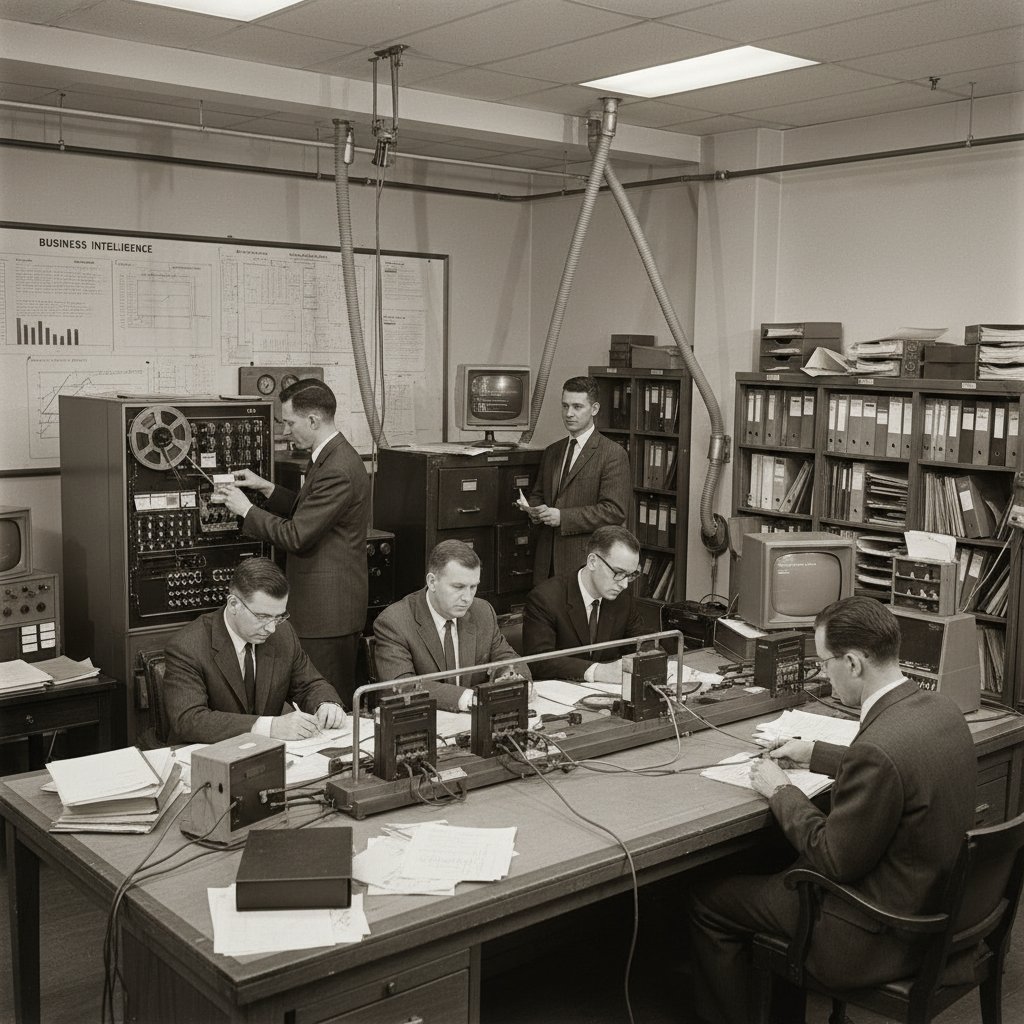
The first wave of BI automation landed with the rise of dashboards, self-service analytics, and cloud storage. Suddenly, teams could visualize trends in near-real time. Yet, even with these advances, humans were still doing the heavy lifting: cleansing data, defining queries, and interpreting results. The real leap came with AI and machine learning, automating the once-tedious steps of data integration, cleansing, and—critically—analysis itself. Tools began surfacing not just what happened, but why and what to do next. BI went from descriptive to predictive, and now, prescriptive.
| Era | Key Innovation | Impact on BI Workflow |
|---|---|---|
| 1980s-1990s | Manual spreadsheets and reports | Slow, error-prone, siloed insights |
| Early 2000s | Traditional BI platforms | Centralized, limited agility |
| 2010s | Cloud and self-service dashboards | Democratized access, quicker insights |
| Late 2010s-Early 2020s | Machine learning, automation | Predictive analytics, partial automation |
| 2024 and beyond | AI-powered BI and LLM automation | Near-total automation, real-time decisions |
Table 1: Timeline of business intelligence technology evolution from manual to AI-powered.
Source: Original analysis based on Forbes, 2024 and industry research.
Why automation isn’t just hype: the forces reshaping business data
Why is ai-powered business intelligence automation suddenly non-negotiable? Market reality bites hard. According to National University (2024), a staggering 77% of companies are actively using or exploring AI in business, with 83% citing it as a top strategic priority. The explosion of data—structured, unstructured, streaming in from IoT, social media, and transactional systems—has overwhelmed human analysts. No matter how caffeinated your team is, nobody can ingest, process, and contextualize petabytes of data in real time.
The convergence of cloud scalability, big data pipelines, and deep learning has redefined the boundaries. Today’s AI-driven BI tools don’t just automate data prep; they surface anomalies, predict churn, and even recommend next-best actions for sales and operations teams. “It’s not about replacing analysts, it’s about arming them for a new war,” says Maya, a data leader at a global retailer—capturing the mood of an industry in flux.
As platforms like Salesforce Einstein Analytics and Microsoft Power BI layer neural networks atop user-friendly interfaces, business users—once locked out by technical jargon—now wield insights once reserved for seasoned data scientists. The result? Decision-making is democratized, relentless, and, at times, brutally efficient.
What everyone gets wrong about ai-powered business intelligence
Mythbusting: common misconceptions and the cold reality
Let’s cut through the marketing fog: the biggest myths about ai-powered business intelligence automation die hard. No, you can’t just “plug in AI” and expect miracles. AI-driven BI is not a magic bullet that makes human expertise obsolete. Misconceptions run rampant, from the belief that automation instantly delivers perfect insights, to the idea that “robots” will replace your entire data team overnight.
- Hidden benefits of ai-powered business intelligence automation experts won't tell you:
- Data trust skyrockets: Automated cleansing and validation sharply reduce human error and bias, making BI outputs more reliable.
- Human capital is unlocked: With machines handling repetitive grunt work, analysts move upstream—crafting strategy, not just reports.
- Speed becomes your weapon: Automated BI can surface insights in seconds, not weeks, making agility a competitive advantage.
- Unstructured data is no longer a black box: AI can extract meaning from emails, social posts, and sensor data—domains previously inaccessible.
- Predictive prowess: With ML models baked in, forecasts become more accurate, helping teams act, not just react.
- Continuous learning: AI-driven platforms improve over time, learning from user feedback and business outcomes.
- Cost predictability: Automation can stabilize costs, even as data volumes explode.
The difference between automation and true intelligence is stark. AI BI doesn’t just accelerate reporting; it changes the very nature of business questioning. But beware: it isn’t plug-and-play magic. Algorithms require rigorous data prep, clear objectives, and constant oversight. “If you think AI will just ‘do the job,’ you’re in for a rude awakening,” quips Liam, an analytics manager at a financial services firm. The lesson? Real intelligence is built, not bought.
When not to automate: the dangers nobody talks about
The promise of ai-powered business intelligence automation is seductive. But it’s not a panacea. There are situations where automation can introduce catastrophic risk: when data is dirty, context is nuanced, or ethics are at stake. Automating flawed processes at scale only amplifies the damage.
- Red flags to watch out for when automating BI:
- Garbage in, garbage out: Automating on top of bad data multiplies errors, not insights.
- Blind trust in models: Overreliance on automated recommendations can suppress critical thinking.
- Lack of transparency: Black-box AI leaves users unable to explain or defend decisions.
- Ethical landmines: Automating decisions with biased historical data can perpetuate discrimination.
- Skill atrophy: Analysts who stop questioning outputs risk becoming “button-pushers.”
- Poor change management: Automation without stakeholder buy-in can trigger sabotage or apathy.
- Unclear ownership: Democratized analytics can devolve into chaos if governance lags.
Hidden costs abound: integrating legacy systems, retraining staff, and managing ongoing model drift. Human oversight is not optional—it’s essential, especially where regulatory or reputational risk is high. In the end, the smartest automation is always paired with the sharpest human minds.
The anatomy of modern ai-powered BI tools
Under the hood: how AI and LLMs actually automate business intelligence
Strip away the branding, and modern AI-powered BI platforms are built on a sophisticated technical stack. At the core: large language models (LLMs) capable of parsing natural language queries, understanding business context, and generating synthetic data for scenario planning. Surrounding this intelligence are automated data pipelines, real-time ETL (extract, transform, load), and machine learning engines that not only detect anomalies but also learn from business outcomes.
LLMs revolutionize BI task automation by translating vague business questions (“Why did churn spike last quarter?”) into precise database queries. They contextualize responses, generate narratives, and even recommend actions. Natural language generation (NLG) features mean your dashboard doesn’t just show numbers—it tells stories.

| Feature | Manual BI | Traditional BI | AI-powered BI |
|---|---|---|---|
| Speed | Slow | Moderate | Instantaneous |
| Accuracy | Variable | High (with effort) | Consistently high |
| Cost | High labor | Software + labor | Labor reduction, scale |
| Scalability | Poor | Moderate | Unlimited |
| User accessibility | Experts only | Analysts/IT | All staff (citizen BI) |
| Predictive analytics | Rare | Limited | Built-in |
Table 2: Feature matrix comparing manual, traditional, and AI-powered business intelligence approaches.
Source: Original analysis based on Semrush, 2023 and Forbes, 2024.
Real-time analytics and decision automation: what’s possible today
In practice, real-time AI analytics means dashboards that don’t just display yesterday’s performance but flag anomalies within seconds. In retail, AI-driven BI spots supply chain disruptions before they hit shelves; in finance, it predicts fraud as transactions happen. But even now, limits remain—data latency, model accuracy, and integration hurdles keep some “real-time” promises out of reach.
"If your dashboard isn’t making decisions, it’s just a fancy mirror." — Harper, business intelligence strategist (illustrative, based on expert consensus from Forbes, 2024)
The distinction is crucial: true real-time insights empower action, not just observation. Whether it’s automated inventory restocking or triggering compliance alerts, the frontier of automation is shifting from insight delivery to autonomous execution.
Show me the money: ROI, costs, and dirty secrets
The true cost of ai-powered business intelligence automation
The sticker shock of AI BI automation can be misleading. Upfront costs—platform fees, integration, training—can be substantial. But the real story emerges in ongoing operations. According to Semrush (2023), AI-driven BI automates up to 90% of data processing roles, and 96% of companies now prefer candidates with AI skills. Over a three-year horizon, labor costs drop and insights multiply, but only if you avoid the classic traps: hidden integration fees, underestimated data preparation, and the endless “training loop” for models and staff.
| Metric / Approach | Traditional BI (Annual) | AI-Powered BI (Annual) |
|---|---|---|
| Analyst labor hours | 1,800 | 400 |
| Average time to insight | Days to weeks | Seconds to minutes |
| Error rate | 3-5% | <1% |
| Average ROI | 120% | 200-350% |
Table 3: ROI and cost comparison between traditional and AI-powered BI automation.
Source: Original analysis based on National University, 2024 and Semrush, 2023.
Hidden costs lurk beneath the surface: legacy system compatibility, model retraining, and organizational change management. Savvy leaders weigh these against hard ROI, using pilot projects and phased rollouts to minimize surprises. The smartest cost-benefit strategies benchmark not just software prices, but total value delivered—faster insights, fewer errors, and strategic agility.
ROI case studies: from wild wins to spectacular failures
In retail, one leading brand implemented AI-powered BI to automate demand forecasting and inventory optimization. The result? A 30% reduction in stockouts and a 25% increase in profit margin within the first year—transformative by any standard. But across the aisle, a global manufacturer rushed automation without cleaning its data or training users. The outcome: flawed forecasts, lost revenue, and a public apology to shareholders.

The lesson is brutal but clear: automation amplifies both strengths and weaknesses. Success demands not just technology, but relentless attention to data quality, stakeholder buy-in, and continuous learning. As in any arms race, the spoils go to those who prepare, adapt, and execute.
The cultural and human side: who wins, who loses?
Job shifts, new skills, and the myth of the jobless future
AI-powered business intelligence automation is not a jobs apocalypse—it’s a radical job shift. According to Mitre (2023), 52% of U.S. workers fear job loss due to AI. But the reality is more complex: while repetitive roles shrink, demand for AI-savvy “citizen data scientists” and “AI stewards” explodes. The rise of these hybrid roles—blending domain expertise with analytics fluency—reshapes what it means to be “data-driven.”
- 1980s: Paper-based reporting dominates business insights.
- 1990s: First-generation BI tools emerge—complex, IT-controlled.
- Early 2000s: Self-service dashboards democratize limited analytics.
- Mid-2000s: Cloud platforms enable scalable, accessible data storage.
- 2010s: Machine learning automates parts of the analytics pipeline.
- Late 2010s: AI integration begins; predictive analytics go mainstream.
- 2020-2022: LLMs and NLG bring natural language to BI.
- 2023-2024: Real-time, automated BI becomes table stakes.
- 2024: Most companies prioritize AI BI for competitive advantage.
- Present: Skills shift from pure analysis to AI oversight and business storytelling.
Smart organizations invest in upskilling, cross-training, and embedding AI literacy into every role. The result: a workforce that leverages automation as augmentation, not annihilation.
The democratization of BI: empowerment or chaos?
Shadow IT—where employees build their own analytics outside official channels—has long haunted organizations. AI democratizes BI, empowering non-technical staff to answer questions once reserved for data wizards. The upside: speed, agility, and inclusivity. The downside: data chaos, security risks, and governance nightmares.

Organizations are learning to balance freedom with guardrails: automated audit trails, role-based access, and mandatory training. When done right, democratization transforms business culture—replacing bottlenecks with a culture of inquiry and action.
Controversies and ethical minefields in ai-powered BI
Bias, privacy, and explainability: the new risk landscape
AI bias sneaks into automated BI decisions through tainted training data and opaque algorithms. What seems like data-driven objectivity can mask systemic discrimination, especially in hiring, lending, and resource allocation. Privacy? AI’s hunger for data means that, without tight controls, sensitive information can be exposed or misused.
- Unconventional uses for ai-powered business intelligence automation:
- Detecting workplace burnout: Analyzing Slack messages for early warning signs.
- Predicting supply chain disruptions: Using satellite imagery and weather data.
- Optimizing office layouts: Tracking badge swipes and movement patterns.
- Personalizing customer retention: Tailoring offers using sentiment analysis.
- Recruitment shortlisting: Screening resumes and social profiles in bulk.
- Detecting fraud: Real-time anomaly detection in transactions.
- Crisis communication: Analyzing public sentiment in real time.
Explainability is the new premium: “You can’t trust what you can’t explain,” says Maya. Regulations and customers now demand that AI-driven BI can justify its decisions, not just spit out numbers.
Mitigating risk: frameworks and best practices
Industry frameworks like the European Commission’s AI Act and ISO/IEC 24028 mandate responsible, explainable AI in BI. The best practice playbook? It starts with rigorous data governance and ends with relentless monitoring.
- Define objectives: What problem will AI BI solve?
- Audit your data: Validate quality, completeness, and bias.
- Map workflows: Identify automation-ready processes.
- Select explainable models: Prefer transparency over black-box magic.
- Pilot, don’t plunge: Start small, iterate fast.
- Train your team: Upskill for AI oversight and interpretation.
- Establish governance: Set up audit trails and escalation paths.
- Monitor outcomes: Track for drift, bias, and evolving business needs.
- Engage stakeholders: Secure buy-in across business and IT.
- Review regularly: Update models and policies as conditions change.
External audits and ongoing monitoring keep bias and drift in check. Services like futuretask.ai are becoming critical partners—offering expertise in robust, ethical, and adaptable AI BI deployment at scale.
How to get started: your blueprint for ai-powered BI success
Step-by-step guide to mastering ai-powered business intelligence automation
Before you automate anything, you need a clear-eyed assessment: What’s your data maturity? Who owns BI? Are you training for technology, or for transformation?
- Assess business objectives: Define concrete goals for AI BI automation.
- Inventory data assets: Audit your data sources for quality and relevance.
- Identify use cases: Prioritize processes ripe for automation.
- Select your tech stack: Research platforms that align with needs.
- Pilot with a cross-functional team: Start small, measure rigorously.
- Cleanse and integrate data: No shortcuts here—bad data is fatal.
- Automate incrementally: Build on successes, fix failures fast.
- Embed explainability: Ensure every output can be understood.
- Upskill and reskill staff: Training is ongoing, not one-off.
- Establish governance: Build in monitoring, escalation, and audit processes.
- Optimize continuously: Adapt to feedback and changing business priorities.
- Celebrate wins—and learn from losses: Share lessons, refine strategy.
Early adopters often stumble by moving too fast or ignoring culture. Build your AI BI team with a blend of tech expertise, business acumen, and change management savvy—division silos are death.
Choosing the right partner: what to look for (and what to avoid)
The vendor landscape for AI BI automation is crowded and confusing, featuring legacy giants, nimble startups, and platforms like futuretask.ai that specialize in cross-functional, AI-driven task automation. Don’t be fooled by glossy demos—demand proof of real-world impact, transparent pricing, and a clear roadmap for continuous improvement.
Key technical terms and jargon in AI BI automation:
- ETL (Extract, Transform, Load): The backbone of data pipelines—moving, cleaning, and prepping data for analysis.
- LLM (Large Language Model): AI models trained on vast datasets to understand and generate human-like language.
- NLG (Natural Language Generation): Automatically turns data findings into readable reports and narratives.
- Citizen data scientist: Business users empowered by AI to perform advanced analytics without formal data science backgrounds.
- Model drift: Degradation of model accuracy over time due to changes in data or business context.
- Explainability: The capacity of AI systems to make their decisions understandable to humans.
- Shadow BI: Analytics initiatives developed outside official IT oversight, often “under the radar.”
Evaluating platforms and services means grilling vendors on integration, scalability, security, and support. Negotiate for flexible contracts and ensure onboarding includes both technical and cultural training—otherwise, your shiny new AI will gather dust.
The future of ai-powered business intelligence automation
Emerging trends and next-gen breakthroughs
Right now, ai-powered business intelligence automation is rewriting the playbook across industries. The next 3-5 years will see breakthroughs in self-healing data pipelines, proactive analytics that anticipate needs, and AI agents that act autonomously. The line between analysis and action will blur as BI itself becomes a living, breathing business partner.

Industries are already being reshaped: retail uses AI BI to hyper-personalize customer journeys; financial services deploy it for risk management and product innovation. The result? Faster, more decisive organizations—not because robots replaced people, but because people and machines finally work in sync.
Are you ready to lead—or be left behind?
The stakes are higher than ever. Organizations slow to embrace ai-powered business intelligence automation aren’t just missing out—they’re risking irrelevance. If your competitors automate insights, decisions, and actions before you do, you’re not just behind—you’re invisible.
Are you still clinging to manual reporting cycles while your rivals deploy automated, real-time BI to outmaneuver you? If you’re not challenging your assumptions, questioning your data, and investing in both technology and talent, you’re standing on a burning platform.

The challenge is clear: automate with purpose, or lose your edge. Will you lead the charge, or become another cautionary tale in the brutal new reality of AI BI?
Summary
The age of ai-powered business intelligence automation isn’t coming—it’s already here, redrawing the battlefield for every data-driven organization. As this article lays bare, the revolution isn’t just about technology, but about the ruthless efficiency, hidden pitfalls, and raw power of automated insight. The winners will be those who pair relentless AI automation with sharp human oversight, who invest in upskilling, and who refuse the safe comfort of old habits. The losers? Those left shuffling spreadsheets in a race that’s already been run. If you’re hungry for more—and ready to rewire your business for the new era—resources like futuretask.ai can help you navigate the storm. The only real question is: will you automate, adapt, and thrive, or let the data revolution leave you behind?
Sources
References cited in this article
- Forbes(forbes.com)
- Semrush(semrush.com)
- Vena(venasolutions.com)
- National University(nu.edu)
- Microsoft Blog(blogs.microsoft.com)
- UiPath(uipath.com)
- Merkle(merkle.com)
- Forbes(forbes.com)
- CDO Magazine(cdomagazine.tech)
- Gartner(gartner.com)
- PwC(pwc.com)
- BuiltIn(builtin.com)
- Statista(statista.com)
- IBM(ibm.com)
- Alphabold(alphabold.com)
- Gartner Magic Quadrant(thoughtspot.com)
- SelectHub(selecthub.com)
- Theoris(theoris.com)
- ZipDo(zipdo.co)
- V7 Labs(v7labs.com)
- Ekuma, 2024(journals.sagepub.com)
- SproutSocial(sproutsocial.com)
- MDPI(mdpi.com)
- Tandfonline Special Issue(tandfonline.com)
- Forbes(forbes.com)
- World Economic Forum(weforum.org)
- Auxis(auxis.com)
- Stanford AI Index 2024(aiindex.stanford.edu)
- Forbes(forbes.com)
- Waverley Software(waverleysoftware.com)
- ThoughtSpot(thoughtspot.com)
- Medium(medium.com)
- LinkedIn(linkedin.com)
- Bilderberg Management(bilderbergmanagement.com)
- Forbes(forbes.com)
- IDC(blogs.idc.com)
Automate Your Tasks, Transform Your Business
FutureTask.ai revolutionizes your workflow by automating complex tasks typically outsourced to freelancers and agencies. Our powerful AI-driven platform leverages cutting-edge LLM technology to deliver precision, speed, and consistency at scale. Whether you're managing content creation, data analytics, marketing campaigns, or customer support, FutureTask.ai ensures seamless task execution, significant cost savings, and unmatched efficiency. Transform your business operations, eliminate delays, reduce operational overhead, and gain a competitive advantage with intelligent automation.
Get startedReady to Automate Your Business?
Start transforming tasks into automated processes today
Frequently Asked Questions
What is the main difference between traditional BI platforms and AI-powered business intelligence automation?
Traditional BI platforms like SAP BusinessObjects and IBM Cognos required steep learning curves and centralized IT control, keeping insights locked away. AI-powered BI automation goes beyond dashboards and visualization to automatically discover insights, explain them, and increasingly act on them without human intervention.
How has business intelligence evolved from the late 20th century to today?
BI evolved from manual data crunching by hand in the late 20th century, to dashboard-based self-service analytics in the 2000s where humans still did most data cleansing and interpretation, to today's AI-driven systems that automate data integration, cleansing, and analysis itself—moving from descriptive to predictive and now prescriptive insights.
What does 'prescriptive' analytics mean in the context of AI-powered BI?
The article indicates that modern AI-powered BI has evolved from descriptive analytics (what happened) and predictive analytics (what will happen) to prescriptive analytics (what to do next), where machines not only discover and explain data but increasingly act on insights automatically.
Why does the article describe AI-powered BI automation as a 'revolution'?
The article characterizes it as revolutionary because it fundamentally disrupts traditional business structures and workflows—upending boardroom hierarchies and the daily work of analysts by automating the wholesale discovery and action on business insights rather than just presenting data.
From the Archive
Explore more from Ai-powered task automation

Ai-Powered Website Analytics Automation: Capabilities and Risks

Why Most Ai-Powered Business Analytics Automation Fails

Automated Critical Data Analysis Insights: Separating Hype From Reality

AI-Powered Predictive Analytics Automation: Benefits and Hidden Risks

How AI Tools Automate Data Analysis and Reshape Teams


