


AI-Powered Customer Onboarding: Where It Fails and Wins in 2025
Written with AI assistance under our editorial guidelines
AI-powered customer onboarding in 2026 uses large language models, behavioral analytics, and automation to transform the experience from bureaucratic processes into streamlined digital journeys. Organizations that modernize their onboarding gain credibility and speed advantages, while those clinging to legacy systems continue losing customers to friction, errors, and poor user experience.
Welcome to the crucible of digital transformation—where customer onboarding isn’t just a handshake, it’s a battleground. The stubborn truth? AI-powered customer onboarding has become the new litmus test for a brand’s credibility, speed, and empathy. It’s rewriting the rules in 2025, smashing through legacy bottlenecks, and exposing uncomfortable realities most leaders would rather sweep under the rug. But here’s the kicker: this isn’t just about swapping paperwork for pixels, or adding a chatbot to an old process. AI onboarding is a seismic shift, fusing large language models, behavioral analytics, and automation to create journeys that are as relentless as your market’s expectations. If your onboarding still feels like a bureaucratic slog, you’re already bleeding customers—and the data doesn’t lie. In this deep dive, we’ll rip back the curtain on the brutal truths, bold wins, and the playbooks your competition is trying (and often failing) to master. Ready to see what really separates the winners from the washed-up?
How we got here: the messy evolution of onboarding
From fax machines to neural nets: a short, brutal history
Cast your mind back a couple of decades. Customer onboarding—whether in finance, telecom, or retail—was a paper-choked, manual grind. New accounts meant endless forms, faxes (yes, people really used them), and a parade of signature requests. The friction wasn’t just annoying; it was a breeding ground for errors, lost paperwork, and customer impatience. According to historical analysis from ChurnZero (2023), even as digital systems crept in, most organizations simply recreated analog routines with digital tools. The result? Slightly faster chaos, still mired in human bottlenecks.
The first digital onboarding wave promised salvation but delivered skepticism. Basic web forms and clunky portals replaced clipboards, but they rarely integrated with back-office systems. Companies boasted about “paperless onboarding,” yet the experience for customers remained disjointed, slow, and often more confusing than before. Missed emails, lost passwords, and cryptic error messages became the new face of digital failure.
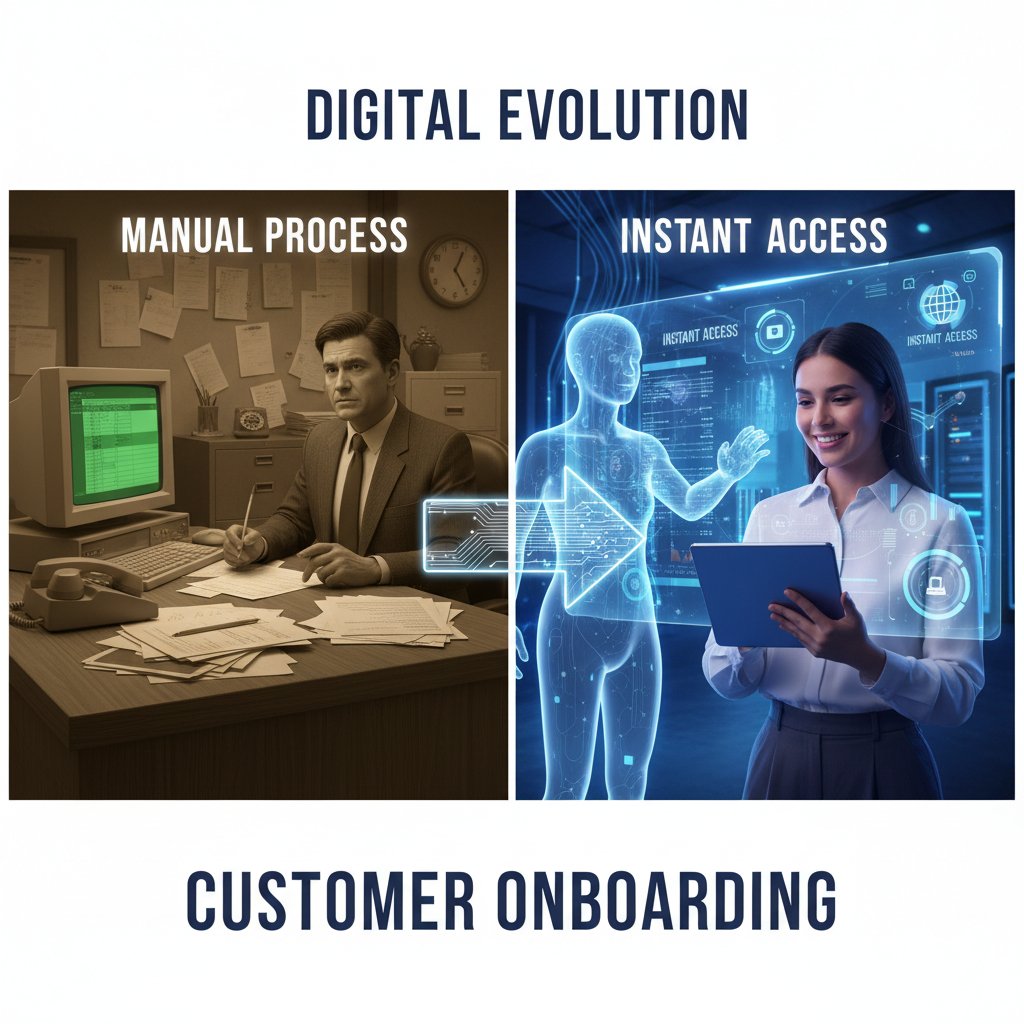
The hidden costs legacy onboarding never told you about
Let’s get brutally honest: legacy onboarding isn’t just inefficient—it’s a silent killer of brand reputation and bottom lines. The costs go beyond wasted hours. Every abandoned signup, every faxed document that goes missing, every frustrated phone call chips away at trust, loyalty, and revenue. According to ChurnZero (2023), organizations clinging to manual processes report churn rates up to 40% higher than those embracing digital innovation. And yet, many still underestimate the hidden opportunity cost: potential customers who never even finish onboarding because the process is just too painful.
| Year | Avg. Onboarding Cost per Customer | Conversion Rate | Customer Satisfaction Score |
|---|---|---|---|
| 1995 | $400 | 35% | 58/100 |
| 2005 | $250 | 47% | 67/100 |
| 2015 | $150 | 54% | 72/100 |
| 2020 | $110 | 60% | 76/100 |
| 2024 | $60 | 78% | 89/100 |
| 2025 (AI-led) | $48 | 85% | 93/100 |
Table 1: Timeline of onboarding costs, conversion rates, and satisfaction scores from 1995-2025. AI-powered onboarding delivers a step-change in efficiency and experience. Source: Original analysis based on ChurnZero (2023), Userpilot (2024), Wyzowl (2023).
"People forget onboarding isn’t just a hurdle—it’s your first real handshake." — Jamie
Why AI wasn’t supposed to fix onboarding—but did
Early on, “AI” sounded like a Silicon Valley fever dream. Leaders scoffed at the idea that algorithms could guide humans through nuanced, trust-sensitive journeys. The skepticism wasn’t misplaced: initial AI attempts were clumsy, rules-based, and often more alienating than helpful. What changed? A perfect storm of customer impatience, skyrocketing digital competition, regulatory headaches, and the sudden maturity of large language models forced a reckoning. As AI began to show it could interpret intent, personalize content, and adapt in real time, the old onboarding playbook evaporated overnight. Today, AI onboarding isn’t just a buzzword—it’s a business imperative, driven not by hype, but by the unrelenting demand for speed and simplicity.
What is ai-powered customer onboarding—beyond the hype?
Defining the new playbook: what counts as 'AI onboarding'?
Here’s the first truth: not every automated system qualifies as AI-powered onboarding. There’s a chasm between basic workflow automation (think: “if X, then Y” checklists) and onboarding guided by true machine intelligence. AI onboarding harnesses machine learning, natural language processing, and behavioral analytics to anticipate, adapt, and personalize every step.
Key terms and context:
Machine-intelligent systems that guide users through account setup or service activation, adapting flows in real time based on user behavior and data.
Rule-based process automation—efficient but rigid. Useful for repetitive tasks but lacks adaptability.
Advanced AI trained on vast datasets to understand and generate human-like language, enabling personalized onboarding conversations at scale.
According to Wyzowl (2023), companies deploying LLM-powered onboarding see loyalty rates jump 86%, as the experience feels genuinely tailored and responsive.

How AI onboarding actually works: the tech under the hood
Forget the black box mythology—AI onboarding is built on a ruthless commitment to understanding and predicting customer needs. The technical architecture typically includes:
- Data intake: AI collects user-provided data, behavioral signals (clicks, hesitations), and contextual information.
- Decision engines: Machine learning models determine the next best action, adapt pathways, and identify potential drop-off points in real time.
- Adaptive flows: Onboarding journeys are dynamically altered based on individual user signals, not rigid scripts.
Large language models (LLMs) take this further by generating personalized, context-aware messaging, answering questions, and proactively addressing concerns—all without human intervention. According to Microsoft (2025), AI-driven onboarding platforms slash completion times by over 50%, with some banks onboarding new clients in less than a day.
| Feature | Classic Onboarding Software | AI-driven Onboarding Platforms |
|---|---|---|
| Static forms | Yes | No |
| Real-time personalization | No | Yes |
| Compliance automation | Limited | Advanced |
| Adaptive user journeys | No | Yes |
| Multichannel integration | Basic | Seamless |
| Behavioral analytics | Minimal | Deep, actionable |
| Human-in-the-loop escalation | Manual | Automated triggers |
Table 2: Feature matrix comparing classic onboarding software vs. AI-driven platforms. Source: Original analysis based on Capgemini (2024), Microsoft Blog (2025).
"If your onboarding feels generic, your AI isn’t doing its job." — Alex
Debunking the three biggest myths about AI onboarding
Let’s clear the air on some persistent misconceptions:
-
AI onboarding is only for big companies: False. With cloud-based AI onboarding solutions, small and midsize companies can now deploy advanced flows without enterprise budgets. According to Userpilot (2024), 78% of firms plan to use AI onboarding—most aren’t Fortune 500s.
-
AI onboarding is impersonal or cold: Wrong again. Personalized AI-driven onboarding (especially with LLMs) produces higher satisfaction scores than most human-led systems, provided it’s designed with empathy and context.
-
AI onboarding is 'set and forget': Deadly mistake. AI systems require continuous tuning, feedback, and monitoring for quality and compliance.
Hidden benefits of AI onboarding experts won’t tell you:
- AI identifies friction points invisible to humans, adapting flows in real time for each user.
- Compliance is built-in; AI checks documents, flags risks, and automates audit trails.
- Multilingual onboarding is effortless, driven by NLP, expanding your global reach.
- AI-powered onboarding can spot and block fraud attempts instantly.
- Continuous learning improves onboarding flows based on real user behavior.
- AI chatbots provide 24/7 onboarding support, reducing wait times to near zero.
- Integration with other tools (CRM, KYC, analytics) is seamless, not a patchwork.
Why most digital onboarding fails (and how AI flips the script)
Where traditional onboarding breaks down—data and drama
Old-school onboarding is a study in frustration. Human-led processes are inherently slow and error-prone, subject to bottlenecks from overworked staff, miscommunication, and siloed information. According to ChurnZero (2023), organizations relying on manual onboarding face up to 40% higher churn rates—hardly a surprise when prospects are left hanging for days or weeks. The real drama? Siloed tech stacks. Data is scattered across CRMs, email, spreadsheets, and niche tools, creating a fragmented, error-filled journey where no one has a complete picture.

The churn factor: how bad onboarding kills growth
The numbers are stark. According to Userpilot (2024), 74% of prospects will abandon the process—and switch to a competitor—if onboarding feels confusing or slow. Every minute spent wrestling with broken links, missing documents, or repetitive forms is a minute closer to lost revenue.
| Industry | Pre-AI Onboarding Churn Rate | Post-AI Onboarding Churn Rate |
|---|---|---|
| Banking | 32% | 13% |
| E-commerce | 27% | 12% |
| SaaS | 38% | 15% |
| Healthcare | 42% | 19% |
Table 3: Onboarding churn rates before and after AI implementation (2024). Source: Original analysis based on Userpilot (2024), ChurnZero (2023).
The emotional cost for customers is real. Frustration leads not just to abandonment, but to negative word of mouth—a reputational scar that’s hard to heal. For brands, every failed onboarding is more than lost revenue; it’s a lost advocate, a lost lifetime value, and a digital black mark that competitors are eager to exploit.
How AI onboarding rewrites the rules (with receipts)
Here’s where AI flips the script. By continuously analyzing user behavior, AI systems flag bottlenecks the moment they emerge. For example, futuretask.ai’s deployment in a fintech context saw conversion rates jump by 25% and onboarding times plummet to under 24 hours. The secret? AI-driven micro-interactions, adaptive document checks, and real-time escalation to human agents when needed.
Step-by-step guide to mastering AI-powered customer onboarding:
- Map your current onboarding journey—document every touchpoint, bottleneck, and pain point.
- Identify automation opportunities—where do human errors, slow handoffs, or repetitive tasks slow things down?
- Choose an AI onboarding platform—evaluate solutions for LLM capabilities, integration, and compliance.
- Set clear KPIs—track churn, completion time, NPS, and cost per onboarding.
- Integrate data sources—ensure AI has access to real-time customer data and context.
- Design adaptive workflows—use AI to personalize flows for different segments and behaviors.
- Test with real users—collect feedback, monitor drop-offs, and refine continuously.
- Implement human-in-the-loop triggers—set up escalation paths for complex or sensitive cases.
- Monitor and iterate—use AI analytics to drive continuous improvement.
The anatomy of an AI onboarding journey: what really happens
The first 60 seconds: micro-interactions that matter
The make-or-break moment comes fast. According to Vidyard (2024), video engagement during onboarding drops sharply after the first minute. AI-powered onboarding leverages this by creating frictionless, micro-interactions—think auto-filled forms, instant ID verification, and contextual tooltips—that reassure and guide users before doubt even has a chance to set in.
Psychologically, these tiny nudges reduce cognitive load and build trust. By analyzing biometric signals (like typing rhythm or facial cues on consent), AI can spot confusion or hesitation and adapt, offering help or simplifying steps on the fly.

Decision trees and deep learning: how AI adapts to user signals
AI onboarding engines are always listening—every click, pause, or reroute is a data point. Deep learning models process these signals in real time, optimizing next steps and even predicting likely drop-offs. This isn’t just about efficiency; it’s about empathy at scale.
The catch? There’s a fine line between helpful adaptation and creepy overreach. Ethical AI onboarding systems prioritize transparency, allowing customers to control their data and opt out of certain tracking features, fully compliant with GDPR and CCPA.
"Every click is a conversation—if you know how to listen." — Priya
Where human touch still wins: hybrid onboarding models
Full automation isn’t always the answer. Over-automated journeys can backfire, especially in high-stakes sectors like finance or healthcare. That’s why hybrid onboarding models—where AI handles the grunt work and humans step in for nuance—are winning converts. AI identifies when a case needs the human touch and escalates accordingly.
Blends AI automation with human input, ensuring complex cases or emotional needs are handled with empathy.
Automated triggers send cases to human agents when risk, confusion, or regulatory issues are detected.
Integrates human review into automated flows, balancing speed with judgment and oversight.
According to Forbes Finance Council (2024), institutions embracing hybrid models report the highest satisfaction and lowest churn, proving that the best onboarding is both smart and human.
Common pitfalls, hidden dangers, and how to dodge them
The dark side: bias, privacy, and over-automation
AI onboarding isn’t a panacea. Algorithmic bias can creep in, especially if training data lacks diversity or reflects historical prejudice. Biased onboarding decisions can lock out entire customer segments—sometimes invisibly so. Privacy is another landmine: aggressive data collection or opaque consent practices risk violating GDPR, CCPA, and eroding trust.

According to Capgemini (2024), compliance automation is a core benefit of AI onboarding—but only when designed with transparency and accountability.
Red flags: signs your AI onboarding is failing (fast)
Even the most advanced AI onboarding projects can implode. Watch for these signals:
- Surging drop-off rates at early steps or after new AI features launch.
- Spikes in customer complaints about confusing or irrelevant flows.
- Repeated compliance violations or data privacy complaints.
- Black-box decision-making with no audit trail.
- AI errors escalating to social media backlash.
- Human agents overwhelmed by escalations, indicating AI isn’t routing cases effectively.
Quick self-assessment checklist:
- Do you track not just completion rates, but why users abandon?
- Is there a clear pathway for customers to request human help?
- Can you explain every major AI decision in onboarding, or is it a mystery even to your team?
- Are you continuously testing onboarding flows with real users?
Mitigating risk: critical questions to ask before you deploy
Here’s your pre-launch gauntlet. Before rolling out AI onboarding, ask:
- What biases exist in our training data?
- How transparent is our consent and data usage policy?
- Who audits our AI decisions, and how often?
- Where does human oversight enter the process?
- How do we handle exceptions and edge cases?
- What’s our escalation protocol when AI gets it wrong?
- How do we ensure compliance with GDPR, CCPA, and sector-specific regulation?
- Are we prepared to iterate rapidly based on customer feedback?
Regular audits and external reviews aren’t optional—they’re critical. According to Forbes Finance Council (2024), organizations that commit to quarterly AI onboarding reviews report 30% fewer compliance incidents.
Case studies: bold wins (and cautionary tales) from the real world
Fintech disruptor: slashing churn with AI
A fast-growing fintech firm faced sky-high churn—over 30% of prospects abandoned the process at the ID verification stage. By deploying AI-powered onboarding (combining LLM chatbots and automated compliance checks), the company cut onboarding time from three days to less than 24 hours and boosted completion rates above 85%.
| KPI | Before AI | After AI |
|---|---|---|
| Avg. onboarding time | 3 days | 22 hours |
| Churn rate | 32% | 12% |
| Customer satisfaction | 64/100 | 91/100 |
Table 4: Before-and-after KPIs for fintech onboarding. Source: Original analysis based on ChurnZero (2023), Userpilot (2024).
What made it work? Relentless focus on friction points, instant escalation for edge cases, and a feedback loop between AI analytics and human agents.
E-commerce: turning first-time buyers into lifelong fans
An e-commerce leader wanted more than a slick signup—they wanted lifelong loyalty. By leveraging personalized AI onboarding flows (including instant promo personalization and dynamic FAQs), the brand increased new user conversion by 26% and saw repeat purchase rates climb. Customer testimonials raved about the “invisible guidance” that made onboarding seamless, not pushy.

When AI onboarding goes wrong: a cautionary tale
Not every AI onboarding tale ends with confetti. A healthtech startup rushed its AI rollout, underestimating the complexity of patient consent and regulatory compliance. The result? Confused users, botched document uploads, and a regulatory slap that cost millions in fines and lost trust.
"Sometimes the tech is ready before the people are." — Morgan
The lesson: AI onboarding demands more than cool tech—it requires ruthless attention to compliance, user feedback, and relentless iteration.
Practical playbook: how to start with AI onboarding (and not screw it up)
Mapping your onboarding flow: what to automate, what to keep human
Start with ruthless honesty. Map your entire onboarding journey—every step, every potential delay. Identify where AI can provide the most value (routine data entry, compliance checks, adaptive help) and where human intervention is essential (complex queries, emotional reassurance). Don’t fall for the “automate everything” myth.
Timeline of AI onboarding evolution:
- 2010: Rule-based automation systems emerge.
- 2013: Workflow tools integrate with basic CRM.
- 2015: NLP chatbots appear, limited contextual awareness.
- 2017: Early machine learning models enter onboarding.
- 2019: Real-time analytics power adaptive flows.
- 2022: Large language models deliver true personalization.
- 2025: Hybrid, self-optimizing AI onboarding becomes the standard.
Choosing the right tech: features you actually need
Ignore the hype. The features that matter are those that solve your unique onboarding pain points. Prioritize adaptive workflows, compliance automation, and real-time analytics. Avoid shiny add-ons that don’t move the needle.
For those exploring advanced task automation, futuretask.ai offers a platform grounded in real-world expertise—worth considering as you vet your options.
| Feature | Practical Impact | Priority Level |
|---|---|---|
| Adaptive user flows | High | Essential |
| Compliance automation | High | Essential |
| Multichannel support | Medium | Important |
| Video onboarding | Low | Optional |
| Custom analytics dashboards | High | Essential |
| LLM-powered chatbots | High | Essential |
Table 5: Comparison of top AI onboarding features with practical impact ratings. Source: Original analysis based on Capgemini (2024), Forbes (2023), Userpilot (2024).
Measuring what matters: KPIs and continuous improvement
It’s not just about launch—it’s about relentless improvement. The KPIs that matter are:
- Onboarding completion rate
- Time to activation (TTA)
- Churn rate within 30 days
- Customer satisfaction (NPS)
- Compliance incident frequency
Feedback loops are your friend. Embed surveys, monitor drop-offs, and use analytics to iterate flows continuously.
Unconventional uses for AI onboarding:
- Onboard freelancers and gig workers at scale, automating compliance and payout setup.
- Automate partner or vendor onboarding, reducing legal review bottlenecks.
- Personalize onboarding for different customer personas using behavioral insights.
- Deliver “onboarding as a service” to B2B clients.
- Use AI onboarding to upsell or cross-sell during the activation process.
The future of onboarding: what comes after AI?
Autonomous onboarding: when AI meets self-optimizing systems
Today’s AI onboarding adapts in real time; tomorrow’s systems will self-optimize based on millions of interactions, blurring the line between digital and human. While full autonomy is a holy grail, the present reality is about striking the balance between automation, empathy, and control.

Societal impact: AI onboarding and the new customer psyche
AI onboarding isn’t just changing processes—it’s changing people. Customers now expect instant, hyper-personalized experiences as the norm. The shift is psychological (less patience for friction), cultural (a demand for transparency), and strategic (brands that don’t deliver risk becoming irrelevant).
"Every onboarding is a new beginning—AI just changes the stakes." — Taylor
Will onboarding ever be truly effortless?
Perfection is a myth. Seamless onboarding is always a moving target, shaped by shifting expectations, new channels, and evolving risks. The best onboarding systems aren’t invisible—they’re resilient, adaptive, and honest about their limits. The human element—empathy, creativity, judgment—remains irreplaceable for the most complex journeys. As you rethink your own onboarding, ask: what would you want if you were your own customer?
Conclusion: the new rules for onboarding in an AI world
The brutal truths? AI-powered customer onboarding is no longer a luxury—it’s the new baseline. Legacy systems aren’t just inefficient; they’re a liability. The bold wins come to those who balance speed with empathy, automation with oversight, and tech with trust. The leaders of 2025 won’t be the ones with the flashiest bots, but those who obsess over every micro-interaction, audit every AI decision, and never lose sight of the human on the other side of the screen.
Are you ready to scrap the old playbook and build onboarding journeys that actually earn loyalty, trust, and growth? Or will you let your competition rewrite the rules while you watch from the sidelines? The next move is yours—make it count.
Sources
References cited in this article
- CMSWire(cmswire.com)
- Forbes Finance Council(forbes.com)
- ChurnZero(churnzero.com)
- Whatsthebigdata(whatsthebigdata.com)
- Userpilot(userpilot.com)
- Microsoft Blog(blogs.microsoft.com)
- MDPI(mdpi.com)
- RapidInnovation.io(rapidinnovation.io)
- Namirial(focus.namirial.com)
- SDCE Executive(sdcexec.com)
- Typeset(typeset.io)
- Sprinklr(sprinklr.com)
- Airwallex(airwallex.com)
- Forbes(forbes.com)
- Aircall(aircall.io)
- SeekOut(seekout.com)
- Built In(builtin.com)
- eLearning Industry(elearningindustry.com)
- BambooHR(clevry.com)
- Gallup(enboarder.com)
- Exploding Topics(explodingtopics.com)
- Shortlister(myshortlister.com)
- Oak Engage(oak.com)
- Cognisaas(cognisaas.medium.com)
- Custify(custify.com)
- Rocketlane(rocketlane.com)
- CNBC(cnbc.com)
- AIHR(aihr-institute.com)
- HubSpot(blog.hubspot.com)
- Akita(akitaapp.com)
- Vxplore(vxplore.medium.com)
- CDOTrends(cdotrends.com)
- Whiteford Law(whitefordlaw.com)
- TechTarget(techtarget.com)
- Gainsight(gainsight.com)
- Google Cloud(cloud.google.com)
- DRUID AI(druidai.com)
- Execs in the Know(execsintheknow.com)
- FinTech Global(fintech.global)
- Advance.AI(advance.ai)
- Simform(simform.com)
- Uvik(uvik.net)
- Mind the Product(mindtheproduct.com)
- Analyzify(analyzify.com)
- QArea(qarea.com)
- Firmbee(firmbee.com)
Automate Your Tasks, Transform Your Business
FutureTask.ai revolutionizes your workflow by automating complex tasks typically outsourced to freelancers and agencies. Our powerful AI-driven platform leverages cutting-edge LLM technology to deliver precision, speed, and consistency at scale. Whether you're managing content creation, data analytics, marketing campaigns, or customer support, FutureTask.ai ensures seamless task execution, significant cost savings, and unmatched efficiency. Transform your business operations, eliminate delays, reduce operational overhead, and gain a competitive advantage with intelligent automation.
Get startedReady to Automate Your Business?
Start transforming tasks into automated processes today
Frequently Asked Questions
What is AI-powered customer onboarding and how does it differ from traditional onboarding?
AI-powered customer onboarding is a seismic shift that fuses large language models, behavioral analytics, and automation to create customer journeys. Unlike legacy onboarding that relied on paper forms, faxes, and manual processes, AI onboarding uses technology to streamline and personalize the experience, moving beyond simply recreating analog routines digitally.
Why do companies still struggle with onboarding in 2026?
According to the article, many organizations have recreated analog routines with digital tools rather than fundamentally transforming the process. Legacy onboarding systems often lack integration between customer-facing portals and back-office systems, resulting in disjointed, slow, and confusing experiences despite appearing 'paperless.'
What were the problems with the first wave of digital onboarding?
The first digital onboarding wave replaced clipboards with web forms and portals but rarely integrated these systems with back-office operations. Customers still experienced missed emails, lost passwords, cryptic error messages, and disjointed processes that were often more confusing than paper-based systems.
What hidden costs do legacy onboarding systems impose on businesses?
According to the article, legacy onboarding costs go beyond wasted hours and include abandoned signups, lost documents, frustrated phone calls, and erosion of trust and loyalty that chips away at brand reputation and bottom lines.
From the Archive
Explore more from Ai-powered task automation

AI-Powered Automated Client Onboarding: Benefits and Real Risks

AI-Powered HR Onboarding Automation: Measuring Real ROI

Automating Employee Onboarding with Ai: Efficiency Versus Human Connection

How AI Transforms Customer Success Tracking and Churn Prevention

AI-Driven Customer Engagement: Strategies That Work in 2025
