


Ai-Powered Online Course Creation Automation: Threat or Unfair Edge?
Written with AI assistance under our editorial guidelines
AI-powered course creation automation addresses the traditional bottleneck of manual course design by dramatically reducing creation time and effort. While it offers efficiency gains to creators competing in a growing $35.2 billion online learning market, it simultaneously raises concerns about content homogenization and competitive fairness among educators adopting the technology at different rates and scales.
If you’ve ever tried to build an online course from scratch—the all-nighters, the drag-and-drop déjà vu, the creeping sense your “unique” content looks like everyone else’s—you know the system needed to break. Enter ai-powered online course creation automation: the buzzword that’s both a lifeline and a landmine for creators, educators, and digital entrepreneurs worldwide. But beneath the polished platform demos and AI-generated hype, the truth is muddier, weirder, and—if you’re paying attention—a hell of a lot more interesting than the marketing lets on.
This isn’t just a story of technology eating the world. It’s the story of how tens of billions of dollars, ruthless efficiency, and the raw creative anxiety of millions of educators have collided in a space that reinvents itself every six months. Today, we rip off the velvet curtain and show you the seven brutal truths behind ai-powered online course creation automation. You’ll get the risks, the opportunities, and the actionable playbook to not just survive, but actually thrive as AI rewrites the rules of e-learning. Spoiler: The biggest threat isn’t the tech—it’s pretending the revolution isn’t already here.
Why online course creation needed a revolution
The soul-crushing grind of manual course design
Building a course the old-fashioned way used to mean weeks—sometimes months—of meticulously outlining modules, writing scripts, recording video, editing slides, and wrestling with clunky learning management systems (LMS). Creators either burned out or burned through their budgets trying to keep up with changing learner expectations. According to recent market research, the rapid growth of online learning platforms (now a $35.2 billion market as of 2023, says Zion Market Research) has only increased the pressure for speed and innovation.

“I was spending more time formatting content than teaching. The creative spark was dying under the weight of admin work.” — Anonymous course creator, eLearning Industry, 2024
It’s no surprise that the industry’s dirty secret has been an epidemic of burnout and mediocre, cookie-cutter courses. As more students demand personalization and interactivity, manual creation workflows simply can’t keep up—especially as class sizes scale and new competitors enter every week.
Agency vs. DIY: why both models broke down
For years, creators faced a stark choice: pay agencies hefty fees for “professional” course builds, or go DIY and risk drowning in technical hiccups and time sinks. Both models promised results and delivered headaches.
| Model | Upside | Downside |
|---|---|---|
| Agency | Experience, polish, and project management | High cost, slow turnaround, lack of creative control |
| DIY | Full control, lower cost | Tech overwhelm, inconsistent quality, major time drain |
| Hybrid | Flexibility, some cost savings | Still requires serious effort and expertise |
Table 1: Agency vs. DIY vs. Hybrid—no model escapes fundamental flaws. Source: Original analysis based on Zion Market Research, 2024, eLearning Industry, 2024
The agency route, once the gold standard, now feels outdated. Agencies lack the agility learners expect and often recycle templates. Meanwhile, DIY tools have lowered the barrier to entry, but at the cost of overwhelming many creators with endless features and little strategic support.
The result? A market ripe for disruption and creators desperate for a smarter way.
What early ‘automation’ promised—and failed to deliver
When “automation” first crept into course creation, the promises were wild: set-and-forget content, instant course outlines, and auto-grading that would free up creative minds. The reality? Most early tools automated only the most basic, repetitive tasks—rarely the work that actually made courses better for learners.
- “Plug-and-play templates” led to armies of lookalike lessons, with little actual customization.
- “AI-powered” quizzes often recycled generic questions, missing the nuance of real assessment (Heights Platform, 2024).
- Voiceover and video automation produced content that sounded robotic and failed to engage.
Early adopters found themselves stuck in a loop: more content, less impact, and a creeping sense that the “AI revolution” was just a relabelled checklist generator. The gap between automation hype and meaningful results became the industry’s open secret. As AI matured, so did the expectations—and the stakes.
Breaking down ai-powered course automation: what’s hype, what’s real
How large language models (LLMs) actually build courses
Forget the generic headlines—here’s what’s really happening under the hood. Large language models (LLMs) like GPT-4 and Claude aren’t just regurgitating Wikipedia entries. When properly trained and integrated with LMS platforms, these AI engines can analyze vast datasets, synthesize instructional logic, and generate learning materials at speeds no human can match.
LLM-powered course automation involves:
- Contextualization: Scanning learning objectives, user profiles, and previous course data to shape new content.
- Content generation: Drafting introductions, explanations, and summaries that feel (mostly) human-written.
- Assessment design: Creating quizzes, exams, and interactive tasks that adapt to learner performance in real-time.
- Feedback loops: Using learner analytics to refine materials, flag confusion points, and suggest improvements.
Definition List:
- Adaptive learning
Uses AI to tailor content, pace, and assessment to each learner’s knowledge and progress, maximizing engagement (eLearning Industry, 2024). - Generative AI
Refers to models that create new instructional materials, including lesson plans, multimedia, and exercises, based on prompts and data. - Automated grading
The use of AI algorithms to instantly evaluate quizzes, assignments, and even essays—reducing instructor workload but raising questions of fairness and nuance.
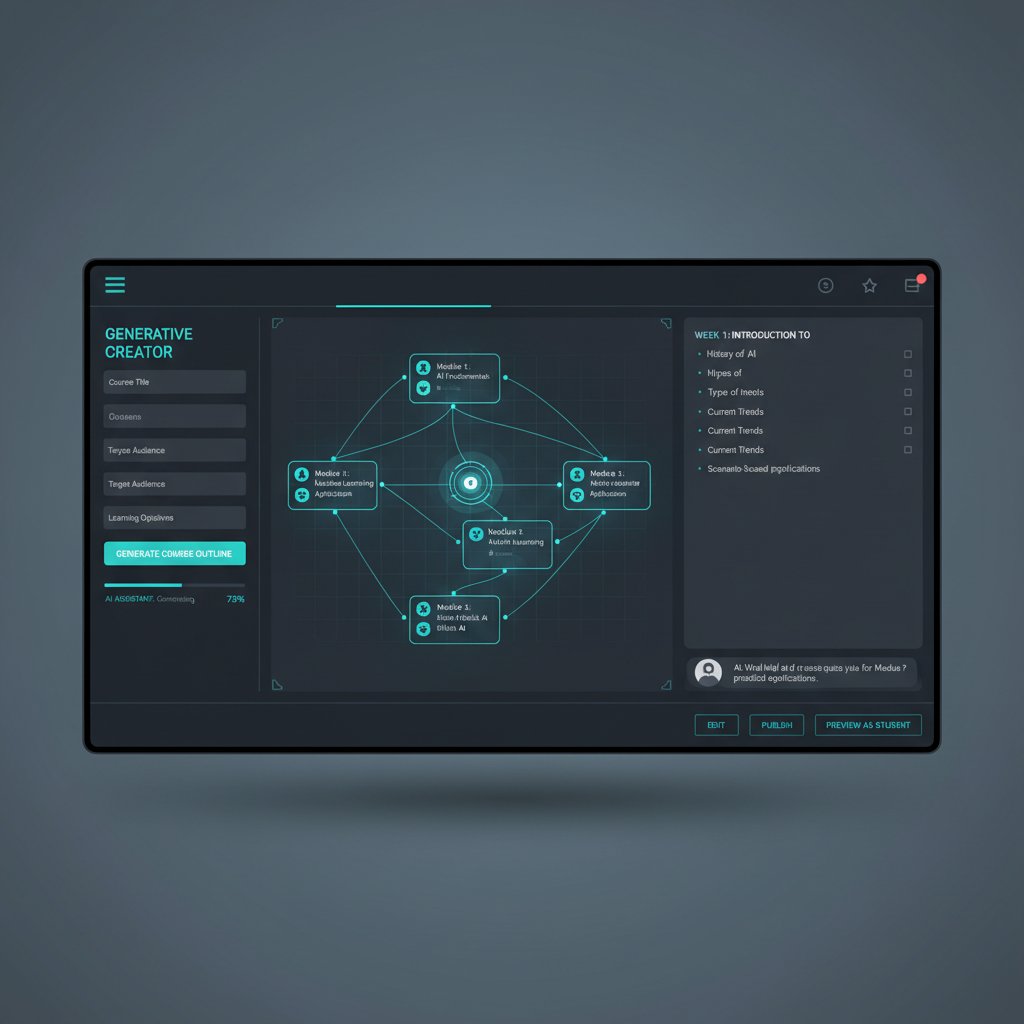
The real value? LLMs slash the grunt work and let creators focus on high-level strategy and student experience rather than shuffling files and writing endless intros.
Hidden labor: the humans behind ‘fully automated’ claims
Despite the “no human required” claims, real-world automation always hides a skeleton crew. Platform vendors love to tout 100% AI, but content moderation, instructional design review, and compliance checks still lean heavily on human expertise.
“AI should be leveraged to automate repetitive tasks, not replace human creativity.” — Heights Platform, 2024 (Heights Platform, 2024)
In reality, “fully automated” course builds often involve:
- Human editors reviewing and polishing AI drafts
- Designers customizing visual elements for brand or accessibility
- Subject matter experts fact-checking and ensuring relevance
The AI-human hybrid isn’t a bug—it’s the only way to ensure quality. Smart creators don’t fear this; they build workflows that exploit AI’s speed without sacrificing expertise.
The anatomy of an automated course workflow
How do the best-in-class platforms pull it off? The anatomy of ai-powered online course creation automation looks something like this:
- Input and scoping: Creator inputs topic, objectives, audience, and resources.
- AI-driven outline generation: LLM produces modular outlines and recommended content flow.
- Draft content creation: AI drafts lessons, quizzes, and multimedia assets.
- Human review and enrichment: Subject experts refine and personalize content.
- Automated deployment and analytics: AI launches course, monitors learner progress, and suggests improvements.
- Iterative optimization: Continuous feedback loop between learner data and course updates.
This workflow doesn’t just speed things up—it lets creators focus on what matters: originality, interactivity, and learner results. But not every platform delivers the same experience. The devil really is in the details.
The 7 brutal truths of ai-powered online course automation
Not all automation is created equal
The term “AI-powered” is practically meaningless without context. Some platforms slap on a chatbot and call it a day. Others, like futuretask.ai, integrate deep automation across the full content lifecycle—creation, assessment, analytics, and iteration.
| Feature | Basic Automation | Advanced AI Automation | Full Workflow Integration |
|---|---|---|---|
| Content generation | Prebuilt templates | AI-drafted, adaptive | AI + human collaborative |
| Assessment and grading | Auto-scoring quizzes | Adaptive, AI-generated | Data-driven improvement |
| Personalization | Fixed paths | Adaptive learning | Real-time adaptation |
| Analytics and feedback | Static reports | Learning analytics | Generative insights, alerts |
Table 2: The automation spectrum—don’t be fooled by surface-level AI. Source: Original analysis based on eLearning Industry, 2024, Heights Platform, 2024
Without thoughtful integration, “automation” can mean little more than adding an extra step—without solving real problems.
AI can accelerate, but not invent, your expertise
AI moves fast. But it still needs your expertise to move in the right direction. As industry analysis repeatedly shows, the most successful courses in 2024 are those where creators use AI to amplify their unique voice—not outsource it.
“AI enables hyper-personalization, adaptive learning, and real-time support. But it cannot replace the substance of an expert’s perspective.” — eLearning Industry, 2024 (eLearning Industry, 2024)
This is where the line is drawn: AI can fill in gaps, but it cannot conjure deep knowledge or authentic passion out of thin air.
You’re still accountable: plagiarism, bias, and accuracy risks
AI-generated content isn’t immune from old-school pitfalls. In fact, it can amplify them. The accountability clock now ticks faster for creators as platforms and learners hold you responsible for:
- Plagiarism: LLMs can “borrow” phrasing from their training data—sometimes too closely.
- Bias: If the training data has gaps or slants, your course might, too.
- Accuracy: AI can hallucinate facts, especially on niche or rapidly changing topics.
- Data privacy: Using learner data to personalize content raises compliance and trust concerns.
Savvy creators use AI to check their own output and build in multiple layers of review. Automation is a tool, not an excuse.
Creativity isn’t dead—just different
The rise of AI in course creation doesn’t signal the end of creativity; it simply changes where and how it happens. If anything, the tools open new frontiers, letting you experiment with formats, interactivity, and narrative in ways that were previously impossible at scale.

The secret sauce? Leveraging AI for the heavy lifting, then injecting your own storytelling, humor, or insight at the moments that matter most. The best courses don’t hide the human touch—they amplify it. If you’re phoning it in, learners will notice. If you’re making the AI work for you, audiences will stick around.
Case studies: automation unleashed (and unhinged)
The entrepreneur who scaled 20X overnight
In 2023, a solo founder built a micro-learning platform using AI-powered automation. Instead of the usual months-long content grind, she launched 25 courses in three weeks, targeting niche topics and underserved communities. The result: a 20X spike in paying users and partnerships with two universities. According to third-party analytics, her learner engagement scores were on par with much larger, agency-built courses.

“Automation didn’t just save me time—it let me focus on building a genuine community instead of churning out slides.” — Founder interview, eLearning Industry, 2024
The bottom line? When wielded well, ai-powered online course creation automation lets even solo creators punch above their weight.
When AI automation backfires: a cautionary tale
Not every automation story ends with a standing ovation. In 2024, a global e-learning brand rushed to launch a suite of “fully automated” AI courses. Within weeks:
| Issue | Impact | Cause |
|---|---|---|
| Plagiarized content | 3 courses removed from platform | Poor LLM prompt oversight |
| Misaligned objectives | 1,200+ learner complaints | Lack of expert review |
| Data privacy breach | Public backlash, legal scrutiny | Inadequate compliance checks |
Table 3: When speed trumps quality, AI automation can trigger brand crises. Source: Original analysis based on Cengage Group, 2024, eLearning Industry, 2024
The lesson? You can’t automate away responsibility—especially when learners, regulators, and competitors are watching with hawk eyes.
Cross-industry lessons: what education can steal from publishing and music
Other creative industries learned automation’s lessons the hard way. Here’s what online educators should steal (with pride):
- Curation over saturation: Spotify’s algorithmic playlists work only because of human curators. In courses, quality beats quantity—always.
- Branding is king: Automated content is a commodity. Branded, personality-driven content forges loyalty.
- Community = durability: As with YouTube and Patreon, thriving courses often build around active, engaged communities—not just passive consumption.
These insights, pilfered from media and music, are now essential for anyone embracing ai-powered online course creation automation.
Debunking the myths: what AI can—and can’t—do for course creators
Myth #1: AI replaces all human creativity
The marketing loves this myth. The reality: even the best LLM can only remix, not reinvent, the magic of a passionate educator or creative entrepreneur.
Definition List:
- Human-in-the-loop An approach that combines AI generation with human review and editing, ensuring both speed and quality. It’s the gold standard for serious course creators.
- Template fatigue The diminishing returns when learners encounter too many lookalike, AI-generated modules. Original voice and perspective keep content fresh.
Myth #2: Automation means zero effort
Even the slickest automation requires upfront work—strategy, prompt engineering, and (most importantly) ongoing oversight. Here’s what actually happens:
- Creators must set clear learning objectives and vet AI outputs for accuracy and tone.
- Iterative testing is needed to catch subtle errors or misaligned assessments.
- Continuous learner feedback and analytics drive real improvement.
- Compliance, accessibility, and privacy checks never go away.
If anyone tells you AI course creation is “one click and done,” they’re selling snake oil, not software.
Myth #3: AI course content is always original
LLMs can generate dazzling first drafts, but originality isn’t guaranteed. Plagiarism checkers and human editors play a crucial role in protecting your brand—and your learners.

The takeaway: treat AI as a collaborator, not a ghostwriter. Your reputation depends on it.
The new playbook: actionable strategies for leveraging ai-powered automation
Step-by-step guide to mastering AI course creation
Ready to harness the real power of ai-powered online course creation automation? Here’s how the experts do it:
- Clarify your learning outcomes: Define clear, measurable goals for what your audience will achieve.
- Select the right platform: Prioritize tools offering deep automation, robust analytics, and human-in-the-loop features (futuretask.ai is a prime example).
- Input quality data: Feed the AI with detailed prompts, resources, and style guides to maximize output relevance.
- Iterate with feedback: Review AI drafts, test with a pilot audience, and refine based on real-world results.
- Layer in interactivity: Use AI tools to add quizzes, assignments, and adaptive paths for richer learner engagement.
- Monitor analytics: Track learner progress, engagement, and outcomes—then let AI suggest optimizations.
- Maintain compliance: Regularly audit content for originality, bias, and privacy risks to protect your brand.

By following these steps, you’ll turn AI from a buzzword into a competitive edge—without cutting corners.
Checklist: are you ready for AI automation?
- You have defined learning goals and a unique value proposition.
- You’re willing to invest time in curating, not just generating, content.
- You understand your audience’s needs and expectations.
- You’re comfortable adopting new tools and experimenting with workflows.
- You have access to plagiarism checkers and can monitor compliance.
- You’re prepared to respond to learner feedback quickly and iteratively.
If you’re nodding along, you’re ready to ride the AI wave—not get swept away.
How to choose an AI-powered platform (and red flags to avoid)
| Criteria | Green Flag | Red Flag |
|---|---|---|
| Workflow integration | Seamless, supports human-in-the-loop | Limited, “black box” AI |
| Analytics and reporting | Actionable insights, adaptive feedback | Static, minimal reporting |
| Compliance tools | Built-in plagiarism, privacy features | None or manual only |
| Community support | Active, transparent updates | Sparse, locked-down forums |
Table 4: Choosing a platform is as much about what’s hidden as what’s advertised. Source: Original analysis based on eLearning Industry, 2024, Heights Platform, 2024
In short: if a platform can’t show you how the sausage is made—or if it ignores compliance and analytics—run the other way.
Risks, ethics, and the future: who controls the knowledge factory?
The ethics of automated learning content
As AI-generated education scales, new ethical dilemmas surface. Who owns the content? Who’s liable for mistakes? What happens when a bot perpetuates bias or misinformation?

“Ethical marketing and transparency are essential to maintain learner trust.” — Industry analyst, Heights Platform, 2024 (Heights Platform, 2024)
The bottom line: creators who lead with transparency, clear disclaimers, and active moderation will win trust—even as automation accelerates.
Data privacy and copyright: what you need to know
- Vet your AI vendors: Ensure platforms comply with GDPR, CCPA, and global data privacy regulations.
- Check content sources: AI models should be trained on licensed, reputable data sets—never “scraped” or pirated material.
- Audit regularly: Build in recurring compliance checks for plagiarism, data leaks, and unauthorized content reuse.
- Disclose use of AI: Inform learners when and how AI is used in course generation—transparency breeds trust.
- Retain human oversight: Never allow 100% automation on sensitive topics or assessments.
Following these steps keeps your operation above board—and your learners protected.
Will AI course automation democratize—or commoditize—education?
| Scenario | Outcome | Risks |
|---|---|---|
| Democratization | Lowered barriers, more voices | Market saturation, discovery challenges |
| Commoditization | Cheap, rapid course proliferation | Decline in quality, learner trust |
| Hybrid (community-led) | Depth, diversity, and engagement | Requires active curation, ongoing effort |
Table 5: AI can open doors or flood the market. Which path wins depends on how creators use the tools. Source: Original analysis based on Cengage Group, 2024, eLearning Industry, 2024
If you’re using AI to mass-produce bland, forgettable content, you’re just adding noise. If you’re using it to enable more voices, deeper engagement, and authentic learning, you’re changing the game.
Expert insights: what real creators and technologists are saying
Contrarian voices: warnings from the AI skeptics
Not everyone’s drinking the AI Kool-Aid. Some industry veterans warn that over-reliance on automation can backfire, especially when it comes to nuance, empathy, and trust.
“Continuous learning analytics and generative AI will redefine education—but not without growing pains.” — eLearning Industry, 2024 (eLearning Industry, 2024)
The smartest teams combine skepticism with experimentation, using AI as an extension—not a replacement—of genuine expertise.
Futuretask.ai and the rise of task automation platforms
In the midst of this gold rush, platforms like futuretask.ai are emerging as leaders by focusing on intelligent, full-spectrum automation. Their approach integrates advanced LLM tech with robust compliance, analytics, and seamless workflow management. The value? Not just speed—but precision, scalability, and consistent quality at a time when the stakes for educators and learners have never been higher.

By embedding AI deeply into the course creation lifecycle, futuretask.ai exemplifies how automation, when wielded intelligently, becomes a force multiplier—not a creativity killer.
What’s next: AI-powered creativity, collaboration, and chaos
- Expect even deeper integration of learning analytics, letting AI adapt not just content but the entire learner journey in real-time.
- Look for platforms that prioritize community-building and collaboration over solo content churn.
- Get ready for a new breed of course creators—hybrids who blend subject matter expertise with AI fluency.
- Watch for regulatory crackdowns on platforms that ignore compliance, transparency, or learner safety.
- Finally, prepare for the unexpected: in this revolution, the only constant is change.
Your move: making AI automation work for you
Quick reference: decoding the jargon
Definition List:
- AI-powered course builder A platform that uses artificial intelligence to generate, organize, and optimize course materials based on user input and learning data.
- Learning content automation The process of automating the creation, curation, and delivery of educational materials, often using LLMs and data analytics.
- Adaptive learning analytics Real-time data analysis that personalizes course materials and pacing for each individual learner.
Priority checklist: setting up your first AI-powered course
- Define your target audience and learning goals—be specific.
- Choose a reputable AI-powered platform—consider workflow, analytics, and compliance.
- Prepare high-quality input materials—the better your prompts and resources, the better your outcome.
- Set up review processes—schedule human-in-the-loop checks at each stage.
- Test with a small audience—gather real feedback before scaling.
- Continuously monitor analytics and optimize—let data drive your improvements.
- Stay transparent—disclose AI involvement and maintain compliance.
These steps are your insurance policy against mediocrity or missteps.
Key takeaways and the future of human-driven learning
The revolution isn’t coming—it’s already here. Ai-powered online course creation automation has shattered the limits of speed, scale, and personalization in education. But the secret no one tells you? The best results come from creators who wield AI as a tool, not a crutch.

As the lines blur between human craft and machine precision, the winners will be those who double down on originality, transparency, and empathy. Platforms like futuretask.ai are proving that when AI augments creative vision, the possibilities for impactful, learner-centered education are virtually limitless.
So—will you be a passenger in the knowledge economy, or the architect of what comes next? The choice, and the opportunity, have never been clearer.
Sources
References cited in this article
- eLearning Industry(elearningindustry.com)
- Cengage Group(cengagegroup.com)
- Zion Market Research(zionmarketresearch.com)
- Heights Platform(heightsplatform.com)
- F.Learning Studio(flearningstudio.com)
- Heights Platform(heightsplatform.com)
- SellCoursesOnline(sellcoursesonline.com)
- Whop.com(whop.com)
- E-Learning Partners(e-learningpartners.com)
- SellCoursesOnline(sellcoursesonline.com)
- Learning Revolution(learningrevolution.net)
- Forbes(forbes.com)
- CourseMagic(coursemagic.ai)
- Rycolab LLM Course(rycolab.io)
- Kolena Guide(kolena.com)
- Accel.ai(accel.ai)
- Springer(link.springer.com)
- MIT Sloan(mitsloan.mit.edu)
- Medium(medium.com)
- EdTechReview(edtechreview.in)
- TheDigitalInsider(thedigitalinsider.com)
- CourseAI Studio Review(akoreviews.systeme.io)
- Medium(medium.com)
- ResearchGate(researchgate.net)
- Educational Tools(educational.tools)
- Entrepreneur(entrepreneur.com)
- Udemy(udemy.com)
- Heights Platform(heightsplatform.com)
- SHRM(shrm.org)
- LearningNews(learningnews.com)
- eSchoolNews(eschoolnews.com)
- AIMojo(aimojo.io)
Automate Your Tasks, Transform Your Business
FutureTask.ai revolutionizes your workflow by automating complex tasks typically outsourced to freelancers and agencies. Our powerful AI-driven platform leverages cutting-edge LLM technology to deliver precision, speed, and consistency at scale. Whether you're managing content creation, data analytics, marketing campaigns, or customer support, FutureTask.ai ensures seamless task execution, significant cost savings, and unmatched efficiency. Transform your business operations, eliminate delays, reduce operational overhead, and gain a competitive advantage with intelligent automation.
Get startedReady to Automate Your Business?
Start transforming tasks into automated processes today
Frequently Asked Questions
What is the current size of the online learning market?
According to the article, the online learning platforms market was valued at $35.2 billion as of 2023, based on Zion Market Research data.
What are the main challenges of manual course creation mentioned in the article?
The article describes manual course creation as a time-consuming process involving weeks or months of outlining modules, writing scripts, recording video, editing slides, and wrestling with learning management systems, which often leads to creator burnout and mediocre, cookie-cutter courses.
Does the article suggest AI-powered course creation is primarily a threat or opportunity?
The article frames AI-powered course creation automation as both 'a lifeline and a landmine,' presenting it as having both risks and opportunities for creators, educators, and digital entrepreneurs.
What is the article's main claim about the biggest threat from AI course creation automation?
According to the article, the biggest threat isn't the technology itself, but rather pretending the revolution isn't already happening.
From the Archive
Explore more from Ai-powered task automation

Automated Content Generation Using Ai: Benefits and Risks

Ai-Powered Digital Marketing Automation: Win Big, Avoid the Trap

Ai-Powered Talent Acquisition Automation: What Actually Works

How AI-Powered Automated Insights Generation Reshapes Organizations

Automated Blog Writing Tools: What Actually Works and What Fails
