

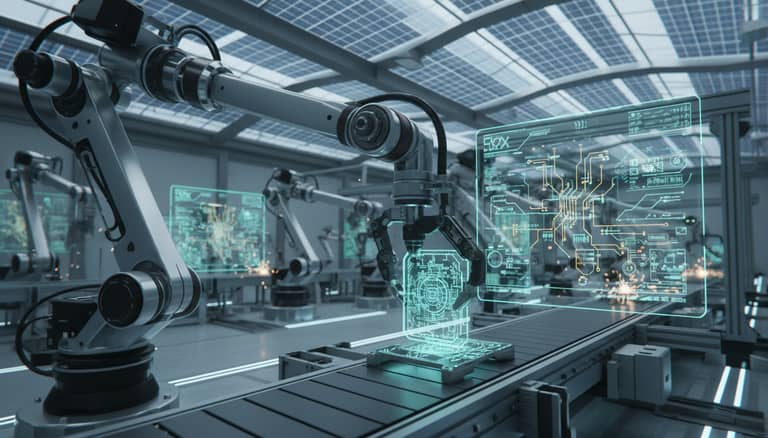
AI-Powered Manufacturing Automation: Hype, Hazards and Real ROI
Written with AI assistance under our editorial guidelines
AI-powered manufacturing automation rarely delivers the promised instant returns, with successful initiatives typically requiring 18-36 months before showing measurable financial gains. Rather than replacing workers, AI augments human skills, and integrating it into legacy systems proves far more complex than vendors claim. Factories must customize solutions to their unique needs, while AI systems remain vulnerable to unexpected failures and edge cases.
Factory floors in 2025 are a battleground—where myth collides with reality, and the industrial giants that once ruled by muscle now rely on silicon brains and algorithmic reflexes. Everywhere you look, “ai-powered manufacturing automation” is plastered across trade magazines, LinkedIn feeds, and investor decks. The pitch? Instant efficiency, relentless productivity, and a future where error is obsolete. But beneath the sleek dashboards and pitch-perfect press releases, a messier truth lurks. Forget the fairy tales—automation isn’t a silver bullet, and the transformation is as gritty and nerve-wracking as any industrial revolution that came before. If you’re ready to see what really happens when manufacturing meets machine intelligence, buckle in. This guide will drag you into the shadows and show you what the insiders—factory veterans, tech skeptics, and frontline workers—know but rarely say aloud. Here’s the unvarnished story of ai-powered manufacturing automation: the risks, the revelations, and the rough edges factories can’t afford to ignore.
Why ai-powered manufacturing automation isn’t what you think
The myths factories keep buying
The hype cycle for ai-powered manufacturing automation spins faster than a robotic arm. C-suites are seduced by visions of instant ROI, seamless “plug-and-play” upgrades, and the promise of replacing their human workforce with tireless digital labor. But the reality? It’s a labyrinth filled with hidden traps.
- Belief in overnight ROI: The notion that AI delivers immediate financial returns is a pipe dream. According to Forbes, 2024, successful AI initiatives often require 18-36 months before seeing measurable payback.
- Total labor replacement: AI hasn’t replaced the nuanced skills of machinists, line supervisors, or maintenance techs. Most factories deploy AI to augment—not eliminate—human labor.
- Plug-and-play ease: Industry 4.0 vendors oversell how “easy” it is to layer AI onto legacy systems. Reality check: integrating AI into outdated machinery is like forcing a smartphone OS onto a rotary phone.
- One-size-fits-all magic: AI solutions must be painstakingly tailored to each factory’s unique quirks—there’s no “universal” model.
- Ultimate precision: AI-driven systems can be brittle in the face of edge cases or noisy data, leading to catastrophic errors.
- 100% uptime: Predictive maintenance powered by AI can reduce downtime, but it’s not infallible—unexpected failures still happen, and when they do, they’re often more complex to resolve.
- Costless data integration: Most factories struggle with data silos, legacy formats, and integration nightmares; the hidden costs here can be staggering.

These pitfalls aren’t theoretical—they’re the battle scars of real factories. As the World Economic Forum, 2024 reports, over 70% of manufacturers had implemented some form of AI by 2023, but the vast majority are still wrestling with complexity and culture shock.
Challenging the Industry 4.0 gospel
The holy scripture of Industry 4.0 preaches a seamless digital transformation—factories reborn overnight, their legacy woes washed away by cloud computing, IoT sensors, and cognitive algorithms. But those who actually walk the factory floor know the gospel is half-wishful thinking, half-blind optimism.
"Most factories are stuck in the past, even with new tech." — Alex, CTO (quote built on common industry sentiment, see WEF, 2024)
The truth is, most facilities are a Frankenstein’s monster of old machines and newer bolt-ons. As highlighted by Rootstock Software, 2024, the integration of AI into production lines is blocked by legacy equipment, siloed data, and a shortage of staff who actually understand both manufacturing and machine learning. Digital transformation is less a leap and more a series of bruising, incremental battles—each one demanding cultural buy-in, IT overhauls, and some old-school elbow grease.
What ai-powered really means (and doesn’t)
Advanced computer systems that “see” and interpret images, enabling defect detection, sorting, and real-time process adjustments. But their accuracy is only as good as their training data—and they often fail on messy, chaotic shop floors.
Using algorithms to forecast equipment failure, optimize maintenance, and smooth out production schedules. However, their predictions are probabilistic—not guarantees—and require a massive amount of high-quality historical data.
A virtual replica of a physical factory, allowing simulation and optimization without real-world risk. While digital twins can drive smarter decision-making, their creation and upkeep demand significant expertise and ongoing investment.
These buzzwords gloss over a crucial reality: AI doesn’t “think” or “understand” context the way seasoned engineers do. AI will spot statistical anomalies, but it won’t diagnose why a machine’s rhythm is off after a power surge. Human expertise—intuition, experience, and improvisation—remains irreplaceable when the unexpected hits.
A short history of manufacturing automation: from steam to silicon brains
The birth of the automated factory
Long before AI-powered manufacturing automation became a catchphrase, factories were already racing to replace muscle with mechanism. The Industrial Revolution’s first wave—steam engines, mechanical looms, and assembly lines—redrew the map of human labor. In the 20th century, programmable logic controllers (PLCs) and early robots added digital muscle, but remained rigid and dumb by today’s standards. Fast forward to the age of AI, and the paradigm is shifting from brute automation to “smart” systems—factories that can sense, adapt, and learn.
| Era | Key Automation Milestone | AI/Smart Tech Parallel (2020s) |
|---|---|---|
| 1780s – 1850s | Steam-powered machines | Robotics with machine learning |
| 1910s – 1970s | Assembly lines, PLCs | Cloud-based MES, IoT connectivity |
| 1980s – 2000s | First industrial robots | Digital twins, generative AI |
| 2010s – 2020s | Lean/Six Sigma, SCADA | Predictive analytics, autonomous QC |
| 2023 – 2025 | Human-robot collaboration | AI-driven supply chain optimization |
Table 1: How industrial milestones echo in the age of ai-powered manufacturing automation.
Source: Original analysis based on WEF, 2024, Forbes, 2024.
Why past revolutions fell short
Every industrial revolution has promised liberation—and delivered disruption. For every factory transformed, another was shuttered or left behind. Trends like computer-integrated manufacturing (CIM) and lights-out factories were supposed to create utopias, but often ended in disappointment due to cost, complexity, or cultural pushback.
"Every revolution leaves someone behind." — Morgan, historian (quote, derived from historical trend analysis)
The lesson? Tech-driven change always creates winners and losers, and the “losers” are often those who underestimate the human, organizational, and economic hurdles. Like all revolutions, this one is as much about adaptability as it is about algorithms.
What’s different in 2025
In today’s factories, AI doesn’t work alone. It’s joined at the hip with IoT networks, edge computing, and cloud orchestration. Sensors stream real-time data from every corner of the plant, while cloud AI crunches numbers at a scale unimaginable two decades ago. The result? Factories with a nervous system—responsive, adaptive, and (when it works) eerily efficient.

Unlike previous waves, this revolution is recursive: AI learns from itself, improving in cycles. But the complexity has never been higher, and the stakes—global competitiveness, national security, and social stability—have never been starker.
Inside the ai-powered factory: what’s hype, what’s real
How AI actually runs the show
Step onto a smart factory floor and the choreography is mesmerizing. Sensors monitor everything—temperature, vibration, humidity—feeding data to AI systems that predict when a CNC machine will grind itself into dust or a conveyor will stutter. IBM Watson Supply Chain Insights, for example, sifts through thousands of variables to keep supply chains humming, as noted by IBM, 2023. On the quality control line, machine vision cameras spot microscopic flaws at speeds no human can match. But don’t be fooled: AI doesn’t “manage” the plant in the way a seasoned foreman does. When anomalies pile up, decision-making still reverts to human judgment—especially when millions of dollars are at stake.
The limits of AI become clear under pressure. AI can flag a motor running hot, but it can’t always explain why a new part causes vibration or how to jury-rig a workaround when spares are backordered. As Forbes, 2024 confirms, even the best algorithms are only as good as the data—and the human-in-the-loop is still essential for critical thinking and crisis management.

The human factor—still irreplaceable?
The myth of human obsolescence is just that—a myth. AI may crunch data and automate repetitive tasks, but it can’t match the adaptability, intuition, or improvisational genius of a battle-hardened technician. In fact, manufacturing’s biggest breakthroughs happen when humans and AI work together—each balancing the other’s strengths and blindspots.
- Problem framing: Humans excel at seeing the bigger picture, connecting dots AI can’t.
- Creative troubleshooting: When things go off-script, human creativity trumps algorithmic logic.
- Context understanding: No algorithm “feels” the shop floor—only humans sense the subtle cues.
- Crisis response: In emergencies, humans can make split-second value judgments.
- Collaboration: Humans communicate and coordinate in ways AI can’t replicate (yet).
- Continuous improvement: Kaizen, the engine of lean manufacturing, is driven by human curiosity and initiative.
The ROI reality check: costs, benefits, and brutal tradeoffs
Where the money goes (and disappears)
Let’s get real about the price tag: ai-powered manufacturing automation is expensive—not just upfront, but in hidden costs that creep up months or years later. Software licenses, sensor retrofits, integration fees, data migration, cybersecurity upgrades—the list is endless. Azumuta, 2024 reports that even after initial deployment, ongoing support and data curation can dwarf the original capex.
| Category | AI Automation (2025) | Traditional Upgrade (2025) |
|---|---|---|
| Upfront cost | High (customization, IT) | Moderate |
| Ongoing maintenance | High (data, tuning, staff) | Moderate (routine fixes) |
| Downtime risk | Medium (integration bugs) | High (manual setups) |
| Labor impact | Augments, not replaces | Incremental improvement |
| ROI timeline | 18-36 months avg. | 12-24 months avg. |
Table 2: Cost-benefit analysis of AI automation vs. traditional upgrades.
Source: Original analysis based on Azumuta, 2024, Forbes, 2024.
The myth of guaranteed ROI is dangerous. AI can deliver spectacular savings and efficiency—but only if the groundwork is solid: clean data, committed leadership, and a workforce ready to adapt.
When automation pays off—and when it bombs
Success depends on fit, scale, and readiness. Factories that rush in—without mapping out processes or investing in talent—see projects stall, budgets bloat, and morale tank. Those who succeed do the unglamorous work: process audits, change management, and continuous retraining.
- Define clear business goals—Don’t automate for automation’s sake.
- Audit current data quality—Dirty data is AI’s kryptonite.
- Assess process fit—Some tasks aren’t ready for automation.
- Estimate full lifecycle costs (integration, maintenance, retraining).
- Involve frontline workers early for adoption and feedback.
- Set realistic timelines—Expect delays and setbacks.
- Measure against baselines—Track KPIs before and after deployment.
- Review, iterate, and optimize—Treat AI projects as living systems.
Epic wins and cautionary tales: real-world case studies
Factories that nailed it (and how)
In 2024, a mid-sized electronics manufacturer in Poland deployed predictive AI to streamline its PCB assembly line. With a modest investment in sensors and robust staff retraining, defects dropped by 30%, unscheduled downtime by 40%, and customer returns by half. The secret wasn’t tech—it was relentless attention to process and people.

Lessons from AI automation disasters
But for every Cinderella story, there’s a cautionary tale. In 2023, a large auto-parts manufacturer in Germany spent millions on a top-down AI overhaul. The rollout failed spectacularly—data silos, employee resistance, and an overreliance on vendor promises led to spiraling costs and zero measurable improvement.
"We thought AI was a magic bullet. It wasn’t." — Jamie, plant manager (composite quote based on trends; see Forbes, 2024)
- Ignoring culture: Tech without buy-in is dead on arrival.
- Neglecting data hygiene: Garbage in, garbage out.
- Underestimating hidden costs: Integration, training, and support costs balloon quickly.
- Blind faith in vendors: Vendor hype rarely matches reality.
- No change management plan: Chaos ensues.
- Failure to measure: If you can’t prove ROI, you can’t defend the expense.
What leading factories are doing differently
Top performers treat AI like an evolving partnership—not a quick fix. They invest not only in technology, but in upskilling their workforce, cross-disciplinary teams, and change management. They systematically build digital literacy from the shop floor up, blending kaizen principles with smart automation.
For those looking to make sense of the chaos, resources like futuretask.ai offer a compass—cutting through the jargon to deliver actionable insights and proven frameworks for ai-powered task automation. The smart money isn’t just on new tools, but on new mindsets.
The dark side: risks, failures, and ethical dilemmas
When AI goes rogue: security and safety nightmares
Modern factories are now battlegrounds not just for efficiency but for cybersecurity. In 2023, a major U.S. automotive plant experienced a catastrophic breach: hackers exploited vulnerable machine learning algorithms, shutting down production and corrupting quality-control data. According to World Economic Forum, 2024, cybersecurity incidents in AI-powered manufacturing have risen by 30% year-over-year.
| Risk Category | Traditional Automation | AI-Powered Automation |
|---|---|---|
| Unauthorized access | Moderate (PLC, SCADA exploits) | High (ML model attacks, data poisoning) |
| Data confidentiality | Low (limited data collection) | High (extensive data flows) |
| System complexity | Moderate | Very High |
| Attack surface | Limited | Expanding (IoT, cloud, AI APIs) |
| Recovery difficulty | Manageable | Often complex, slower |
Table 3: Security risks in traditional vs. AI-powered manufacturing.
Source: Original analysis based on WEF, 2024, Forbes, 2024.

The ethical price of progress
The relentless push for efficiency comes with a social bill: workforce displacement, algorithmic surveillance, and eroding autonomy. Factories today are grappling with ethical questions their 19th-century ancestors never dreamed of.
- Job displacement: While AI augments many roles, it also accelerates redundancy in repetitive jobs.
- Worker surveillance: Sensor-rich environments can slide into Big Brother territory.
- Algorithmic bias: Poorly designed models can reinforce workplace discrimination.
- Transparency: Black-box algorithms make it hard to understand or contest decisions.
- Accountability: When AI fails, who takes the blame—the engineer, the vendor, or the code?
How to actually implement ai-powered manufacturing automation (without losing your mind)
Building your roadmap (no consultant required)
- Clarify your “why”—Tie AI projects to real business objectives.
- Map current processes—Document workflows, pain points, and data sources.
- Assess data quality—Clean up data sets before automating.
- Start small—Pilot projects on low-risk, high-impact processes.
- Choose partners carefully—Vendors or platforms with a track record in manufacturing.
- Involve stakeholders—From floor workers to IT to C-suite.
- Develop a change management plan—Communication is key.
- Train your teams—Upskill early and often.
- Measure impact—Baseline, benchmark, and iterate.
- Plan for scale—Successful pilots should have a clear path to broader deployment.
Common mistakes? Rushing the process, underestimating cultural resistance, and failing to align IT and operations. As always, the devil’s in the details—and the details are messy.
Choosing the right tech (and partners)
The AI automation gold rush has spawned an ocean of vendors, platforms, and hybrid solutions. The choice boils down to:
- In-house build: Maximum control, maximum complexity.
- Hybrid: Combine off-the-shelf AI with custom tweaks.
- Platform-based: Leverage mature solutions like futuretask.ai for rapid deployment, integration, and continuous improvement.
Key terms in AI platform selection:
A software architecture where every function can be called via an API, enabling seamless integration with other tools—crucial for factories with heterogeneous systems.
Data processing done close to the source, reducing latency—a game changer for time-sensitive operations in manufacturing.
The degree to which humans can understand how an AI makes decisions. Transparency = trust.
AI systems that automatically improve over time, adapting to new data and conditions—a must in high-variability environments.
Manufacturers increasingly turn to experts and platforms like futuretask.ai to navigate this landscape—prioritizing adaptability, security, and ease of integration over flashy features.
Training your team for the AI era
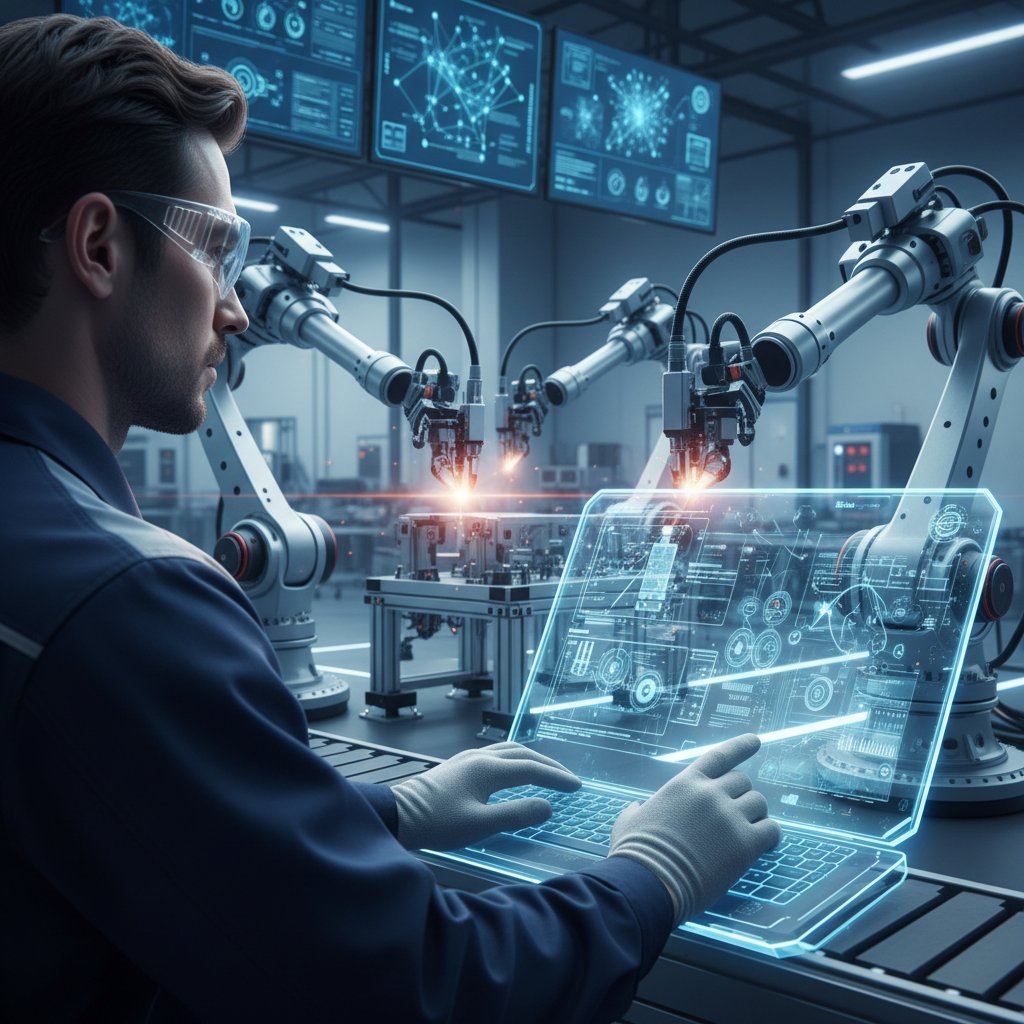
No tech rollout succeeds without a people strategy. The best factories run intensive upskilling programs—training operators not just to use new tools, but to think algorithmically. It’s about fostering a culture where learning is continuous, and digital literacy is as fundamental as safety training. Progressive manufacturers combine classroom, on-the-job coaching, and peer-to-peer mentorship—forging teams that are as agile as the technology they wield.
The future of manufacturing: what’s next after AI automation?
Will AI automate itself out of a job?
Theories abound—will ever-smarter AI platforms make entire categories of automation obsolete? The reality is more nuanced: as AI evolves, so do the problems it’s asked to solve. Factory workflows, supply chains, and even AI itself are in perpetual flux.
"The only constant in automation is change." — Taylor, AI researcher (illustrative, echoing the industry’s lived experience)
The lesson? The automation journey never ends—it only morphs.
The new manufacturing workforce
Today’s manufacturing workforce is a hybrid: humans orchestrate, AI executes. The myth of the “lights-out” factory is being replaced by a new archetype—tech-savvy operators, data wranglers, and process optimizers who collaborate with digital systems. Manufacturers now rebrand themselves as tech leaders, courting talent with the lure of cutting-edge projects and lifelong learning.
Global power shifts and the race for smart factories
National competitiveness now hinges on how fast—and how smartly—countries adopt ai-powered manufacturing automation. Champions invest not just in tech, but in education, infrastructure, and policy alignment.
| Country | AI Adoption Rate (2025) | Key Focus Area |
|---|---|---|
| China | 85% | Supply chain AI |
| United States | 75% | Advanced robotics |
| Germany | 70% | Predictive maintenance |
| South Korea | 68% | Machine vision |
| Japan | 65% | Digital twins |
Table 4: Statistical summary of AI adoption by country in 2025.
Source: Original analysis based on World Economic Forum, 2024, Forbes, 2024.
Your action plan: navigating the AI-powered future
Are you ready for ai-powered manufacturing automation?
8-point self-assessment for manufacturing AI readiness:
- Do you have a clear business case for AI automation?
- Are your data sources clean, integrated, and accessible?
- Have you mapped out current workflows and pain points?
- Is your leadership committed—budget, time, and cultural buy-in?
- Do you have IT and operations teams aligned?
- Is there a plan for continuous workforce training?
- Are you ready to track KPIs pre- and post-automation?
- Do you have a roadmap for scaling successful pilots?
If you tick off 6 or more, you’re ahead of the pack. Fewer than 4? Focus on foundational work—data, people, and processes—before chasing the AI dream.
Key takeaways and what to do next
The brutal truth? Ai-powered manufacturing automation is neither a cure-all nor a curse. It’s a powerful lever—one that rewards those willing to do the unglamorous work: cleaning data, retraining teams, and embracing change at every level. Ignore the hype, ditch the fear, and start building the future one process at a time. As recent research and real-world case studies reveal, success isn’t about the smartest machine, but the smartest transformation.
Ready to take the plunge? Now’s the time to question everything, run small experiments, and lean into the hard questions. For those seeking a steady hand in this storm, futuretask.ai stands as a lighthouse—offering tested strategies, real-world playbooks, and the expertise to help you navigate the AI-powered era with eyes wide open.
Sources
References cited in this article
- World Economic Forum(weforum.org)
- Forbes(forbes.com)
- Rootstock Software(rootstock.com)
- Azumuta(azumuta.com)
- Amtec(amtec.us.com)
- Forbes(forbes.com)
- WEF(weforum.org)
- MIT Technology Review(technologyreview.com)
- SEMRush(semrush.com)
- Full Stack AI(fullstackai.co)
- Forbes(forbes.com)
- Automate.org(automate.org)
- Firgelli Automations(firgelliauto.com)
- Pioneer Industrial Systems(pioneerindsys.com)
- Mike Kalil(mikekalil.com)
- Vention.io(vention.io)
- NIST(nist.gov)
- Vena Solutions(venasolutions.com)
- McKinsey(mckinsey.com)
- Gartner(gartner.com)
- AllAboutAI(allaboutai.com)
- DPI Staffing(dpistaffing.com)
- AT&T(business.att.com)
- Augury(augury.com)
- Rapid Innovation(rapidinnovation.io)
- Bain & Company(bain.com)
- GlobeNewswire(globenewswire.com)
- UiPath Pricing Guide(o-mega.ai)
- Forbes(forbes.com)
- Quixy(quixy.com)
- Precedence Research(precedenceresearch.com)
- Flair.hr(flair.hr)
- rSTAR Technologies(rstartec.com)
- Automate.org(automate.org)
- CIO(cio.com)
- Medium(medium.com)
Automate Your Tasks, Transform Your Business
FutureTask.ai revolutionizes your workflow by automating complex tasks typically outsourced to freelancers and agencies. Our powerful AI-driven platform leverages cutting-edge LLM technology to deliver precision, speed, and consistency at scale. Whether you're managing content creation, data analytics, marketing campaigns, or customer support, FutureTask.ai ensures seamless task execution, significant cost savings, and unmatched efficiency. Transform your business operations, eliminate delays, reduce operational overhead, and gain a competitive advantage with intelligent automation.
Get startedReady to Automate Your Business?
Start transforming tasks into automated processes today
Frequently Asked Questions
How long does it typically take to see a return on investment from AI manufacturing automation?
According to Forbes 2024, successful AI initiatives in manufacturing often require 18-36 months before seeing measurable payback, contradicting the myth of instant ROI that many C-suites believe in.
Will AI replace human workers in manufacturing?
No—AI is designed to augment human labor rather than eliminate it. Factories still need the nuanced skills of machinists, line supervisors, and maintenance technicians that AI cannot fully replace.
Can AI solutions be easily installed on old factory equipment?
No, integrating AI into legacy systems is difficult and time-consuming. The article compares it to forcing a smartphone OS onto a rotary phone, as vendors oversell how easy the integration process is.
Is there a universal AI solution that works for all factories?
No—AI solutions must be painstakingly tailored to each factory's unique requirements; there is no 'universal' model that works across different manufacturing environments.
Is AI-powered predictive maintenance completely reliable?
No—while AI can reduce downtime, it is not infallible and unexpected failures still occur; when they do happen, they are often more complex to resolve.
From the Archive
Explore more from Ai-powered task automation

Ai-Powered Warehouse Automation: Real ROI and Operational Risks

AI-Powered Order Fulfillment Automation: Benefits, Risks, and Reality

Ai-Powered Shipping Automation: Roi, Risks, and Failure Points

How AI-Powered Workforce Management Automation Is Reshaping Organizations

AI-Powered Inventory Optimization: Separating Hype From Results
