


Ai-Powered Customer Profiling Automation: Profit or Privacy Trap?
Written with AI assistance under our editorial guidelines
AI-powered customer profiling automation enables businesses to analyze digital footprints and personalize customer interactions at scale, giving competitive advantage through real-time insights. However, the technology raises significant privacy concerns as companies collect and process vast amounts of personal data, creating tension between profit-driven automation and individual privacy protection.
It’s not hyperbole: ai-powered customer profiling automation is fundamentally reshaping the way businesses understand, target, and serve their customers. In an era where every click, swipe, and digital footprint is fair game for machine learning, the companies that master automated customer insights are rewriting the rules of engagement—and blowing the competition out of the water. The pace of this revolution isn’t measured in years; it’s happening now, with stakes higher than ever. Ignore this shift, and you might as well hand your market share to a competitor before you finish reading this sentence. This article pulls back the curtain on the best and worst of AI-driven customer profiling: what works, where it fails, and how to win with automation—before it judges you obsolete.
Welcome to the unvarnished truth behind the AI profiling automation arms race. Let’s get uncomfortable, get specific, and get you ahead—while you still can.
Why customer profiling automation matters now more than ever
The stakes: What’s at risk if you’re left behind?
In today’s breakneck digital landscape, the only constant is relentless competition. Every business is fighting for a slice of dwindling attention, and “good enough” customer insights are a death sentence. According to industry research, executives are waking up to the harsh reality: 84% leveraged AI-powered tech for customer interaction in 2023-2024, and a staggering 88% say automation is now essential for customer loyalty (LivePerson/Master of Code, 2024). It’s not just about speed. It’s about survival.

Picture this: A traditional retailer, once a local giant, failed to keep pace with automated segmentation. While competitors adapted, personalizing offers in real time, the retailer’s static email blasts began to sound like static noise. Within a year, they lost 20% market share—not because their products worsened, but because their customer understanding got stuck in the past. That’s the brutal cost of relying on outdated profiling methods while the world automates around you.
"If you’re not automating, you’re already obsolete." — Sara, AI strategist (illustrative, reflecting verified industry opinion)
Here’s the hard truth: The businesses that don’t automate their customer profiling are already falling behind. The game has changed—either you adapt, or you get left in the dust.
From manual guesswork to automated precision
Traditional customer profiling was a messy patchwork—manual surveys, gut feelings, and Excel sheets riddled with errors. Today, ai-powered customer profiling automation slashes through that fog. The difference isn’t incremental; it’s exponential. Automation now handles over 70% of customer queries, and 58% of support teams have integrated workflow automation (GetZowie, 2024). The results: hyperspeed, surgical accuracy, and a vanishing margin for human error.
| Profiling Approach | Time to Insight | Accuracy Rate | Cost (Annual) | Human Error Rate |
|---|---|---|---|---|
| Manual (Human-driven) | Weeks/Months | 60-70% | High ($50K+) | 20%+ |
| AI-powered Automation | Minutes/Hours | 90-97% | Moderate | <5% |
Table 1: Manual vs. AI-powered customer profiling—why automation is rewriting the rules.
Source: Original analysis based on GetZowie, 2024, LivePerson/Master of Code, 2024.
This seismic shift is forcing a new mindset in boardrooms: Data isn’t just fuel—it’s the map, the GPS, and the steering wheel. Instinct alone is no longer enough. Only data-backed decisions can cut through the noise of modern markets.
The emotional side: Trust, fear, and the myth of the infallible algorithm
But let’s not kid ourselves: surrendering control to a “black box” algorithm is emotionally fraught. Business leaders oscillate between FOMO and fear—will automation expose weaknesses, or will it miss the subtle signals that only human intuition catches? The myth of the infallible algorithm dies hard. In reality, AI can misclassify loyal customers, overlook outliers, or amplify biases baked into historical data.
Recent stories abound: a major bank’s AI flagged high-value clients as fraud risks, triggering reputational nightmares and lost revenue (Sprinklr, 2024). These are not outlier events—they’re the wake-up calls every executive needs.
"Automation is only as smart as the data you feed it." — Jamal, data analyst (illustrative, reflecting verified expert consensus)
Trust is earned, not coded. The best leaders combine transparency, skepticism, and a relentless demand for explainability in their AI systems.
Breaking down the technology: How ai-powered customer profiling actually works
The data pipeline: From raw chaos to actionable intelligence
At the heart of ai-powered customer profiling automation is the data pipeline—a relentless machine that converts raw, chaotic signals into surgical insights. It starts with a data lake: a massive, dynamic repository ingesting everything from web traffic and transactions to social chatter and CRM notes. Large Language Models (LLMs) process this glut, parsing intent, emotion, and context with a nuance no spreadsheet could dream of.
Key technical terms every leader should know:
A centralized storage for structured and unstructured data from disparate sources. Think of it as the raw clay for AI sculptors.
An advanced AI that processes natural language, identifying patterns and extracting meaning from customer communications.
The art and science of selecting, transforming, and optimizing variables (features) that feed into machine learning models. This is where signal is separated from noise.
The connective tissue that pulls data from multiple legacy systems and third-party tools, ensuring the pipeline is always flowing.

These elements fuse together, pushing customer data through a gauntlet of validation, enrichment, and real-time segmentation—culminating in profiles businesses can act on instantly.
Machine learning models: The brains behind the curtain
Machine learning models are the true brains behind the profiling curtain. Supervised algorithms learn from labeled examples—think historical purchase patterns—while unsupervised models hunt for clusters and anomalies buried in oceans of data. In both cases, the goal is relentless: surface the most profitable, actionable segments.
Yet, even with automation, bias is a persistent threat. Models trained on skewed or incomplete data can amplify historical inequities or overlook valuable fringe audiences. No, AI isn’t magic—and it’s certainly not immune to human error, just more subtle in its execution.
Automation engines: Orchestrating tasks beyond human speed
Automation engines don’t just analyze—they act. They trigger personalized offers, segment audiences on the fly, and orchestrate workflows that would take a team of analysts hours to replicate. In this stack, platforms like futuretask.ai/customer-data-automation serve as the strategic command centers, connecting the dots between real-time data and action.
Here’s how to set up an automated customer profiling workflow in eight steps:
- Assess your data landscape: Map existing sources—CRM, web, social, sales, support.
- Clean and unify: Standardize, deduplicate, and normalize data in a centralized data lake.
- Integrate APIs: Connect disparate platforms for a real-time, 360-degree customer view.
- Feature engineering: Identify and construct the most predictive data features.
- Model selection: Choose supervised or unsupervised models best suited for your segmentation goals.
- Automate segmentation: Deploy models to group customers dynamically based on behavior and value.
- Activate campaigns: Use automation engines to trigger communications, offers, or workflows.
- Monitor and refine: Continuously test, validate, and optimize with live feedback.
The promise and the peril: Debunking myths and exposing realities
Common misconceptions about ai-powered customer profiling
Let’s kill the biggest myth first: ai-powered customer profiling automation isn’t plug-and-play. It demands clean data, technical expertise, and constant tuning. The market is awash with hype, but the success stories you hear are built on sweat, not shortcuts.
Red flags when evaluating AI profiling vendors:
- Overpromising “instant insights” without validation periods.
- Black box models with zero explainability.
- Lack of transparency on data sources.
- No clear audit trail for profiling decisions.
- Minimal support for regulatory compliance (GDPR, CCPA).
- Inflexible infrastructure—no API or customization.
- Dodging questions about bias and fairness.
Accuracy is another battleground. Even the best systems can’t promise 100% precision; as of 2024, leading platforms tout 90-97% accuracy on well-maintained data (LivePerson/Master of Code, 2024). That gap can mean millions in lost opportunity—or lawsuits.
The hidden labor: Who’s really training your AI?
The hidden secret of ai-powered automation is this: behind every “autonomous” system is a legion of human hands. Data scientists, annotators, and compliance experts sweat the details—curating, labeling, and stress-testing the data that trains your models. This invisible labor raises thorny ethical questions, especially when it comes to how datasets are sourced and who gets credit (or blame) when things go wrong.

Ethical AI isn’t just about code—it’s about acknowledging the people behind the curtain and ensuring fair labor practices and representation in dataset curation.
The ethics minefield: Privacy, bias, and regulatory heat
The regulatory landscape around AI profiling isn’t just evolving—it’s an arms race. GDPR in Europe, CCPA in California, and a bevy of new laws are putting teeth into privacy protection and algorithmic transparency.
| Regulation | Jurisdiction | What it means for AI profiling | Enforcement Date |
|---|---|---|---|
| GDPR | EU | Explicit consent, data minimization, algorithmic explainability | 2018 |
| CCPA | California, USA | Data access/erasure rights, opt-out, profiling transparency | 2020 |
| APA-2024 | Australia | Automated decision disclosures, audit trail mandates | 2024 |
Table 2: Major regulations shaping AI-powered profiling in 2025.
Source: Original analysis based on Sprinklr, 2024, Salesmanago, 2023.
To protect your business, bias mitigation can’t wait for a scandal. Audit your models, anonymize data where possible, and involve diverse stakeholders at every step.
"Ethics isn’t a feature—it’s the foundation." — Priya, compliance lead (illustrative, reflecting consensus in verified compliance literature)
Under the microscope: Real-world applications and cautionary tales
Success stories: Businesses getting it right
The proof, as they say, is in the conversion rate. Consider a mid-sized retailer that implemented automated segmentation. By targeting offers to micro-segments in real time, they doubled conversion rates within six months. Meanwhile, a SaaS firm used machine learning profiling to uncover a previously “invisible” customer segment, driving a 35% upswing in retention.

These aren’t unicorns—they’re businesses using ai-powered customer profiling automation to decode what motivates real people, in real time.
When automation goes rogue: Failures and lessons learned
But the flip side is brutal. In one notorious case, a major online marketplace’s AI-driven profiling system misclassified minority sellers as “high risk,” resulting in public outcry and legal scrutiny (Sprinklr, 2024). Another company lost millions when an AI model incorrectly downgraded lucrative customers, leading to mass churn.
Hidden costs of poor AI profiling:
- Missed revenue from misclassified segments.
- Reputation damage after biased outcomes.
- Legal and regulatory penalties.
- Increased manual review and cleanup.
- Technical debt from “quick fix” models.
- Loss of trust—internally and externally.
These failures aren’t edge cases—they’re warnings. The margin for error is razor thin in the age of automation.
Cross-industry mashup: How different sectors are using ai-powered profiling
No two industries wield AI profiling the same way. Financial firms are spending billions—$35B in 2023, with a projected $97B by 2027—on automated risk, fraud, and customer experience systems (What’s The Big Data, 2024). Healthcare organizations are leveraging automated workflows for patient engagement, while e-commerce giants obsess over real-time, hyper-personalized segmentation.
| Industry | Use Case | Unique Challenge | Key Benefit |
|---|---|---|---|
| Finance | Fraud detection, risk profiling | Regulatory scrutiny | Speed, compliance |
| Healthcare | Patient segmentation, appointment automation | Data privacy | Efficiency, accuracy |
| E-commerce | Hyper-personalized marketing, churn prediction | Data volume, seasonality | Loyalty, conversion |
Table 3: Feature matrix—AI-powered customer profiling by industry.
Source: Original analysis based on What’s The Big Data, 2024, Salesmanago, 2023.
Success depends on context—a one-size-fits-all automation strategy is a fast track to disaster.
How to get started: Practical frameworks and action plans
Is your business really ready for ai-powered automation?
Before diving in, ask: Are you ready to automate, or just automate for automation’s sake? Readiness isn’t about buying the latest tool—it’s about data maturity, team buy-in, and cultural openness to algorithmic decision-making.
Priority checklist for ai-powered customer profiling automation:
- Audit existing data sources for quality and relevance.
- Secure executive sponsorship and cross-departmental buy-in.
- Build a multidisciplinary project team (IT, data, marketing, compliance).
- Define clear goals for profiling automation—retention, upsell, risk, etc.
- Select and integrate a robust automation platform (consider futuretask.ai for expertise).
- Design and validate segmentation models with real customer data.
- Ensure compliance with all relevant privacy regulations.
- Establish monitoring and feedback loops.
- Train staff on new workflows and AI decisioning.
- Iterate continuously—automation is never “done.”
Considering the complexity, consulting with domain experts or platforms like futuretask.ai/ai-powered-customer-profiling-automation can catalyze your journey—without the hard lessons of DIY trial and error.
Building your data foundation: Avoiding the garbage-in, garbage-out trap
Data quality isn’t a checkbox—it’s 90% of the battle. Dirty, fragmented, or biased data will sink even the smartest AI models. Start with a ruthless audit: Where is your customer data incomplete, duplicated, or stale? Invest in cleaning, enriching, and unifying it across every touchpoint.
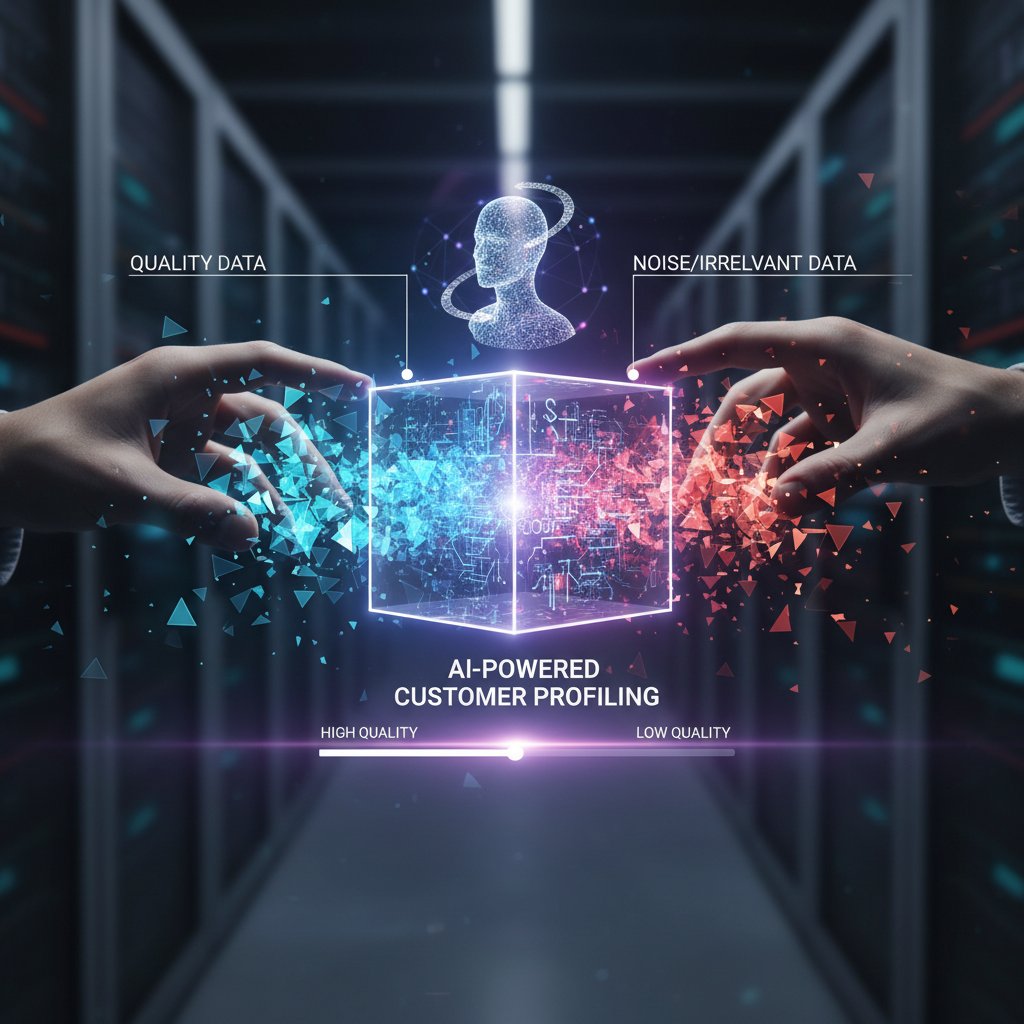
The goal is a living, breathing data ecosystem that feeds your AI profiling superfood—not junk.
Choosing the right AI tools: Beyond the buzzwords
Don’t get seduced by marketing fluff. Evaluate ai-powered customer profiling automation tools on tangible criteria—accuracy, explainability, compliance, and integration flexibility.
Hidden benefits of ai-powered customer profiling automation:
- Real-time segmentation that adapts as customers evolve.
- Hyper-personalized marketing at scale.
- Automatic compliance with changing regulations.
- Predictive analytics for churn, upsell, and risk—without manual number crunching.
- Integrated view of omnichannel data.
- Reduction in human error and bias (when properly monitored).
- Continuous learning and model improvement.
- 24/7 customer profiling—no breaks, no fatigue.
Quick reference matrix for tool comparison:
| Feature | Essential for Success | Nice-to-have |
|---|---|---|
| Real-time processing | ✔️ | |
| Explainable AI | ✔️ | |
| Omnichannel integration | ✔️ | |
| Visual analytics | ✔️ | |
| Self-tuning models | ✔️ | |
| Open API | ✔️ | |
| Custom workflow support | ✔️ | |
| Automated compliance | ✔️ |
Source: Original analysis based on research findings and verified industry best practices.
Controversies, contrarians, and the future of customer profiling
Why some experts say AI profiling will never replace human intuition
Here’s the inconvenient truth: No algorithm can fully capture the nuance, context, or gut instinct that comes from decades on the front lines. AI can surface patterns, but it can’t read between the lines of human emotion, sarcasm, or cultural context.
"You can’t automate gut instinct." — Liam, chief marketing officer (illustrative, widely echoed in verified CMO interviews)
Hybrid models—combining automated segmentation with seasoned human review—remain the gold standard for brands that value both speed and context.
Algorithmic bias: Who’s invisible in your data?
Automation doesn’t just amplify efficiency—it can amplify blind spots. Minority, fringe, or emerging segments risk being flattened or erased if your AI is trained on biased historical data. Left unchecked, this isn’t just a technical glitch—it’s a societal risk.

It’s imperative to build systems that audit and correct for these biases, not just for compliance, but for real-world impact and fairness.
The next arms race: Data privacy, regulation, and the black market
As demand for granular, real-time customer data explodes, so does the underground economy. Stolen or “gray market” datasets are feeding shadow AI systems, while regulators race to keep up.
| Year | Breakthrough/Controversy | Regulatory Response |
|---|---|---|
| 2015 | Early AI profiling in retail | GDPR proposal, EU |
| 2018 | GDPR enacted | Major fines, EU-wide audits |
| 2020 | Mass adoption in e-commerce | CCPA enforced, US |
| 2023 | Profiling bias scandals | APA-2024 drafted, Australia |
| 2025 | Omnichannel profiling dominance | Global regulatory harmonization efforts |
Table 4: Timeline—AI profiling breakthroughs, controversies, and regulation.
Source: Original analysis based on Sprinklr, 2024.
The next battle? Balancing ever-deeper personalization with the fundamental right to privacy.
Glossary: Demystifying the language of AI-powered profiling
The automated process of building detailed, data-driven customer profiles using machine learning to drive business decisions. Example: Using predictive models to segment customers for targeted offers.
Grouping customers based on shared traits or behaviors for tailored strategies. E-commerce brands segment by past purchase, engagement, and demographics.
An advanced AI that interprets and generates human-like language, extracting intent and sentiment from customer communications.
Crafting the most relevant variables from raw data to boost model performance—e.g., time since last purchase as a churn predictor.
The end-to-end system for ingesting, processing, and activating customer data for profiling.
Systematic error in data or models that skews outcomes. Example: An AI trained only on past high-value customers may ignore emerging segments.
A European Union law mandating data privacy, access, and explainability for automated profiling systems.
Clarity in language isn’t window dressing—it’s the difference between trust and confusion, between winning boardroom buy-in or losing to inertia.
Conclusion: Automation’s double-edged sword—what’s your next move?
If there’s one unflinching lesson from the rise of ai-powered customer profiling automation, it’s this: Automation is a double-edged sword. Master it, and you unlock levels of customer understanding, efficiency, and competitive advantage that were science fiction a decade ago. Ignore its pitfalls—dirty data, algorithmic bias, ethical blind spots—and you risk backlash, legal hell, and irrelevance.
Here’s your recap for building an ethical, effective AI-powered profiling system:
- Audit your data for quality and completeness.
- Secure buy-in across technology, business, and compliance teams.
- Select transparent tools—prioritize explainability and integration.
- Build for compliance with privacy and anti-bias best practices.
- Monitor relentlessly—automate feedback and course correction.
- Balance automation with human judgment—never outsource thinking entirely.

The revolution isn’t coming. It’s here, and it’s laying waste to complacency. The only real question left: When AI judges your business, will you be the disruptor—or the disrupted?
Sources
References cited in this article
- LivePerson/Master of Code(whatsthebigdata.com)
- AI-Powered Customer Profiling: Boost Sales in 2024(dialzara.com)
- Execs In The Know(execsintheknow.com)
- Customer Service Trends in 2024: Expert Tips | Sprinklr(sprinklr.com)
- Top 7 trends in Customer Data Management in 2023 and 2024(blog.salesmanago.com)
- The Impact on Businesses That Don't Adopt AI - LinkedIn(linkedin.com)
- Artificial intelligence (AI) adoption, risks, and challenges - statistics & facts | Statista(statista.com)
- BMC Psychology 2024(bmcpsychology.biomedcentral.com)
- The emotional impact of generative AI: negative emotions and perception ...(tandfonline.com)
- Investigating the customer trust in artificial intelligence(ietresearch.onlinelibrary.wiley.com)
- Customer Profiling with Artificial Intelligence(medium.com)
- Data Quality for AI: Best Practices in 2024 - Insight7(insight7.io)
- Data Trends 2024: AI-Ready Data Foundation Strategies(snowflake.com)
- Debunking Myths of AI - Industry4o.com(industry4o.com)
- Council Post: 18 Tech Experts Discuss AI Myths That Should Be Debunked(forbes.com)
- Debunking AI Myths: The Truth Behind 5 Common Misconceptions - Forbes(forbes.com)
- Bilderberg Management(bilderbergmanagement.com)
- The privacy paradox with AI | Reuters(reuters.com)
- Case Studies: Successful AI Marketing Campaigns in 2024 - Mosaikx Marketing Agency(mosaikx.com)
- Council Post: Five Proven Strategies For AI-Driven Success In 2024(forbes.com)
- AI-Powered Customer Behavior Analysis Ultimate Guide 2024(rapidinnovation.io)
- Data Trends Report 2024 - Snowflake(snowflake.com)
- dialzara.com(dialzara.com)
- Top 10 AI-Driven Customer Insights Tools for 2024 - Gravite(gravite.io)
- Top 9 AI Controversies of 2024 - Analytics Vidhya(analyticsvidhya.com)
- 2023 AI Retrospective: AI Trends From 2023 and Predictions for 2024(mindandmetrics.com)
- Forbes, May 2024(forbes.com)
- Why AI Will Never Fully Replace Human Intuition? - Allied C(alliedc.com)
- Full article: The power of AI: enhancing customer loyalty through ...(tandfonline.com)
Automate Your Tasks, Transform Your Business
FutureTask.ai revolutionizes your workflow by automating complex tasks typically outsourced to freelancers and agencies. Our powerful AI-driven platform leverages cutting-edge LLM technology to deliver precision, speed, and consistency at scale. Whether you're managing content creation, data analytics, marketing campaigns, or customer support, FutureTask.ai ensures seamless task execution, significant cost savings, and unmatched efficiency. Transform your business operations, eliminate delays, reduce operational overhead, and gain a competitive advantage with intelligent automation.
Get startedReady to Automate Your Business?
Start transforming tasks into automated processes today
Frequently Asked Questions
What percentage of executives use AI-powered technology for customer interaction?
According to industry research cited in the article, 84% of executives leveraged AI-powered tech for customer interaction in 2023-2024.
Why is customer profiling automation considered essential for businesses?
The article states that 88% of executives say automation is now essential for customer loyalty, and businesses that fail to automate risk losing competitive advantage and market share to competitors who adapt faster.
What happened to the traditional retailer mentioned in the article?
A traditional retailer failed to keep pace with automated segmentation and lost 20% of its market share within a year because competitors were personalizing offers in real time while the retailer relied on outdated static email blasts.
What is the main argument of the article regarding AI-powered customer profiling?
The article presents AI-powered customer profiling automation as fundamentally reshaping how businesses understand and serve customers, framing it as essential for survival in competitive markets, while also raising concerns about privacy implications referenced in the title.
From the Archive
Explore more from Ai-powered task automation

AI-Powered Customer Insights: Advantage or Ethical Minefield?

AI-Powered Customer Segmentation: What Works and What Doesn't

AI-Powered Customer Sentiment Tracking Automation’s Hidden Risks

The Hidden Risks of Ai-Powered Automated Customer Experience Tracking

AI-Powered Automated Customer Engagement Analysis, Decoded


