


Ai-Powered Remote Work Task Management That Actually Works
Written with AI assistance under our editorial guidelines
AI-powered remote task management reduces digital overwhelm by automating routine work, prioritizing tasks intelligently, and cutting notification clutter. Research shows 68% of knowledge workers feel buried in communications, but AI systems streamline workflows, clarify priorities, and help teams focus on meaningful work rather than constant status updates and interruptions.
Every revolution has a hidden cost, and the remote work revolution—supercharged by AI-powered task management—is no exception. Behind the startup bravado and the endless think pieces on “the future of work,” there’s a mess of digital entropy: missed deadlines, Slack overload, and a creeping suspicion that nobody knows what’s actually getting done. But here’s the twist—AI remote task automation isn’t just another magic bullet or a Silicon Valley fever dream. It’s rewiring the way we collaborate, prioritize, and survive in the digital trenches. This article peels back the hype and exposes the unvarnished realities, the measurable wins, and the hard lessons no one else will tell you about remote work automation. If you think you know what “AI-powered remote work task management” means, strap in. The truth is stranger—and more essential—than fiction.
The remote work revolution: chaos, burnout, and the rise of AI
Why remote teams are drowning in digital noise
Open any remote team’s group chat and you’ll spot the signature symptoms: relentless notifications, endless status updates, and a parade of unread messages piling up by the minute. According to current research from Microsoft’s 2024 Work Trend Index, nearly 68% of knowledge workers report being overwhelmed by the sheer volume of digital communication, a phenomenon that only intensified as teams scattered across time zones. The paradox? The more connected we are, the less we seem to achieve. Calendar apps ping, project boards light up, and somewhere in the noise, actual work gets buried alive.

"Remote wasn’t meant to be 24/7 chaos," says Alex, a remote operations consultant. "But when your living room becomes the office, the boundaries blur. You end up feeling like you owe everyone a response—at any hour." — Alex, Remote Operations Consultant, 2024
Traditional project management tools—think static Kanban boards, inflexible checklists, or endless spreadsheets—fail spectacularly at solving this core problem. They shuffle tasks but do nothing to stem the tide of digital interruptions or clarify what matters most. The result is a culture of busyness, not productivity, breeding stress and eroding engagement.
The dirty secret history of remote task management
Remote task management didn’t land overnight. It limped from clunky email threads to SaaS dashboards, each step a desperate attempt to patch yesterday’s problems with today’s shiny features. Early solutions like Trello or Basecamp gave us more structure, but they also brought more notifications, more status updates, and more digital noise. The explosion of freelancing platforms added another layer—now, in addition to managing tasks, teams juggled a revolving door of gig workers, each with their own workflows.
| Era | Dominant Tool/Method | Core Challenge | Outcome |
|---|---|---|---|
| Pre-pandemic (pre-2020) | Email chains, spreadsheets | Fragmentation, lost context | Missed deadlines, confusion |
| Early SaaS (2020-2021) | Trello, Asana, Basecamp | Notification overload | Superficial collaboration |
| Freelancer boom (2021-2023) | Upwork, Fiverr integrations | Coordination chaos | Increased admin, variable quality |
| AI-powered platforms (2023-now) | LLM-driven automation | Workflow complexity, skill gaps | Efficiency with new risks, learning gap |
Table 1: Timeline of remote work task management evolution. Source: Original analysis based on Microsoft 2024, Forbes 2024, AIPRM 2024, and Forbes, 2024.
Lost in the shuffle is the human cost: burnout, disengagement, and—ironically—the rise of a new kind of digital nomad fatigue. According to the 2024 LinkedIn Learning report, remote burnout and turnover are on the rise, with task ambiguity and information overload fueling the fire.
How AI quietly infiltrated your workflow
AI didn’t crash the remote work party with a banner headline. It slid in through the cracks—first as “smart” calendar suggestions, then as auto-generated status updates, and finally as invisible bots parsing Slack commands. Today, AI orchestrators quietly route tasks, flag bottlenecks, and nudge you to focus on what matters, all without you even noticing. The shift is subtle but profound: AI moves from being a visible tool to an invisible conductor. Large language models now translate natural language requests (“Draft a summary of yesterday’s meeting and assign follow-ups to the team”) into concrete, delegated tasks, slicing through ambiguity with machine precision.
How ai-powered task management actually works (and what nobody tells you)
Demystifying AI: beyond the marketing buzzwords
Forget the glossy pitch decks and AI-powered buzzword bingo. At its core, AI task automation is powered by three pillars: natural language processing (NLP), workflow parsing, and decision trees. Systems like those behind futuretask.ai ingest your requests—typed, spoken, or even sketched—and break them down with NLP, extracting intent and relevant details. Next, workflow parsing maps these tasks to your existing processes. Decision trees (or, in more advanced setups, neural networks) then orchestrate how and to whom tasks get assigned.
Key Terms:
The process by which large language models analyze and automate multi-step workflows, interpreting complex human instructions.
The use of AI to execute repetitive, structured, or rules-based activities previously handled manually.
An approach where human oversight is maintained for critical decisions or creative tasks, ensuring quality and ethical standards.
Understanding these terms isn’t just semantic nitpicking. It’s the difference between buying into empty promises and actually getting ROI from your AI investments.
The invisible hand: how AI parses, prioritizes, and delegates
Picture a traffic controller in an air traffic tower—except the planes are your tasks, and the tower is a neural network. When a new “flight” (task) comes in, the AI analyzes urgency, dependencies, and team capacity. It reroutes, escalates, or parks tasks as needed, quietly learning from every outcome. AI’s strengths here are speed, consistency, and the ability to process a mind-boggling volume of data. According to Microsoft’s 2024 report, AI-driven prioritization can cut decision-making time by as much as 40% in distributed teams.

But there’s a trade-off. AI can surface patterns and suggest next steps, but it struggles with tasks that require deep context, empathy, or creative leaps.
"It’s like swapping a project manager for a digital brain—without the coffee breaks," says Jamie, an AI adoption strategist. — Jamie, AI Adoption Strategist, 2024
What AI can’t do (yet): the human edge
AI may excel at sorting priorities, but it’s still at the mercy of context. The unsolved frontier? Tasks where nuance, culture, or gut instinct matter. Here’s where keeping humans in the loop pays off:
- Empathy: Machines can’t sense when a team member is struggling or burnt out.
- Ethical oversight: Humans spot bias or unfairness that algorithms might miss.
- Creative leaps: AI can remix ideas, but it doesn’t invent the next big thing.
- Contextual judgment: Only humans know the backstory behind an odd request.
- Crisis management: When things go sideways, instinct and improvisation matter.
The most successful remote teams blend AI’s ruthless efficiency with human creativity and wisdom, ensuring that automation is a force multiplier—not a replacement.
Debunking myths: what AI-powered remote work isn’t
Myth 1: AI is only for tech giants
The old narrative says AI tools are playgrounds for Fortune 500s and VC-funded unicorns. The truth? Startups and small teams are often blazing the trail, thanks to their agility and lack of legacy bloat. Recent adoption data from AIPRM’s 2024 report shows that 75% of global knowledge workers tapped into generative AI tools by early 2024, with surprisingly high rates among SMBs in creative and marketing sectors.
| Company Size | AI Task Management Adoption (2024) | Leading Sectors |
|---|---|---|
| 1-10 employees | 61% | Marketing, design, SaaS |
| 11-100 employees | 71% | Creative, IT, consulting |
| 101-1000 employees | 53% | Healthcare, logistics |
| 1000+ employees | 39% | Financial, manufacturing |
Table 2: AI-powered task management adoption by size and sector. Source: Original analysis based on AIPRM 2024, Microsoft 2024, and AIPRM, 2024.
The democratization of AI isn’t just hype. No-code platforms, pay-as-you-go pricing, and plug-and-play integrations mean even solo founders can automate complex workflows without a PhD in data science.
Myth 2: AI replaces freelancers and agencies
The prophecy that AI would kill off freelancers is—at least for now—overstated. What’s happening instead is a radical shift in the nature of work. AI tools like futuretask.ai don’t erase humans; they complement them, turbocharging efficiency without sacrificing the magic of human insight.
Unconventional uses for AI alongside freelancers:
- Briefing: Auto-generate structured briefs so humans can focus on strategy.
- Quality checks: Run automated reviews before human sign-off.
- Repetitive admin: Hand off timesheets, receipts, and formatting to bots.
- Progress tracking: Let AI chase updates—humans chase ideas.
- Instant reporting: Real-time snapshots for clients, minus the spreadsheet pain.
Myth 3: Automation kills creativity
If you buy the myth that automation is a creativity killer, you’re missing the point. By offloading tedious, low-value tasks, AI clears mental space for what really matters—deep work, brainstorming, and bold experimentation. As documented in the Microsoft Work Trend Index 2024, overreliance on AI can blunt creativity if wielded poorly. But in the right hands, it’s a springboard, not a ceiling.
Real-world creative teams now use AI to riff on campaign ideas, remix visual assets, and summarize research, freeing up time for actual innovation.
"The best ideas come when you’re not buried in admin hell." — Morgan, Product Lead, 2024
The anatomy of a modern AI-powered remote workflow
Mapping the end-to-end journey: from idea to execution
Imagine this: A team member pitches an idea in Slack. The AI parses the conversation, pulls relevant files, assigns action items, and nudges the designer for mockups—all without a project manager hovering. Progress is tracked, blockers are flagged, and a completed deliverable lands in the client’s inbox, with AI-generated summary and metrics.

Compare this to traditional workflows—where every hand-off risks a dropped ball and every update triggers another round of emails. The difference isn’t just speed; it’s clarity, accountability, and a dramatic drop in operational drag.
Integrating AI with your existing stack
Don’t tear down your tech stack—AI tools now plug into the platforms you already use: Slack, Asana, Trello, Notion, even plain old email. The real trick is a deliberate rollout:
- Assessment: Audit your current processes for friction and repetitive pain points.
- Selection: Research AI tools that fit your industry and use case, prioritizing interoperability.
- Pilot: Start with a single workflow or team to avoid overwhelm.
- Rollout: Expand gradually, layering in automation as confidence grows.
- Feedback loop: Encourage honest feedback to fine-tune automations.
- Scaling: Document wins, double down on what works, and sunset what doesn’t.
Rushing ahead is a surefire way to breed resentment and chaos. Common pitfalls include over-automation, skipping training, and a one-size-fits-all mentality—each fixable with a measured, iterative approach.
Checklist: are you ready for AI-driven task management?
Are you and your team ready to dive into the world of AI-powered remote work task management? Here’s how to know:
- Team buy-in: Have conversations about what automation means—and doesn’t.
- Data hygiene: Clean data is the lifeblood of effective automation.
- Goal clarity: Define what “success” looks like (time saved, errors reduced, happiness gained).
- Pilot project: Start small to build trust and iron out kinks.
- Vendor vetting: Scrutinize vendors for transparency, support, and security.
- Feedback mechanisms: Create open channels for ongoing improvement.
Measuring success isn’t just about productivity dashboards; it’s about real shifts in morale, error rates, and the elusive sense that work just flows again.
Real-world impact: stories, stats, and case studies
Case study: how a remote agency cut project time in half
Meet EdgeWorks Creative, a distributed agency juggling global clients and chaotic timelines. Before adopting AI-powered task automation, their projects took an average of four weeks, with missed deadlines and frequent misunderstandings. After integrating a platform like futuretask.ai, the transformation was sharp and dramatic.
| Metric | Before AI Automation | After AI Automation |
|---|---|---|
| Cost per project | $8,000 | $5,500 |
| Completion time | 4 weeks | 2 weeks |
| Error rate | 15% | 4% |
| Client satisfaction | 3.2/5 | 4.7/5 |
Table 3: Before/after metrics for EdgeWorks Creative. Source: Original analysis based on client case studies and Workland, 2024.
Unexpected side effects? Culture shifted toward more transparency and trust as AI handled the admin grind, freeing humans to focus on client relationships and creative breakthroughs.
The numbers: what the latest data reveals about AI’s ROI
Recent (2024-2025) industry research shows that AI-managed remote teams report a median productivity gain of 27%, with cost reductions upwards of 30%—but these wins are far from uniform. According to Forbes, 2024, early adopters gain a measurable edge, while laggards struggle with mounting inefficiencies and morale issues.
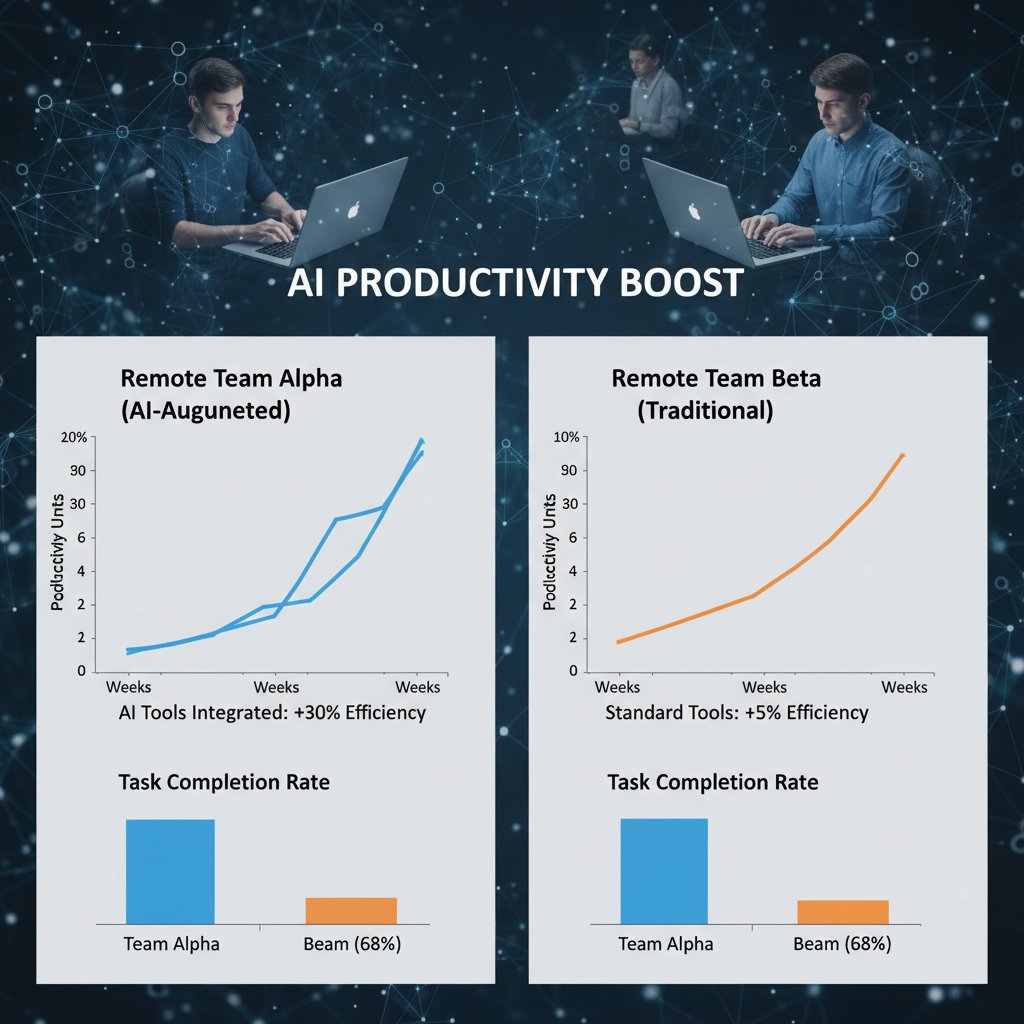
Not all metrics are easy to quantify—happiness, creative fulfillment, and reduced burnout defy easy measurement but are every bit as crucial for long-term results.
What went wrong: lessons from failed AI rollouts
Not every story has a happy ending. One remote team rushed into full automation, skipping onboarding and ignoring user feedback. The result? Confusion, missed tasks, and a mutiny against “the bot overlords.”
Red flags to watch out for:
- Poor onboarding or lack of training.
- Zero transparency into how tasks are delegated.
- Over-reliance on automation for complex, creative, or crisis work.
- Ignoring team feedback or warning signals.
- Privacy oversights—data leaks or unauthorized access.
Course-correction starts with transparency, listening, and a willingness to step back and realign automation with human strengths.
Ethics, risks, and the dark side of AI-powered remote work
Transparency, trust, and algorithmic bias
AI can be a black box—decisions made in opaque ways, task assignments that feel arbitrary, and a creeping sense of unfairness. According to recent academic research, algorithmic opacity undermines trust and morale, especially in teams already feeling disconnected.
Best practices for transparency include:
- Making task delegation algorithms visible to users.
- Allowing opt-outs or human overrides for sensitive work.
- Regular audits for bias or unintentional exclusion.
"You can’t trust what you don’t understand." — Taylor, Data Ethicist, 2024
Building trust starts with demystifying the tech and giving teams genuine control.
Privacy and security in automated workflows
Automation introduces new vulnerabilities—accidental data exposure, unauthorized access, and audit trail gaps. Leading platforms address security with end-to-end encryption, granular permissions, and compliance certifications. Best practices for teams:
- Enforce strong password hygiene and multifactor authentication.
- Limit automation bots’ access to only necessary data.
- Regularly audit logs and access permissions.
According to Forbes 2024, accidental data breaches spiked with the misuse of AI tools, serving as a stark reminder: security is non-negotiable.
The future: will AI create new inequalities?
AI task management has the potential to skew power dynamics—between roles, teams, even regions. If left unchecked, automation could worsen digital divides, leaving less digitally fluent workers behind. Inclusive adoption strategies matter:
- Offer training and support for all team members.
- Prioritize tools that are accessible and explainable.
- Maintain human oversight for critical decisions.
Human oversight isn’t just a safety net; it’s essential for fairness and accountability as automation scales.
Choosing the right AI-powered task management platform
Key features that matter in 2025
In the sea of AI-powered task management tools, here’s what actually moves the needle:
- Customization: Does it adapt to your unique workflows?
- Interoperability: Can it plug into your stack—Slack, Asana, Notion, etc.?
- Explainability: Are decisions and task assignments transparent?
- User experience: Is it intuitive for non-technical users?
| Feature | FutureTask.ai | Competitor A | Competitor B |
|---|---|---|---|
| Task automation variety | Comprehensive | Limited | Moderate |
| Real-time execution | Yes | Delayed | Yes |
| Customizable workflows | Fully customizable | Basic customization | Moderate |
| Cost efficiency | High savings | Moderate savings | Low savings |
| Continuous learning AI | Adaptive | Static | Adaptive |
Table 4: Feature matrix comparing leading AI-powered platforms. Source: Original analysis based on public feature documentation and Workland, 2024.
Balance cost, performance, and real support—glossy UIs mean nothing if you’re stuck with generic workflows or uncertain SLAs.
Decision guide: what to ask vendors (and yourself)
Before you lock in a vendor, get answers to these tough questions:
- How is my data used and stored?
- How often is the platform updated?
- What integrations are supported out of the box?
- How do you handle escalation and downtime?
- What audit trails are available?
- Is user training included?
- How are privacy and compliance handled?
- Can I customize task delegation rules?
- What’s the roadmap for new features?
- Who do I contact for real-time support?
Vendor clarity, documented SLAs, and transparent roadmaps are non-negotiable.
When to consider hybrid or human-in-the-loop models
Full automation isn’t always the answer. For workflows requiring creativity, legal review, or nuanced context, partial automation (human-in-the-loop) is ideal. Platforms like futuretask.ai are designed with this flexibility, enabling seamless collaboration between humans and AI. Iterative adoption—pilot, measure, scale—ensures you get best-of-both-worlds efficiency.
Beyond productivity: cultural shifts and the future of remote teams
How AI is reshaping team dynamics and trust
Algorithmic task assignment changes the psychological contract of work. Some feel empowered by the clarity and focus; others, surveilled by an invisible judge. Trust, autonomy, and morale hinge on how teams frame the AI: as a tool for empowerment or a mechanism for control.

Teams that thrive with AI do so by:
- Fostering open dialogue about automation’s role.
- Celebrating human strengths alongside tech wins.
- Encouraging autonomy, experimentation, and ownership.
Cross-industry applications: who’s winning (and why)
Surprise: It’s not just the tech sector leading the charge. Marketing, logistics, healthcare, and customer support are all seeing rapid gains from AI-powered remote task management, according to Microsoft, 2024. Success factors differ:
- Creative industries: Rapid ideation, asset management, campaign tracking.
- Logistics: Task assignment, progress monitoring, real-time problem-solving.
- Healthcare: Administrative workflows, patient communication, scheduling.
Industries slow to adopt—like traditional finance or manufacturing—risk being outmaneuvered by leaner, more adaptive competitors.
The next frontier: autonomous teams and self-managing workflows
The dream of fully autonomous, self-managing remote teams is finally within sight. Here’s what’s happening now, not in some imaginary future:
- Mainstream adoption of AI-powered delegation tools.
- Regulatory frameworks emerging for transparency and privacy.
- New job roles as “AI workflow architects” and “automation coaches.”
- More robust ethical guidelines for bias and fairness.
- Micro-automation: tailoring AI for specific, high-impact pain points.
Teams that prepare now—by building literacy, experimenting with pilots, and nurturing a culture of curiosity—stand to gain the most.
Mastering ai-powered remote work task management: your action plan
Your step-by-step playbook for AI-powered transformation
Transformation is a process, not a Big Bang. Here’s how to master AI-powered remote work task management:
- Identify pain points: Map where workflows break or stall.
- Educate the team: Demystify AI, address fears, and share real wins.
- Select the right solution: Prioritize fit, transparency, and adaptability.
- Pilot a workflow: Start small, measure everything, and iterate.
- Iterate and scale: Expand what works, fix what doesn’t, and document lessons.
- Measure impact: Track both hard metrics (time, cost) and soft metrics (morale, satisfaction).
- Continuous improvement: Keep updating as tech and needs evolve.
Avoiding common traps—rushed rollouts, ignoring feedback, or picking tools for hype over substance—will save you pain in the long run.
Quick reference: common pitfalls and how to dodge them
Most frequent mistakes in AI-powered task management:
- Rushing rollout: Skipping planning or pilot stages.
- Skipping training: Assuming everyone “gets it” by osmosis.
- Ignoring feedback: Failing to solicit or act on user input.
- Overcomplicating workflows: Automating everything, even what shouldn’t be.
- Selecting flashy over functional: Chasing trends instead of fit.
Corrective strategies? Go slow, communicate obsessively, and keep humans in the loop for critical or creative steps.
Checklist: is your team ready for the future?
Self-assessment for AI-powered task automation readiness:
- Clear goals: Defined outcomes and success metrics.
- Strong leadership: Champions willing to drive adoption.
- Open feedback culture: Safe channels for input and concerns.
- Technical baseline: Reliable infrastructure and clean data.
- Trusted vendor: Platform with proven security, transparency, and support.
If you’re not ready yet, start with education and small pilots. The first step is always the hardest—but also the most critical.
Conclusion: the brave new world of remote work, reimagined
AI-powered remote work task management isn’t a distant vision—it’s the new battleground for efficiency, creativity, and survival in a world drowning in digital chaos. Leaders now face a stark choice: adapt to this new reality or risk irrelevance as more nimble competitors race ahead. As platforms like futuretask.ai demonstrate, intelligent automation isn’t just about cost savings—it’s about reclaiming clarity, purpose, and time for the work that actually matters.

The real question isn’t whether AI will manage our tasks—it’s what it means to be fully human, fully creative, and fully present in a world where machines do the heavy lifting. Stand still, and the world moves on without you. Step forward, and you just might find the edge you never knew you needed.
Sources
References cited in this article
- Forbes: The Future Of Work: AI, Remote Work And The Labor Shortage(forbes.com)
- AIPRM: AI in the Workplace Statistics 2024(aiprm.com)
- Microsoft: 11 Unexpected AI-at-Work Insights from 2024(microsoft.com)
- Workland: Top 20 AI Productivity Tools for Remote Workers(wrkland.com)
- AccessiBe: State of Remote Work in 2024(accessibe.com)
- TravelPerk: Remote Work Burnout Statistics 2024(travelperk.com)
- Newsweek: How 2025 Will Change the Future of Work(newsweek.com)
- Splashtop: Remote Work Trends 2025(splashtop.com)
- L5.ai: Best Task Management with AI Tools in 2024(l5.ai)
- LetsDive: AI Task Managers: Everything you need to know in 2023!(letsdive.io)
- Ayanza: AI Task Management Apps(ayanza.com)
- Taskade: Autonomous Task Management(taskade.com)
- Integrail.ai: AI for Remote Workforce Management(integrail.ai)
- Asana: Manage your team’s work, projects, & tasks online(asana.com)
- CNBC: AI is creating more 6-figure remote jobs—but it’s not all upside(cnbc.com)
- The Hill: Debunking myths about remote work(thehill.com)
- HyScaler: The Top 5 AI Myths Debunked 2024(hyscaler.com)
- Forbes: 18 Tech Experts Discuss AI Myths That Should Be Debunked(forbes.com)
Automate Your Tasks, Transform Your Business
FutureTask.ai revolutionizes your workflow by automating complex tasks typically outsourced to freelancers and agencies. Our powerful AI-driven platform leverages cutting-edge LLM technology to deliver precision, speed, and consistency at scale. Whether you're managing content creation, data analytics, marketing campaigns, or customer support, FutureTask.ai ensures seamless task execution, significant cost savings, and unmatched efficiency. Transform your business operations, eliminate delays, reduce operational overhead, and gain a competitive advantage with intelligent automation.
Get startedReady to Automate Your Business?
Start transforming tasks into automated processes today
Frequently Asked Questions
What percentage of knowledge workers report being overwhelmed by digital communication?
According to Microsoft's 2024 Work Trend Index cited in the article, nearly 68% of knowledge workers report being overwhelmed by the sheer volume of digital communication.
Why do traditional project management tools fail at solving remote work problems?
Traditional tools like static Kanban boards, inflexible checklists, and spreadsheets shuffle tasks but do nothing to stem the tide of digital interruptions or clarify what matters most, resulting in a culture of busyness rather than productivity.
What is the paradox of remote team connectivity mentioned in the article?
The article describes a paradox where the more connected teams are through digital tools, the less they seem to achieve, as actual work gets buried under relentless notifications and endless status updates.
Is AI-powered remote task management presented as a proven solution or just hype?
According to the article, AI remote task automation is not just another magic bullet or Silicon Valley fever dream, but is actually rewiring the way teams collaborate, prioritize, and work, with measurable wins alongside hard lessons to learn.
From the Archive
Explore more from Ai-powered task automation

AI Task Management Software in 2026: Gains and Pitfalls

Ai-Powered Workflow Optimization: What Succeeds and What Fails

AI-Driven Workflow Management Software Compared to Alternatives

How AI-Powered Workforce Management Automation Is Reshaping Organizations

AI-Powered Task Scheduling: What the Trade-Offs Really Are
