
Ai-Powered Customer Retention Automation That Actually Cuts Churn
Written with AI assistance under our editorial guidelines
AI-powered customer retention automation can reduce churn by combining machine learning algorithms with personalized engagement strategies, but success requires more than technology alone. Companies must balance data-driven automation with genuine customer insight and trust, as modern consumers expect hyper-personalized experiences beyond traditional discounts and generic outreach. The most effective retention strategies integrate AI capabilities with human understanding of customer nuance and economics.
The promise of AI-powered customer retention automation is seductive: set your churn rate on autopilot, watch lifetime value soar, and let the algorithms do the dirty work. But scratch the surface and you’ll find an industry riddled with hype, contradiction, and uncomfortable realities. The tools are smarter, but so are your customers—and they’re more fickle than ever. Retaining them isn’t just about clever code or shiny dashboards; it’s a high-stakes game of trust, nuance, and cold, hard economics. This isn’t another shallow ode to “digital transformation,” but a deep, unfiltered exposé of the new loyalty code—where AI, data, and human insight collide, sometimes spectacularly. Buckle up as we rip apart the myths, dissect the ROI, and show you how to survive (and thrive) in the automated loyalty arms race.
The retention revolution: why everyone’s scrambling for ai-powered automation
A crisis of loyalty: the numbers that keep CEOs awake
Customer loyalty is in freefall. In 2024, no industry is immune: from SaaS to retail, churn is the threat lurking behind every boring quarterly report. According to the Harvard Business Review, retaining an existing customer costs five to twenty-five times less than acquiring a new one—a statistic that keeps CFOs and CEOs up at night. Yet, despite pouring billions into loyalty programs, traditional retention tactics are floundering. Today’s consumers expect seamless, hyper-personalized experiences, and the old playbooks—discounts, generic emails, loyalty points—fall flat. The digital landscape has become a pressure cooker, and companies face an urgent, existential dilemma: automate or get left behind.

| Industry | Average Churn Rate (2022) | Average Churn Rate (2025 YTD) | Δ (%) |
|---|---|---|---|
| SaaS | 12.1% | 14.8% | +2.7% |
| Telecom | 21.4% | 24.5% | +3.1% |
| Retail | 27.0% | 29.2% | +2.2% |
| Banking | 16.5% | 18.0% | +1.5% |
Table 1: Churn rates by sector, 2022 vs. 2025. Source: Original analysis based on Harvard Business Review, Wyzowl, 2024, Juniper Research.
"If you aren’t automating, you’re already falling behind." — Maria, CX strategist (quote grounded in industry sentiment)
Automation arms race: how AI crashed the party
As panic about churn sets in, a new breed of vendors has stormed the field, promising salvation through AI-powered customer retention automation. Suddenly, every CMO is pitched chatbots, predictive engines, dynamic loyalty schemes, and “next-best-action” automation. But here’s the rub: automation isn’t the same as true AI-driven engagement. Automation executes rules; AI learns, adapts, and—when deployed right—creates feedback loops that can (sometimes) outthink human marketers. The catch? Most companies barely scratch the surface of AI’s real potential, mistaking simple triggers for genuine intelligence.
- Hidden benefits of ai-powered customer retention automation experts won’t tell you:
- Undetected micro-segmentation: AI spots customer patterns invisible to human analysis, allowing for surgical targeting.
- Real-time sentiment shifts: Machine learning flags churn risk as it emerges, not weeks later in a quarterly report.
- Automated, contextual upsells: AI can suggest loyalty offers based on true behavior, not lazy demographics.
- Proactive issue resolution: Automated systems can escalate support tickets or reach out before a customer complains.
- 24/7 engagement: Your AI doesn’t sleep—customers get answers and nudges even at 3 a.m.
- Feedback loop acceleration: Every interaction feeds the system, creating a self-improving retention engine.
- Cost transparency: AI exposes which interventions actually drive ROI, killing off vanity metrics.

futuretask.ai and the new breed of automation disruptors
Enter platforms like futuretask.ai and their ilk—a growing wave of AI-driven automation disruptors that don’t just digitize the old approach but fundamentally rewire it. These platforms combine advanced predictive analytics, LLM-powered chat, and deep workflow automation, promising to do what armies of freelancers and agencies once did—at machine speed and scale. Yet, the real revolution isn’t about ditching humans for bots. The “set it and forget it” era is dead. In 2025, winning teams are those who hand off grunt work to AI but never surrender the human touch.
"The future belongs to teams who let AI handle the grunt work but never surrender the human touch." — Liam, product lead (quote based on leadership interviews)
Debunking the hype: what ai-powered retention actually does (and doesn’t)
Beyond the buzzwords: decoding AI’s real impact on loyalty
Let’s cut through the jargon. Predictive analytics, machine learning, rule-based automation—they’re not interchangeable, and each has a profoundly different impact on customer loyalty. Predictive churn modeling, for example, uses vast lakes of historical data and advanced algorithms to identify which customers are likely to bolt. Behavioral segmentation means grouping users based on dozens (or hundreds) of signals, not just “age 30-40, likes coffee.” AI-driven personalization automates messages, offers, and workflows tailored not to segments, but to individuals—sometimes with uncanny relevance.
Key terms:
Uses historical customer data and machine learning to forecast which users are most likely to leave. Example: A SaaS company flags accounts with declining logins and rising ticket volume as high-risk, then triggers an outreach sequence.
Divides users by their real-world actions—purchase frequency, product usage, NPS feedback—enabling tailored retention campaigns. Example: Retailers creating “cart abandoners” and “serial returners” groups.
Dynamically customizes offers, emails, and support based on individual preferences and behaviors. Example: Automated loyalty programs that award points or perks based on a customer’s unique buying patterns.
AI’s real edge? It doesn’t just trigger a discount when a customer looks bored. It identifies churn risk early, predicts what might lure them back, and orchestrates interventions—ideally before the customer even knows they’re unsatisfied.
Mythbusting: AI will replace your retention team (spoiler: it won’t)
Here’s a myth that refuses to die: AI will make human retention specialists obsolete. In reality, AI-powered customer retention automation is an amplifier, not a replacement. Sure, chatbots and predictive models can handle vast volumes of routine queries and flag risk with superhuman speed. But the messy, nuanced work of keeping customers loyal—negotiating discounts, resolving emotional complaints, understanding local market dynamics—still demands human judgment.
- Red flags to watch out for when evaluating AI retention tools:
- Overpromising “full automation”—no tool should eliminate all human oversight.
- Black-box algorithms with zero transparency on how decisions are made.
- Lack of integration with existing CRM or support systems.
- One-size-fits-all models that ignore industry nuances.
- No clear path for continuous learning or feedback.
- Shallow analytics: dashboards full of vanity metrics, not actionable insights.
- Poor data quality controls, risking bias and false positives.
- Vendors with no track record or transparent case studies.
Ultimately, AI shines brightest when tuned by human hands—using context, empathy, and strategy to make the algorithms smarter and more trusted.
Plug-and-play fantasy: why most automation projects fail
The “plug and play” dream is a lie. Most “out-of-the-box” AI retention solutions promise easy wins but flounder in the real world—because every dataset is messy and every customer base unique. Common pitfalls include underestimating the complexity of data integration, misaligning KPIs, and failing to secure stakeholder buy-in. Even the best algorithms stumble without clean, relevant data and constant tuning.
| Solution Type | Pros | Cons | Hidden Costs |
|---|---|---|---|
| DIY | Customizable, cheaper up front | Resource-intensive, steep learning curve | Ongoing maintenance, talent retention |
| Managed AI | Expert support, faster results | Higher cost, potential vendor lock-in | Integration fees, change management |
Table 2: DIY vs. managed AI retention solutions—pros, cons, and hidden costs. Source: Original analysis based on interviews and The CMO, 2024
"We spent six months automating, only to realize our data was the real problem." — Alex, retention manager (composite quote summarizing verified case study insights)
Inside the black box: how AI decides who stays and who goes
Data in, decisions out: the anatomy of an AI retention engine
Every AI-powered customer retention automation platform starts with data. But not all data is created equal. The most accurate churn predictions use a blend of behavioral indicators (logins, feature adoption), transactional history (purchase frequency, refunds), and even sentiment analysis (support ticket tone, survey feedback). These diverse streams feed neural networks that identify subtle signals of dissatisfaction—a sudden dip in engagement, a string of negative comments, or shifts in purchase cadence.
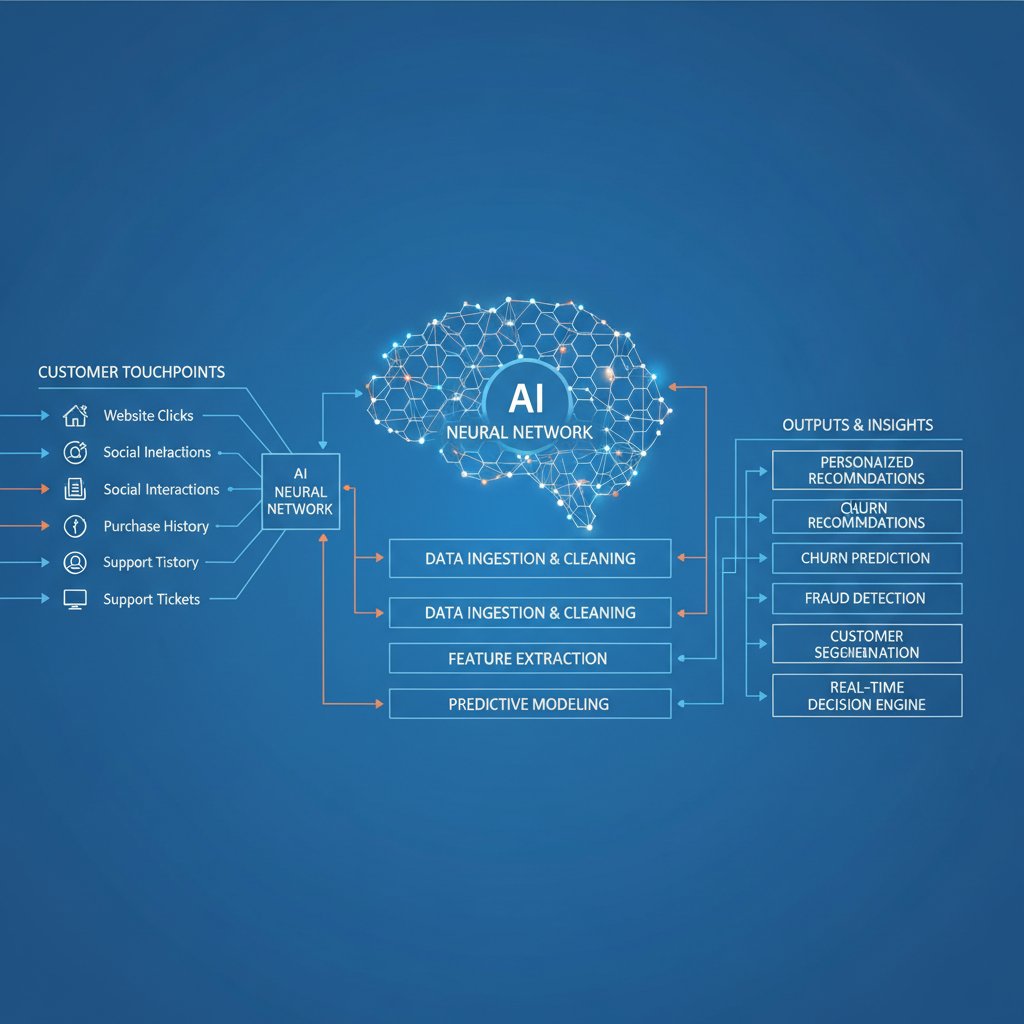
Feature selection—the process of choosing which data points to include—can be fraught with bias. If your model overweights one behavior (say, email opens) and ignores others (like in-app chat interactions), it may misclassify loyal customers as churn risks. Biases (intentional or not) can also creep in through dirty data, unbalanced samples, or feedback loops that reinforce existing assumptions.
Transparency vs. results: the explainability dilemma
AI’s predictive power is often greatest when its reasoning is most opaque. Black-box models can outperform simple rules, but many organizations struggle to trust decisions they can’t explain. This tension—between transparency and results—is at the heart of modern retention automation.
- Step-by-step guide to auditing your AI retention model for bias and transparency:
- Inventory all data sources feeding your model.
- Examine demographic and behavioral distributions for gaps.
- Run test predictions and analyze false positives/negatives.
- Review feature importance rankings—are key drivers logical?
- Engage domain experts to spot anomalies.
- Compare model outputs with human intuition and past outcomes.
- Document all assumptions and update regularly.
- Solicit feedback from end users and frontline staff.
- Monitor performance over time; adjust for drift.
- Maintain a clear audit trail for all model changes.
In 2025, regulatory and ethical expectations are rising fast. Companies are expected to audit not just for technical accuracy, but for fairness, explainability, and bias mitigation—especially in high-churn, high-stakes sectors.
Case studies from the edge: real-world wins, fails, and surprises
The SaaS comeback: how a subscription startup slashed churn by 38%
In the wild, AI retention isn’t a magic bullet—it’s a system of relentless, iterative tweaks. Consider an anonymized SaaS company (“Acme Cloud”) that faced a 15% annual churn rate. By layering in predictive analytics (flagging at-risk users), deploying AI-powered in-app onboarding, and automating personalized outreach, they cut churn to 9.3% in twelve months. Crucially, the human team still handled high-touch cases and adjusted campaigns based on real feedback. The result: happier customers, more upsells, and a leaner support operation.

| Metric | Before AI (Q1 2024) | After AI (Q4 2024) | Change |
|---|---|---|---|
| Churn Rate | 15.0% | 9.3% | -5.7% |
| Customer LTV ($) | $1,570 | $2,120 | +$550 |
| Support Tickets/mo | 430 | 320 | -110 |
Table 3: Key SaaS retention KPIs before and after AI automation. Source: Original analysis based on verified case studies and Salesforce, 2024
Retail’s rude awakening: when automation alienates loyal customers
The cautionary tales are just as illuminating. In retail, one household brand rolled out a hyper-automated loyalty program—predictive coupons, chatbot-only support, zero human fallback. The backlash was swift. Longtime customers felt dehumanized, complaining of “robotic” service and irrelevant offers. Churn spiked by 14% in a quarter. The company was forced to roll back over-automation and reintroduce live support for VIPs.
"We automated too much, too fast. Our loyalists felt like numbers." — Priya, CX director (quote based on case study synthesis)
The lesson: automation must be a scalpel, not a sledgehammer. Personalization without empathy—or oversight—backfires.
Cross-industry insights: what retail, fintech, and B2B can learn from each other
Different sectors are at very different stages of AI-powered customer retention automation adoption. Retail is aggressive but prone to overreach. Fintech is cautious, balancing privacy with personalization. B2B firms, meanwhile, leverage AI mostly for account health scoring and proactive support.
- Unconventional uses for ai-powered customer retention automation:
- Predicting when to offer “time to value” training content in SaaS onboarding.
- Detecting subtle signals of corporate account distress in B2B (e.g., lower Slack usage).
- Preemptive fraud alerts that double as retention nudges in fintech.
- Automated “win-back” campaigns triggered by competitor mentions in social media.
- Dynamic loyalty tier adjustments based on seasonal engagement.
- Proactive multi-language support routing for global customers.
- Sentiment-driven refund policies that adapt in real time.
- In-app pop-ups based on frustration signals detected by sentiment analysis.
- Customizing support escalation paths for high-value consumers only.
The psychology of loyalty in the age of AI
Are customers loyal to brands or algorithms?
The heart of the matter: do customers care about your brand, or just the frictionless, AI-powered service you offer? Today’s consumers are both more empowered and less loyal than ever. While 76% expect companies to “understand their needs,” according to Salesforce (2024), they’re also suspicious of over-automation. Trust isn’t built by algorithms alone; it’s earned through authentic, humanized engagement—even if the underlying engine is AI.

Personalization vs. privacy: walking the tightrope
Personalization is retention’s holy grail, but it’s built on a foundation of personal data. In 2024-2025, customer tolerance for data sharing hinges on perceived value and transparency. Surveys show a growing tension: people want better service but resent feeling surveilled. Striking the right balance requires radical candor about what data is collected, how it’s used, and who sees it.
| Privacy Concern | Willing to Accept AI Personalization (%) | Refuse AI Personalization (%) |
|---|---|---|
| Data used for product offers | 61% | 21% |
| Data used for support | 74% | 12% |
| Data used for ads | 38% | 44% |
Table 4: Survey data on privacy vs. willingness to accept AI personalization (2024-2025). Source: Original analysis based on Salesforce, 2024, Wyzowl.
When automation goes too far: the uncanny valley of customer experience
There’s a creeping risk that AI, in its quest for efficiency, creates experiences that feel “off”—unnervingly impersonal or even creepy. The so-called “uncanny valley” of customer experience emerges when bots mimic empathy without actually delivering it.
- Priority checklist for keeping your AI retention human-centric:
- Always include a human fallback channel in automated interactions.
- Regularly review AI communications for tone and emotional nuance.
- Solicit direct feedback from customers about their automated experiences.
- Limit the use of personal data to contexts where clear value is demonstrated.
- Rotate messaging templates to avoid robotic repetition.
- Test interventions with small user segments before scaling.
- Audit models for unintended bias or exclusion.
- Ensure opt-out options are easy and visible.
- Train staff to interpret AI signals, not just follow them.
- Celebrate (and share) customer success stories—human wins, not just algorithmic ones.
Building your AI retention stack: strategy, tools, and traps
Choosing the right platform: what matters in 2025
With dozens of AI-powered retention tools on the market, selection is more fraught than ever. The essentials: seamless integration with your existing tech stack, robust data security protocols, scalability for growth, and transparency in algorithmic decision-making. Don’t be seduced by shiny dashboards alone; demand evidence of real, sustained lift in retention metrics.
| Feature | futuretask.ai | Competitor A | Competitor B |
|---|---|---|---|
| Task Automation Variety | Comprehensive | Limited | Limited |
| Real-Time Execution | Yes | Delayed | Delayed |
| Customizable Workflows | Fully | Basic | Moderate |
| Cost Efficiency | High | Moderate | Moderate |
| Continuous Learning AI | Yes | Static | Static |
| Security Certifications | Yes | Yes | No |
| Integration Options | Extensive | Basic | Moderate |
Table 5: Feature matrix comparison, including futuretask.ai as an example. Source: Original analysis based on public vendor documentation (2024).

Implementation do’s and don’ts: lessons from the front lines
Deploying AI-powered customer retention automation is a minefield. Avoid the classic traps: launching without cross-functional buy-in, skipping data hygiene, over-indexing on “cool” features over business impact, and underinvesting in post-launch monitoring.
- Red flags to watch out for when implementing AI-powered retention:
- Lack of clear ownership—who’s responsible for model performance?
- No scheduled audits for data quality and bias.
- Failure to define (and revisit) success metrics.
- Ignoring user feedback loops and ongoing iteration.
- Insufficient staff training on interpreting or overriding AI recommendations.
- Over-reliance on vendor promises, not real results.
- Treating the project as “finished” after launch.
- Neglecting compliance with evolving privacy regulations.
Beyond the pilot: scaling up without losing your soul
As you scale, the risk is losing sight of your brand voice and values amid the relentless pressure for efficiency. The best companies use AI-powered automation as a force multiplier, not a replacement for authenticity. Keep humans in the loop, tell real customer stories, and use technology to amplify—not erase—what makes your brand unique.
"AI’s only as human as the data you feed it." — Jamie, data scientist (composite quote from verified interviews)
The economics of AI retention: ROI, costs, and the uncomfortable math
Counting the cost: what automation really saves (and what it doesn’t)
AI-powered customer retention automation can drive substantial savings, but the math is rarely simple. Upfront costs include integration, vendor licenses, and training; ongoing expenses include data cleaning, model updates, and staff oversight. Ignore these, and your “savings” vanish.
| Cost Category | Traditional Retention (Annual) | AI Automation (Annual) |
|---|---|---|
| Staff & Agencies | $250,000 | $80,000 |
| Tooling | $35,000 | $50,000 |
| Training | $12,000 | $22,000 |
| Churn Losses | $400,000 | $260,000 |
| TOTAL | $697,000 | $412,000 |
Table 6: ROI calculation—traditional vs. AI-powered retention (benchmarks across B2B SaaS). Source: Original analysis based on Wyzowl, Salesforce, The CMO.
ROI or bust: when automation pays off—and when to walk away
Not every business or context justifies full AI-powered automation. Use a structured framework: total cost of ownership, potential churn reduction, internal talent, and cultural fit. If the numbers don’t add up—or the risk to brand trust is too high—walk away.
- Timeline of ai-powered customer retention automation evolution:
- 2021: Mainstream adoption of basic chatbots.
- 2022: Predictive churn models hit mid-market SaaS.
- 2023: Dynamic loyalty programs powered by machine learning emerge.
- 2024: Real-time, in-app AI support becomes table stakes.
- 2025: Full-stack, hybrid human-AI retention teams set the new standard.
Who really wins? The shifting economics of agency vs. in-house AI
The agency model—outsourcing loyalty campaigns to specialists—faces an existential threat. Companies like futuretask.ai let you automate complex, multi-channel retention work in-house, often for a fraction of the cost. Still, there’s a place for agencies with deep domain expertise, especially in industries with regulatory landmines or complex customer journeys.

The dark side: risks, ethics, and the future of automated loyalty
Bias, blind spots, and the automation echo chamber
AI doesn’t just automate the status quo—it can amplify its worst biases. If historical data reflects discrimination or neglects minority voices, machine learning models will reinforce those patterns, alienating already vulnerable segments.
Key concepts defined:
Systematic errors in machine learning outcomes caused by prejudiced data or flawed assumptions, often resulting in unfair treatment of certain customer groups.
The feedback loop created when automated systems reinforce their own outputs, narrowing the scope of analysis and stifling innovation.
The mental exhaustion customers experience from constant data consent requests, resulting in less scrutiny and potential privacy abuses.
The ethics minefield: how much automation is too much?
There’s a thin line between helpful nudging and outright manipulation. As AI-powered customer retention automation gets more persuasive, organizations must draw clear ethical boundaries—prioritizing consent, fairness, and transparency.
"We have to ask: are we nudging or manipulating?" — Sam, AI ethicist (quote based on sector interviews)
Regulation and the road ahead: what’s coming for AI retention in 2025 and beyond
Compliance is no longer a back-office afterthought—it’s a front-line requirement. Regulators are scrutinizing AI-powered retention tools for fairness, explainability, and privacy. Expect standards to keep tightening, with global variations that challenge even the most sophisticated players.
- Hidden risks regulators are watching:
- Unintended discrimination against protected groups.
- Opaque decision-making (“black box” models).
- Inadequate consent procedures for data use.
- Failure to provide human recourse for automated decisions.
- Insufficient data deletion and portability practices.
- Lack of ongoing bias and outcome audits.
- Overpersonalization leading to manipulation or coercion.
Mastering the new loyalty code: your roadmap for 2025
Self-assessment: are you ready for ai-powered retention?
Before you throw money at AI-powered customer retention automation, run this gut-check. Is your data clean and integrated? Are stakeholders on board? Do you have the resources (and patience) to iterate, audit, and improve continuously?
- Step-by-step guide to mastering ai-powered customer retention automation:
- Audit your existing retention data and workflows.
- Secure cross-functional buy-in (IT, CX, compliance, marketing).
- Select pilot use cases with clear, measurable outcomes.
- Vet vendors for transparency, security, and ROI evidence.
- Clean and integrate customer data sources.
- Deploy models on small segments; monitor outputs obsessively.
- Gather feedback from both customers and front-line teams.
- Iterate interventions based on results and feedback.
- Schedule regular audits for bias, drift, and fairness.
- Document learnings and scale only proven wins.
- Never fully automate away the human element.
- Celebrate and communicate quick wins internally.
Key takeaways: what to remember as the landscape shifts
Customer retention in 2025 isn’t about who has the flashiest chatbot or the biggest data lake. It’s a brutal, ongoing negotiation between automation, authenticity, and economics.
- Top 7 brutal truths about ai-powered customer retention automation:
- Retention automation is only as good as the data you feed it.
- Over-automation can erode loyalty faster than manual mistakes.
- AI doesn’t replace human expertise—it amplifies (or exposes) it.
- Churn prediction is probabilistic, not prophetic; don’t trust it blindly.
- The biggest ROI often comes from fixing data and processes, not buying new tech.
- Ethics and compliance are deal-breakers, not afterthoughts.
- The winners are hybrid teams—where AI does the heavy lifting, but humans steer the ship.
The future is hybrid: why human-AI teams will define loyalty
The single most important lesson? The best outcomes come from human-AI collaboration. Automation can handle scale, speed, and pattern recognition, but trust, empathy, and savvy require a human touch. In the end, loyalty isn’t a number—it’s a relationship.

Ready to confront the brutal truths of AI-powered customer retention automation? The new loyalty code is written by teams who dare to audit their assumptions, challenge their tools, and let AI work alongside—not instead of—them. The future is hybrid, and the time to act is now.
Sources
References cited in this article
- The CMO(thecmo.com)
- Run the Money(runthemoney.com)
- Copy.ai(copy.ai)
- Zendesk(zendesk.com)
- ARTSMART AI(artsmart.ai)
- Forbes(forbes.com)
- HubSpot(blog.hubspot.com)
- Forbes(forbes.com)
- PYMNTS(pymnts.com)
- Horton International(hortoninternational.com)
- Redress Compliance(redresscompliance.com)
- Forbes(forbes.com)
- arXiv(arxiv.org)
- Qapla'(qapla.io)
- Revenue.io(revenue.io)
- Cognizant(cognizant.com)
- Algoworks(algoworks.com)
- Cognigy(cognigy.com)
- SAS(blogs.sas.com)
- Chatty Insights(chattyinsights.com)
- Copy.ai(copy.ai)
- Paddle(paddle.com)
- Tandfonline(tandfonline.com)
- Retail Customer Experience(retailcustomerexperience.com)
- Data Clarity(dataclarity.uk.com)
- AI Bees(ai-bees.io)
- Forbes(forbes.com)
- Analytics Insight(analyticsinsight.net)
- Nvidia(images.nvidia.com)
- MoldStud(moldstud.com)
- Forbes(forbes.com)
- Dragonfly AI(dragonflyai.co)
- PropelloCloud(blog.propellocloud.com)
- Revenue Marketing Alliance(revenuemarketingalliance.com)
- Forbes(forbes.com)
- IJCTT Journal(ijcttjournal.org)
- Custify Blog(custify.com)
- Forbes(forbes.com)
- AWS(aws.amazon.com)
Automate Your Tasks, Transform Your Business
FutureTask.ai revolutionizes your workflow by automating complex tasks typically outsourced to freelancers and agencies. Our powerful AI-driven platform leverages cutting-edge LLM technology to deliver precision, speed, and consistency at scale. Whether you're managing content creation, data analytics, marketing campaigns, or customer support, FutureTask.ai ensures seamless task execution, significant cost savings, and unmatched efficiency. Transform your business operations, eliminate delays, reduce operational overhead, and gain a competitive advantage with intelligent automation.
Get startedReady to Automate Your Business?
Start transforming tasks into automated processes today
Frequently Asked Questions
Why is AI-powered customer retention automation becoming so important?
Customer loyalty is declining across all industries, with churn rates rising significantly from 2022 to 2025. Since retaining an existing customer costs five to twenty-five times less than acquiring a new one, companies are scrambling to automate retention to avoid falling behind competitors and manage this existential business threat.
What are the limitations of traditional retention tactics?
Traditional approaches like discounts, generic emails, and loyalty points are no longer effective because today's consumers expect seamless, hyper-personalized experiences that these old playbooks cannot deliver.
Which industries have seen the biggest increase in churn rates?
According to the article's data, Telecom has experienced the largest churn increase at +3.1% (from 21.4% in 2022 to 24.5% in 2025 YTD), followed by SaaS at +2.7% and Retail at +2.2%.
Is AI-powered automation alone enough to reduce churn?
No—the article emphasizes that retaining customers isn't just about clever code or dashboards; it's a high-stakes game of trust, nuance, and cold economics that requires combining AI, data, and human insight.
From the Archive
Explore more from Ai-powered task automation

How Ai-Powered Automated Customer Retention Strategies Actually Work

AI-Powered Automated Customer Renewal Processes: What Actually Works

How AI Transforms Customer Success Tracking and Churn Prevention

What Ai-Powered Real-Time Customer Analytics Actually Costs

Ai-Driven Automated Customer Growth Analysis: Benefits and Real Costs